History-making music group for UMM - morris mn

History-making music group for UMM - morris mn
The UMM men's chorus opened the Minnesota Day program at the 1962 Seattle World's Fair (Century 21 Exposition).

Thursday, June 26, 2014

Our Jerry Koosman put stamp on baseball history

Morris had no Prairie Pioneer Days when I was a kid. This isn't to say Motown couldn't hold a big celebration. In 1971 we had the Centennial. You might think that gala event could be parlayed into an annual summertime affair. But no. Quiet prevailed.
Two years before 1971, Morris had a huge celebration for a major league baseball pitcher. Jerry Koosman was one of our own at that time. It's the reason the Met Lounge has its name. Koosman was a pitcher not for the Minnesota Twins (at that time) but the New York Mets. Yes, the boy from the country excelled with his pitching talents under the Klieg lights of New York City.
The big city can be hard on young athletes with the attention it bestows. Roger Maris from Fargo started losing his hair. The grating effect of the media was a primary angle in the Billy Crystal movie about the 1961 baseball season. That's when the quiet and unassuming Maris hit 61 home runs.
Koosman seemed much like Maris. He didn't exude charisma. He was the big lefty in the Mets' 1969 rotation. That rotation also included Tom Seaver who seemed to take to the limelight more. It's not that Koosman recoiled from the limelight. He didn't have the conflict that Maris went through. He was just a man of few words who wanted to win. The media had no trouble accepting him that way.
Our community of Morris burst its buttons to honor "Koos" in the afterglow of the 1969 World Series. It was a World Series for the ages. Why? It was a five-game series which suggests one-sidedness. The Mets handled the Baltimore Orioles. Today such a series would come and go and I'd barely pay attention.
Remember that in 1969, the Mets seemed like a still-new franchise. They were born in 1962 as an expansion team, bringing the National League back to the Big Apple. The Dodgers and Giants had left. New York City had gone from three big league teams to one, amazingly. The American League Yankees held forth for a time as that lone big league club. They had that monopoly when Maris hit his 61 homers in 1961.
Then in 1962, the brand-new Mets came on the scene. I'm puzzled why the Mets were allowed to start out as such a bunch of stumblebums. They were bad but as time went on, they came to be seen as charmingly bad. We wax nostalgic about the likes of Marv Throneberry. Or Casey Stengel, the aging old hand as manager. Stengel and Yogi Berra gained note for being "creative" with the English language.
The Mets were all good baseball people, of course. They were just typical of all expansion teams of that era (all sports): a combination of athletes on the way up or on the way down, or complementary players who couldn't shoulder a prime burden to lead. Who could knock Richie Ashburn? But those Mets of the early 1960s could take their lumps. It went beyond 1962. The mediocrity seemed pretty well embedded.
  
Much to appreciate in 1969
Then in 1969, you might say Pinocchio became a real boy. I was 14 years old. I had been captivated by the Minnesota Twins of course. And, 1969 was a quite fine season for our ballclub: it was the year Billy Martin managed and we won the American League West, in the first year of the divisional format. I don't recall any special mania gripping Minnesota in 1969 over the Twins. We did like Billy. Legend has it the Twins lost much of their sheen when Martin was fired after '69.
I would suggest we had gotten spoiled. We have always been blessed having the Twins. The '69 Twins with Billy were sent to the sidelines quite unceremoniously by the Baltimore Orioles. Those were the Frank Robinson years in Baltimore. When the Twins were done, we suddenly noticed that the Mets were quite firmly in the spotlight. The Mets had emerged as a division winner. They overcame the Chicago Cubs who for much of that season seemed like a team of destiny. The Cubs with manager Leo Durocher got into a commanding position, then they crumbled. They crumbled in the face of the Mets' dramatic advance.
Jim Bouton wrote that the Cubs' clubhouse had probably become like a morgue. He argued that the Cubs might have done better if they had just stayed happy and upbeat.
Our Jerry Koosman was a cog with those surging, charming New York Mets. Today I doubt the nation could get mesmerized by any big league baseball team. Baseball today is a huge money-making enterprise that doesn't let anything happen by caprice. It's a better situation for players who don't seem to be used up and discarded like in an earlier time. The empowerment of players, going back to when Curt Flood won his legal case, has been good for them.
Bowie Kuhn wrote that the owners lost the Curt Flood case just like the South lost the Civil War. In other words, there's no equivocating. One side crushed the other. But I doubt there are any holes in the owners' shoes. They never became "dead broke" like Hillary Clinton (LOL).
  
From WCSA to Gotham
"Big Koos" had ties to Appleton and Holloway as well as to Motown. He graduated from our West Central School of Agriculture in Morris. That's the campus we now call UMM.
Back in 1969 we all knew the story of how Jerry got discovered by the Mets: he was discovered by the son of a Shea Stadium usher who caught Koosman when he pitched in the U.S. Army at Fort Bliss TX. The son wrote to his dad. A mere usher? Maybe so, but the connection was good enough. The Mets offered a contract after Jerry's discharge. Perhaps the military instilled a sense of discipline that enabled Jerry to rise. The military has a way of doing that.
Koosman broke into the Mets' pitching rotation in 1968. I have written about 1968 as "the year of the pitcher." Koosman was happy to ride along. He struck out Carl Yastrzemski for the final out in the 1968 All-Star game, won by the Nationals 1-0. Just one run? Yes, it was the year of the pitcher. Baseball had to make adjustments after that season, including a lowered pitching mound. Koosman was runner-up to Johnny Bench (today a TV commercial pitch man) for 1968 Rookie of the Year.
In '69 the pitching couldn't dominate quite so much. But Koosman progressed just fine. He had a 17-9 won-lost record, a 2.28 ERA and 180 strikeouts. He won eight of his last nine decisions.
The Mets had to get past Atlanta before entering the World Series. Atlanta had Hank Aaron and Orlando Cepeda, along with the knuckleballing pitcher Phil Niekro. I remember a story where Niekro's manager was asked if Phil could really pitch on two days' rest, and the manager said "We're not worried about Niekro, we're worried about Uecker (Bob Uecker who was the catching specialist for knuckleballs)." Given Uecker's reputation as a character of the first order, that's quite the funny vignette.
Koosman actually had a bad game in the National League playoffs vs. Atlanta. He pitched in game 2. Truly the Mets were buoyed by destiny, because even though Koosman gave up six runs in four and two-thirds innings, the Mets won 11-6. That playoff series is barely remembered, and that's being generous.
  
Koosman pitches 1969 finale
In the "big show" of the World Series, Jerry Koosman starred. Tom Seaver lost game 1. After game 1 the Mets ran the table with Koosman winning the triumphant game 5. But game 5 wasn't wholly a cakewalk. The Mets fell behind 3-0 in the third. They took the lead with two runs in the eighth. Koosman got the complete game win. It was the days before "setup men" and "closers." Pitchers would strive for complete games.
I remember watching TV and seeing Cleon Jones catch a fly ball for the final out. He positioned himself like a statue, ready to squeeze his glove around the ball. He gave Koosman the game ball.
Koosman was inducted into the New York Mets Hall of Fame in 1989. He attended the 40th anniversary reunion of the '69 team at Citi Field on August 22, 2009. He has since had some legal problems. He was a Wesley Snipes type of tax denier. He pleaded guilty in May of 2009 to misdemeanor Federal tax evasion after failing to pay up to $90,000 in Federal income taxes for 2002-04. He admitted to having been "suckered" by anti-tax rhetoric. He was sentenced to six months in prison in September of 2009. He was released from a Federal prison camp in Duluth on June 30, 2010.
Big Jerry could overcome those Baltimore Orioles with Frank Robinson, but not the Feds. Those legal problems will be a mere asterisk with his life. We'll always visualize him as that towering presence on the mound, ready to uncork an unhittable pitch.
He always looked so relaxed. It must have been his peaceful rural background. From Holloway to New York City. Amazing.
Koosman is reported to enjoy joking about the value of his rookie baseball card. It's a 1968 card. Yes it's valuable, but keep in mind it also includes Nolan Ryan! Oh, I'm sure Koosman adds a little to the value. My generation of Morris kids bought cards at the old Stark's Grocery which is now a cemetery monument business. Times change.
Koosman would still be a great pitcher today. No PEDs needed.
We salute Jerry Koosman the "hayseed" out of West Central Minnesota, a cog with the baseball powerhouse representing the world's most important city. Only in America?
I played in the band for the big celebration in 1969 for Koosman, here in Morris. I was also a musician two years later for the big Morris Centennial. Those events have seemed to fade rather significantly in our collective memory. That's too bad because they were most gala. Our museum could develop an exhibit acknowledging both.
Halsey Hall was here for the Koosman celebration. He was the iconic "color man" for broadcasts in the Twins' early years. Those where the days.
Jerry Koosman was eventually able to pitch for the Twins, and when he was still in his prime. Those memories are quite fine, I'm sure, but in my mind his fantastical 1969 campaign was unmatched, still etched in the memories of boomers. The Mets win the World Series! We should hardly be surprised given the home base of New York City. But the Mets had been so forlorn just a few years earlier. Pinocchio, you're a real boy now!
Eventually us boomers would mature just like the New York Mets did, or at least I think we did.
- Brian Williams - morris mn minnesota - bwilly73@yahoo.com

Wednesday, June 18, 2014

All writing is product of the writer's world view

Jim Bouton, pitcher/author
A UMM faculty member recently spoke at our Morris Public Library on "biographical fiction." It seems like a contradiction in terms. I would expect a biography to be factually accurate by definition.
"Biographical fiction," by definition, involves taking some liberties. Is there serious confusion here needing to be ironed out? No, I don't think so. Here let's allow a dirty little secret to hop out. "Journalists" who purportedly deal only in fact take liberties all the time.
Do you remember reading a journalistic piece with lots of direct quotes? Don't you assume that lots of those quotes are actually paraphrases? Did the writer always have a notebook ready and scribble notes while in conversation? If he did, wouldn't this inhibit the source? A more pertinent question, perhaps, is whether a writer could scribble notes fast enough to record everything word by word. Then there's the option of having a tape recording device. Wear a wire (as for the FBI)?
I know Jim Bouton narrated his daily diary into a tape recorder when at work for the history-making sports tome, "Ball Four."
There was a time when sports biographies were written by having the sports star/celebrity answer questions into a tape recorder. Those tapes would go to the professional writer. This was the approach that Bouton and his editor would have pooh-poohed. It had an assembly line quality to it. The traditional books were sanitized. They catered to our desire to see sports stars as role models with their basic character.
Bouton's book was a shot across the bow in more ways than one. He and his editor decided that our icons of sport should be shown as human beings with human failings. The book was anything but sanitized. "Ball Four" burst forth like a bright shining meteor. It filled a need for its time. Its year of 1970 was when society had turned a page and decided to throw off lots of inhibitions.
Bouton quoted lots of conversations in the book. Avant garde intentions aside, I have to believe he followed pretty conventional procedure for quoting conversations. We strive to capture the essence. Our paraphrases shouldn't upset the source. I think the writers of reality (not to be confused with the swill of reality TV) do this all the time. Don't let those quote marks fool you.
Tony Horwitz (goodreads image)
Which brings us to the subject of Tony Horwitz. He is a journalist/author I admire greatly. He writes about real things and real people. He does so in a storytelling way. He projects a real fascination with it all, as when he tells us the story of Civil War memory in the South. Horwitz's goal is to capture the essence and reveal truth about all of his subject matter. But, I'll assert such writers take more liberties than we think. It's a testament to their skill that we can turn page after page and feel convinced every word was spoken as such, and that every scene developed just as described. Sometimes the skill breaks down, as with Twin Cities scribe Jim Klobuchar who was humiliated when it was revealed he had gone off base paraphrasing a Minnesota Vikings official. It was bad enough to justify tossing him from the writers fraternity. Apparently he had cultivated enough good will to keep going. I think he's still going today with the Minnpost website. Any writer can keep going online. Today Jim is not the most famous Klobuchar.
  
To the roots of writing
Writing is nuanced. Fact is, all journalism is a product of the writer's feelings, philosophy and world view. We are vain enough to feel others should simply adopt our world view.
A dirty little secret is that all journalists, all true journalists anyway, are motivated by wanting to convince others of a particular attitude about things, or set of facts. We are quite sincere. We are not propagandistic. It's just that we evaluate things in a manner common to all, and because of the writing gift (we feel) God has given us, we dispense those insights. It's not a stealth proposition for us. We are quite zealous.
Jim Bouton wanted to rip the pretense away from big-time sports. He felt it was proper for us to see the vices and mistakes that our sports heroes are prone to. Of course, did we ever doubt they were real human beings? I don't think so. An anti-Bouton would say traditional sports book served the purpose of presenting healthy examples, especially for our youth. Hero worship meant we were going to aspire to the best, most uplifting standards. We were never going to know these sports heroes personally. We might as well believe they reside on Mount Olympus or something like that. Same with movie stars.
"Biographical fiction" would seem to go beyond paraphrasing for quotes. It would seem to be a step beyond what has been called "interpretative journalism." It's not as bad as "advocacy journalism" where a political type of zeal possesses the writer. I've had it with ideologically tainted journalism, especially after having seen Fox News become the behemoth it is. It's about as annoying as a moth. 
Advocacy journalism gained currency when the young writing community thought liberal views were the only answer. We'd think "what the heck, this isn't really bias, it's the way things have to be." There was some justification for this. Liberals were the ones taking the initiative to attack the Jim Crow South. Liberals rose up to despise the Viet Nam War. The nation had gotten involved in a tragic war under false pretenses (the need to fight Communism). We'd never allow that to happen again, would we? Let's see, what are the headlines from Iraq today?
The Viet Nam War became more of a lightning rod than Iraq, because we had the draft. Chris Matthews always emphasizes this. Of course, we compelled National Guardsmen to go into Iraq. We have a "voluntary military" with many members drawn to that life because of a lack of options (i.e. from challenged socioeconomic circumstances).
Viet Nam was a reason why advocacy journalism, a practice we might reject in a knee-jerk way, gained respect or currency. We read about it in college like we should at least respect or understand it. Today? I doubt it. We saw the movie "All the President's Men" about reporters who were good guys in the classic "good guys and bad guys" dichotomy. So it was like a western in Washington D.C. It was also a horribly poor example for young writers like me looking for inspiration. Watergate, Washington D.C. and "Maximum John" Sirica (the judge) were all components in the anomalous world around the U.S. power corridor, as anomalous as artist Jackson Pollock was to the art world.
P.J. O'Rourke laughed once about how college art students all started "splashing paint around" because of Pollock. O'Rourke talked about how Hunter Thompson could similarly inspire young writers. He said a young reporter beginning his first job might show up at a sewage commission meeting wearing a Hawaiian shirt and sunglasses. Thigh-slappingly funny. And yet, many young writers were in fact inspired by quite atypical writers and/or situations. Maybe there really is greater wisdom out in America's heartland!
Remember that Hunter Thompson did his best work and made his permanent mark while his lifestyle was conventional and responsible.
 
Professor Lackey gives background
"Biographical fiction" which is the focus for UMM Professor Michael Lackey, is a cousin of the schools of writing I've been alluding to here. Surely the genre is a blood brother of "historical fiction." The best book I have ever read is "The Killer Angels" set in the U.S. Civil War. As I read, I know full well the author is filling in lots of blanks. There's a clear understanding of this. That's vital, having the reader understand the speculative nature of the writing.
A Civil War general wonders that if he dies and goes to the afterlife to see his comrades, family and friends, what age will they be? It's so believable that someone courting death would have such a thought. Author of the book, the late Michael Shaara, says in his preface that "I have not deliberately changed any fact." Of course, given the obsessive nature of Civil War research and study, critics were going to find lapses in the historical reliability of the book. And they did. But Shaara was sincere.
I feel sorry for Civil War artists who have to try to get everything right, down to the last belt buckle. An exasperated critic of this once said: "We must understand the difference between art and illustration. Illustration shows things the way they are, or were, while art is judged by the emotional impact on the viewer." (Hey, I'm paraphrasing!) 
  
The newspaper model
Newspaper writers developed this thing called "objective journalism" which has a shorter history than you'd expect. It's also not a slam-dunk principle with merit. Oh, but "objectivity" is the ideal, right? Not so fast. Objective writing was really developed as a way to keep advertisers from getting nervous. It coincided with the consolidation of newspapers into these big enterprises benefiting from monopoly distribution systems.
"Objectivity" is an artificial middle ground which writers carefully identify after pinpointing the two sides of a particular issue. There is nothing magical or noble about that middle ground. It's a defensive position, one designed to pacify or to ensure quiet.
The new media have pulled journalists out of their shackles. Ironically we have gone back to an older model of journalism, one in which writers are quite uninhibited and write from a point of view.
Professor Lackey notes that biographical fiction has expanded greatly. We then wonder why. Perhaps the development parallels the unleashing of opinion journalism. The New York Times doesn't have the primacy it once did. Nor the Washington Post. The Washington Post took down Richard Nixon, thanks to the power owned by those two reporters who worked for a company buoyed by monopoly advertising.
The undaunted Watergate investigation wasn't due so much to principle or to the Post's desire to boost profit - news has little to do with profit - rather the zeal was attributable, I feel, to the Post's desire to protect Washington D.C. as a "company town" (with government). Government needed to groom a reasonably good reputation. I know, that's hard.
  
Academic, refined perspective
Professor Lackey of UMM shared from his quite academic perspective at our library.*
I think this "Professor" could actually get the gang off Gilligan's Island!
As it sank in what an academic Lackey is, I got a little intimidated and fearful about asking any questions. I'm scared to death of coming across as a hayseed. But he's quite the mind. His children asked questions! He'll tell you all about biographical fiction. He's a pillar with his research. He's associate professor of English at our local esteemed institution, and English discipline coordinator. He got his Ph.D. from the University of Kentucky.
Me? All I do is compose online essays, trying to follow the example of Tony Horwitz, who might find it necessary to write that a person with whom he's speaking uses safety pins instead of buttons on his jacket!
I get out pen and notepad most mornings at about 5:30 a.m. with a steaming mug of instant coffee in front of me, and "Morning Joe" on TV as soft background. I might have been a better writer when our dog Sandy was alive.
I remember when the University of Minnesota-Morris decided to offer a course on the poetry of Robert Browning. My father said "I wonder if Robert Browning could get accepted to UMM." A little cynical humor can spice one's day, to be sure - better than that steaming coffee, but not as good as a loyal canine.
 
* I wrote the first draft for this post before the travail that has befallen our precious Morris Public Library. Melissa Yauk must be beside herself. I doubt the library can rebound as if nothing happened. Is this cause for feeling skepticism about government? The library is a government-sponsored institution. Would a private sector asset like this be made so vulnerable to a simple heavy rainfall? A Republican might say we should "privatize" the library. Republicans say we should "privatize" everything. Maybe the library needs to sell memberships or something. Of course, that contradicts everything I feel the library stands for. We must cling to public institutions that serve all. "It takes a village," or something like that.
- Brian Williams - morris mn minnesota - bwilly73@yahoo.com

Monday, June 9, 2014

Floyd Lange gave last full measure of devotion in WWII

USS Luce (Wikipedia image)
You look at a photo of Floyd Lange and you know you could easily engage him in conversation. How wonderful if we could have shared his company through the years. There's no doubt he had the approachable qualities of his sisters.
I covered the Morris Memorial Day program for many years when Joyce Kramer and Lola Michaelson were present. They were honored as Gold Star Sisters. Irene Monroe often did the honoring with help from the Girls Stater. Joyce and Lola were sisters of Floyd Lange. Lola is now deceased. Joyce was present for the 2014 Memorial Day program.
Years from now when I reflect on Memorial Day, I'll instantly remember the sound of Eleanor Killoran playing "It's a Grand Old Flag" on piano. Those programs were held at the old elementary auditorium. That structure has been razed. Today the site is the National Guard Armory.
Floyd is the reason we have a Memorial Day. He and so many of his comrades didn't make it through World War II. He served in the Pacific Theater as did my late father Ralph E. Williams. Both were gunnery specialists.
Floyd came from a lively family that had seven children, Floyd the oldest. It was a nomadic type of farm family. Nomadic they were but they stayed in Stevens County. Lola and Joyce were among five girls in the family. Floyd's face is remindful of the sisters we know. Therefore we just know, as if he were literally with us, that he was winning with his personality. I'm inclined to say he looks like "the Kramer boys" too!
The loss of Floyd in combat makes us realize, lest we need reminding, the utter tragedy of war. In Floyd's case the tragedy seems larger because war's end was so close. So staggered were the Japanese, they were resorting to the last-gasp tactic of kamikaze planes. It was just such a tactic, from the most depraved depths of warmaking, that sank the ship on which Floyd served. He went down with the ship. He was announced as "a Donnelly boy" in the headlines that followed.
The family lived in Chokio when the kids were little. They made a move to the country which required the kids to walk two miles to school. There was a time when the older generation was known to embellish a little about the hardships in getting to and from school. We teased them good-naturedly about it. Ah, but there was no embellishing re. the Lange family. "On the place we had a house, barn and outhouse," Lola wrote for the Stevens County Historical Society book "The '40s: a time for war and a time for peace."
The Lange family pulled up stakes and moved to Donnelly. Floyd completed his education through the eighth grade. He surprised the family one day: he announced he had enlisted in the U.S. Navy. The family wasn't inclined to believe him right away. A friend of Floyd supplied confirmation. I remember my father saying that he too enlisted and chose the Navy. Was there really a preferred branch of the service? Oh, in the Viet Nam War there certainly was: "the National Guard." Ironically it was the National Guard that was called to duty for the Iraq War (or police action or whatever it was).
Floyd's sisters remembered that he was accurate with a gun when hunting. Therefore they saw it as most apt he became a gunner on the USS Luce. He was assigned "S2C." Floyd's birthday was January 29, one day later than mine.
Floyd was 19 years old when the Luce went down and he perished. "Because he was a gunner, he probably manned his post to the end," Lola wrote. She noted that "sometimes it was hard to believe it really happened, since we never saw his body." A memorial service was held.
  
Ship did lots of work
The Langes could be proud that Floyd served on a vessel of distinction. It dealt out much punishment to the Japanese (or "Japs" or "Nips" as they were called by American patriots of the time). The USS Luce was a Fletcher-class destroyer. It was commissioned on June 21, 1943, Commdr. D.C. Varian in charge. It sailed out of New York on September 5 of 1943. It arrived in Bremerton WA on October 28, then it was on to Pearl Harbor where it would be assigned as plane guard for "Enterprise."
The Luce conducted gunnery training exercises in the Hawaiian Islands until November 24. Then it was on to Adak Island, AK, and from 11/30 of 1943 to 8/8 of 1944, the ship patrolled off Attu Island. They sailed from Attu on February 3-4 of 1944, and participated in the bombardment of Paramushiru in the Kurile Islands. They were attached with Task Force 94 of the Northern Pacific Force. They surprised the enemy. Floyd and his mates destroyed a 2000-ton enemy freighter.
The Luce sailed back to Attu to continue with patrol duties. In June the ship bombarded Matsuwa in the Kurile chain, and pounded Paramushiru a second time. The Luce sailed back to Pearl Harbor on August 31. Then it sortied from Manus in the Admiralty Islands on October 11.
Allied forces assaulted the Leyte Islands on October 20-23. During that engagement, the Luce patrolled outside of the LST (landing ship/tank) areas, providing cover.
The next destination for this most intrepid craft/crew was New Guinea. There it supported the Huon Gulf landing operations. Next was the job of supporting the Lingayen Gulf attack and landings. 
The calendar moves on to the year 1945, the last year of the war, and could the Luce make it through? We're used to happy endings in war movies. The reality is that "war is hell," as General Wm. Sherman once said (at the Ohio State Fair, and actually it was a paraphrase). Or, as the National Guard commander said to the delusional young man in the movie "Taps": "War is just one thing, and that's bad."
The Luce arrived on January 9, 1945, to an operating area for screening LSTs and transports. With Lange's sharp shooting eye employed, it fended off enemy attackers and shot one down on January 11. On that day the Luce departed for San Pedro Bay, engaging in combat en route. The empire of Japan was sliding to its catastrophic fate, but wasn't going to surrender until the Allies unleashed new tech with those two bombs.
 
Axis powers on their last legs
You might say the Japanese were delusional. Ditto the Nazis. Many of their high-ranking officers did in fact see reality and some were amenable to a peace pact, especially on the German side, as I have read. The Nazi SS was staunch vs. such inclinations. Defeat was never accepted on anything approaching civil terms. Mussolini's body was hung up on meat hooks to be abused. Hitler's inner circle were willing to kill their own family members in suicidal capitulation. What a time in which mankind showed its most base, sin-filled inclinations. Are we really programmed so much differently today? We must be vigilant.
The Luce patrolled San Pedro Bay until January 25, 1945, at which time she departed for the assault on an area of Luzon called "San Antonio/San Felipe." There the ship was unopposed. It sailed on, reaching Mindoro on January 30. There the Luce escorted resupply convoys between Subic Bay and San Pedro Bay. The Luce and its gallant crew were headed for an appointment with fate.
March 24 saw the ship depart Leyte escorting and screening units of "TF51" which landed heavy artillery on Kelse Shima, for support of the main landings on Okinawa. The Luce performed radar picket duty. The ship was now in peril vs. the reeling empire of Japan. On May 4, Japanese suicide planes were intercepted by the combat air patrol in the vicinity of Luce. Two of the kamikaze planes avoided the interceptors. They attacked the Luce from portside. Luce gunners shot down one, but the explosion of the bomb on that plane caused a power failure on the ship. The Luce was unable to bring her guns to bear in time. It was struck in the aft section by the second kamikaze.
The port engine was disabled. Engineering spaces were flooded. The rudder jammed. The grand but exhausted ship took a heavy list to starboard. The order came down to abandon ship. The account reminds me of how the "Sullivan boys" of Waterloo IA perished in the Solomon Islands. "Abandon ship." Moments later the Luce slid beneath the surface in a violent explosion. Going down with the ship were 126 of her 312 officers and crew members.
Floyd Lange had given "the last full measure of devotion." He had contributed to a naval campaign that brought five battle stars for the USS Luce. We feel thankful for such gallant men as Floyd Lange who answered the call. But it's sobering to realize that man's inclination toward conflict can reach such levels. It hardly ended with the end to WWII. Korea followed and then Viet Nam.
A Gold Star Mother who was honored on the 2014 Memorial Day was Vicki Day, mother of David Day, casualty in Iraq. The Iraq conflict had a questionable foundation unlike WWII. Iraq had nothing to do with 9/11. Saddam Hussein was a standard "strongman" of the Middle East, a part of the world we have a hard time understanding. Perhaps he was caricatured by the media. It seemed Iraqi troops couldn't surrender fast enough. That's a night-and-day contrast to the crazed devotion of the Japanese to their cause near the end of WWII.
Let's be frank: We had to dehumanize the enemy. A WWII vet once told me that the Japanese were described by some as "slant-eyed sons of bitches." Such is the intensity or insanity of war.
  
Ironic term: "divine wind"
"Kamikaze" means "divine wind." This tactic was more successful than conventional attacks vs. Allied warships. At least 47 Allied vessels, from PT boats to escort carriers, were sunk by kamikazes, and about 300 were damaged.
The TV series "McHale's Navy" was about a PT boat crew. A friend tells me that the reason we don't see re-runs anymore is political correctness, as the crew members used those denigrating terms for the Japanese that I have included in this post. I always worry that the old western movies will disappear because of the portrayal of Native Americans (screaming from horseback, "lining up on the hill" etc.).
The movie "PT 109" was about the PT boat of John F. Kennedy. Kennedy said he would only go along with the movie if it was totally historically accurate, and if he could choose the leading actor. He chose Cliff Robertson over Warren Beatty! I remember seeing the movie at our Morris Theater. Us kids were reverential toward the memory of JFK.
About 3,860 kamikaze pilots were killed, and 18.6 per cent of kamikaze attacks managed to hit a ship. Just think of the extent of that: 3,860 pilots giving their own "last full measure." What an epidemic of delusion to think such a commitment was justified. How tragic we in the U.S. had to go to such great lengths to snuff all that out. Floyd Lange is in a grave at Fort Snelling because of this. "Floyd Roland Lange."
We pay homage on Memorial Day, perhaps the most quiet day of the year. Peace. Contemplation. So contrary to the explosive atmosphere of war. Just imagine the Luce's last day. Or, the Sullivans going down. If only Floyd could have returned to join his wonderful farm family and to shoot game, not at an "enemy." Stevens County was where he belonged. If only we could talk to him today, to see those same lively eyes and energetic persona that he shared with his siblings.
 
"A tradition of death"
The kamikaze planes were laden with explosives, bombs, torpedoes and full fuel tanks. A kamikaze could sustain damage that would disable a conventional attacker, and still achieve its objective.
It's not widely known but the Nazis formed their own group of suicide pilots, called the "Leonidas Squadron." Ah, it must have been named for those warriors of Sparta, Greece. The Nazis ended up reluctant to use the tactic. As for the Japanese, a tradition of death instead of defeat was embedded in their military culture. It was a tradition in Samurai life: "loyalty and honor until death."
What would Floyd Lange say to that kamikaze pilot if he were to encounter him in the afterlife? A Christian would say that forgiveness prevails. The young men of war are only doing what their governments demand of them. Wars are fought between governments, or at least they were through the 20th Century. Today we worry about detached terrorists. It's hard to come up with tactics vs. them. We hope the "solutions" don't hurt more people than the actual perceived menace.
The terrorists "got us" on 9/11. Maybe we should have just acknowledged defeat, albeit temporary, at that time. Maybe we should have taken a deep breath before going into Iraq.
Wouldn't it be a blessing for both Floyd Lange and David Day to still be among us. God bless their memory and their surviving family members. God bless the service organizations and their auxiliaries who ensure each Memorial Day that proper recognition is given. God bless those who decorate veterans graves at our cemeteries.
  
Life at home disrupted too
The civilian "home front" in WWII was a story in itself. One of the biggest audiences to be attracted for a book event at our Morris Public Library was for an author who wrote about this. I was there and heard him talk a lot about the Brainerd National Guard and what it experienced. Had I known this would be a focus, I would have had my mother Martha accompany me. She was a 1942 graduate of Brainerd High School. She played in the band for the send-off and the somber welcome-back for the troops. The Brainerd Guardsmen were captured in the Philippines.
The late Jack Watzke in the Historical Society book wrote that "the civilian war years were filled with anguish, concern, heartbreak, giving, sacrifice and always support."
Watzke wrote about how General MacArthur had to abandon the Philippines at war's start. I found this very interesting, because Jack said the escape was made by PT boat, but in the WWII documentary currently airing on a cable TV channel, it shows him on a plane. I trust that Watzke's account is accurate. The documentary creators must have been assuming.
"The remaining years of the war were involved with taking and retaking islands, sea areas and land areas, slowly and methodically," Watzke wrote. 
We pray such a burden will never land on our young men and women again. Floyd Lange, RIP.
- Brian Williams - morris mn minnesota - bwilly73@yahoo.com

Tuesday, June 3, 2014

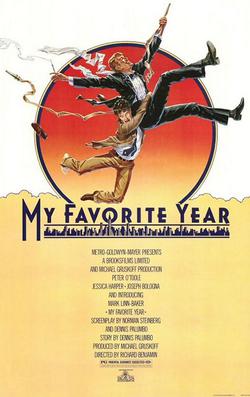
1982's "My Favorite Year" is a movie I can gush over

"Miss America" aired for the first time on national TV in 1954. It was the year before I was born. The pageant drew 27 million TV watchers. Lee Ann Meriwether got the crown. TV was fully in color by the time she starred with Buddy Ebsen in "Barnaby Jones" in the disco '70s.
A lot of dreck appeared on television in the 1970s. It made us pine for the so-called "golden age" of television. No wonder, then, that a comedy writer might look back on 1954 as "my favorite year."
I would argue it's impossible not to like the movie "My Favorite Year." We don't typically think of it as a Mel Brooks movie. But Brooks was executive producer of the film. He knew of what he was presenting. The young comedy writer character in the movie might have been Brooks himself. That character guides us into the story.
Mark Linn-Baker plays the narrator, "Benjy Stone." He might as well have been Brooks who was a writer for the Sid Caesar variety program "Your Show of Shows." Whenever we see a retrospective on "Your Show of Shows," it seems the same highlight clip is pulled from the archives: the characters playing roles on that giant decorative clock. It's a little frustrating for me because 1) it gets old, and 2) I think they did a lot funnier stuff than that.
Performers then didn't have to degrade themselves to try to be funny. No potty mouth needed. Censors were on the alert anyway. The entertainment was classy in a way we can only dream about today. I'm going to sound awfully snooty here, but I think TV in those seminal times was more classy because TV was still limited to the more affluent segment of our population. By the time of "Barnaby Jones" in the '70s, that problem had sure been solved. The '70s brought what Newton Minow referred to as that "vast wasteland." The problem was that TV entertainment had to try to cater to everyone.
This isn't to say creativity was snuffed out. I recently wrote a post saying we should take a fresh look at "Gilligan's Island." I suggested that those seven performers might join the pantheon of classic comedy. On the whole, though, we cannot ascribe a lot of high art in connection with stuff like "Laverne and Shirley." That stuff was crafted to appeal to the lowest common denominator.
In the 1950s, TV comedy was impulsive and slapstick. The 1982 movie "My Favorite Year" is a marvelous and authentic lens into a world that was still fresh and beloved in Mel Brooks' memory. How can we not love those memories?
I have a DVD of a Jack Benny New Year's Eve TV special from the mid-1950s. I watch it every New Year's Eve. Don Wilson plays the tuba for a little sketch promoting the show's sponsor, State Farm Insurance. Oh, and Dennis Day sings! The men were mature and classy, wearing suits.
 
Obvious inspiration for character
Peter O'Toole was nominated for Best Actor for his role in "My Favorite Year." His character was based totally on the real-life Errol Flynn, who was the embodiment of the "big screen" prime of Hollywood entertainment. The terms "big screen" and "small screen" were tossed around a lot, as if the distinction was important. "Big screen" suggested higher status, still.
In the back of everyone's mind, though, the power of TV was obvious. I had a book about Shirley Temple once with a caption that suggested we should be fascinated, sort of, by the "big screen" Shirley appearing with the "small screen" Red Skelton on TV. The author noted Shirley seemed a little stiff in this appearance. She never really did cut it as an adult actress, did she.
Shirley Temple and Errol Flynn impressed themselves as "movie stars" when that term suggested an awe that was almost other-worldly. A movie star!
"Benjy Stone" in "My Favorite Year" befriends "Alan Swann," the Errol Flynn clone. Benjy is a junior comedy writer for a variety show starring Stan "King" Kaiser, played by Joseph Bologna. Swann seems past his prime but still exudes fame. Kaiser's show is called "Comedy Cavalcade" which is the perfect name for a comedy show of the era. Such shows were live. This absolutely shocks Mr. Swann, accustomed to multiple "takes" for a scene. We get the impression his movies consisted almost entirely of swordfighting! His movies were set in exotic places. Is there really a "Tortuga?"
The Errol Flynn movie I remember best is "They Died With Their Boots On." It's a highly fictionalized account of George Armstrong Custer's life. Imagine embellishing the life of a war figure! In fact, Custer and his Confederate foe George Pickett both ascended to post-Civil War fame largely because of the efforts of their widows. Custer was sympathetic as a Union officer. He was pugnacious, a quality usually associated with the South. We all know the kind of infamy that came his way later, out West.
Olivia de Havilland starred with Flynn in "They Died With Their Boots On." The golden age of Hollywood, to be sure. Is de Havilland really about to turn age 98? Our best wishes to the actress.
 
The plot develops
Peter O'Toole as Swann shows up as a roaring drunk for his 1954 TV appearance. Benjy Stone is a long-time admirer of the man. Kaiser wants to dump Swann but Benjy intervenes. Benjy will do what he can to keep Swann stable, sober and capable of performing.
But, Swann is simply aghast at the thought of "going on live." This veteran entertainer has the kind of panic attack that might befall an amateur. Meanwhile, Kaiser is threatened by a corrupt union boss who doesn't like being parodied on the show. The "Boss Hijack" sketches are the bone of contention.
Swann becomes reluctant and consumes alcohol. He's in a mood to simply bolt but he's "rescued" by an exasperated Benjy Stone who in effect gives him a pep talk. Stone doesn't want to be let down by the iconic "big screen" Swann. Stone implores Swann to realize he really does have the heroic qualities of the swashbuckling character we saw in the movies. A poignant line is "Nobody's that good an actor," meaning that Swann deep down is the true hero.
The TV cameras go on. The studio audience enthusiastically pours in, and they're in the mood for comedy. The glorious spontaneous quality of 1950s television unfolds. Mel Brooks must have been consumed with nostalgia. We don't blame him. We drift back as if in some sort of time machine. Television was like an infant with the same charming qualities. Everyone was learning.
King Kaiser gives the thumbs-up for the "Boss Hijack" gag. That doesn't sit well with certain shady parties. The gangster minions of the corrupt union boss show up backstage. They're thugs and behave accordingly. A fight starts and spills onto the stage, perceived as part of the act. The audience laughs thigh-slappingly.
Alan Swann and Benjy Stone are up in a balcony. The audience becomes aware of Swann and erupts in vocal acclamation. They're unaware that everything is developing unscripted.
Swann, at first frozen and panicked by the "live TV" demands imposed on him, has his instincts take over, proving Benjy right with that pronouncement that he's a genuine hero. Swann grabs a rope or fire hose. (Earlier in the movie he used a hose to go from one apartment to another outside a building.)
Dressed as a musketeer for a later sketch, Swann looks every bit the Errol Flynn-type character. The audience is captivated and loves it. Swann swings heroically from the balcony, arriving on stage to save the day for the "good guys." He saves King Kaiser!
There are sub-plots about family challenges facing both the Swann and Stone characters. Benjy narrates the epilogue, explaining that Swann, his confidence bolstered by his marvelous improvised performance on the "Cavalcade," works up the courage to get to know his daughter better - a girl who lives separate from him with one of his several ex-wives.
Meanwhile Benjy overcomes his own inhibitions. Is this biographical, relating to Mel Brooks? Benjy has a "thing" for the TV show's assistant producer, "K.C. Downing." He "can't get to first base." Swann gives encouragement based on his romantic insights, never mind that his marriages don't stick. He uses the fire hose to try to make a dramatic entrance to the Downing apartment. It's probably set up as a precursor scene, just like "Happy Gilmore" playing miniature golf as a precursor to his final dramatic putt in the movie "Happy Gilmore" (Adam Sandler). 
Stone takes Swann to his Jewish mom's Brooklyn apartment where awkwardness prevails. The mom fawns over the star while uncouth "Uncle Morty" crudely asks Swann about a paternity suit. Didn't Errol Flynn have to deal with some messy personal details like this?
The "odd couple" friendship of Swann and Stone brings dividends for both - they overcome their inhibitions. The ending seems triumphant for all. The nostalgia is thus enhanced. We have overwhelmingly warm feelings at movie's end.
Swann acknowledges the admiring audience at the show's conclusion. He's right at home on TV after all! His instincts took over just like Benjy Stone said they would. A signature line from the movie is Swann saying "I'm not an actor, I'm a movie star!" We realize he's a flawed human being who can be dauntless when prompted.
 
Richard Benjamin: Wasn't he "Quark?"
"My Favorite Year" was the directorial debut of Richard Benjamin. Immediately I think of the late-1970s TV show "Quark" starring Benjamin. It's not a well-remembered show. Its lifespan was short. A shame, because the show had great potential as a sci-fi parody. It was created by Buck Henry who gave us "Get Smart" with Don Adams.
"Quark" is set on a United Galaxy Sanitation Patrol Cruiser. Three of the episodes were direct satires of "Star Trek" episodes. Satire can be a delicate thing. It's sophisticated. The watered-down nature of 1970s television made it largely impractical. You had to hit people on the head with what you were doing.
Buddy Ebsen as "Barnaby Jones" was an old geezer out chasing crooks. Ridiculous. "McCloud" was a western guy on his horse doing good in the big city. Implausible. Hollywood can be a "dream factory." It would also give us that "vast wasteland" (Newton Minow).
Today, TV is incredibly fragmented. There's something for everyone. We are tremendously spoiled. We are spared the likes of "Laverne and Shirley." Or at least, we can turn away from it.
That intriguing "Quark" show had navigator characters: "the Bettys," cute young women one of whom was a clone (although they both denied being the clone). Benjamin's "Adam Quark" says he's in love with Betty but isn't sure which one. The likes of "Star Trek" were ripe for satire. "Quark" just didn't break through.
Predicting success was very difficult. Remember, Jerry Van Dyke passed on the role of "Gilligan" because he saw more potential in "My Mother the Car." Didn't Dennis Weaver leave "Gunsmoke" for a short-lived comedy? But he re-appeared as "McCloud."
How we all wasted time watching TV. We vicariously attached ourselves to the characters, I guess. I read that psychological depression resulted from this. In 1954 the TV universe was fresh and unpretentious, in comparison to the '70s contrived dreck. One negative was the unabashed cigarette commercials.
 
"Seeing" the big news
In '54 television gave us, live, the broadcast of the Army/McCarthy hearings. And, Lee Ann Meriwether getting the crown of Miss America. We would be "subjected to" years of Miss America being hosted by Burt Parks. Mad Magazine had a satire where you could buy "Having to watch Burt Parks on TV insurance," and there was an illustration of a guy who had tried to change channels but the knob came off the TV. Ah, comedy!
 
All hail "My Favorite Year"
"My Favorite Year" is my favorite movie. It has sentiment without being maudlin. It balances a serious side with the madcap comedy.
Knowing it's a Mel Brooks movie, you can look for signs of the Brooks sense of humor, and it's there. Like, in the scene where Swann asks Stone to create a diversion at a nightclub so Swann can make a play on a certain young, admiring woman who's present with a dweeb-ish male companion. The tactic works, whereupon the jilted man, prone on the floor, says "somebody took my girl!" The lounge musicians take that as a request and instantly break into the song of that name. I laughed out loud.
I laughed out loud several times before movie's end. It's rare I can kick back and just describe a movie as totally wonderful from beginning to end. "My Favorite Year" is such a gem. The Mel Brooks touch continued with this historical flourish. 
The early TV was endearing because it came right into our homes, adding a new dimension there, whereas movies had been a detached experience. (The movies didn't work out too good for John Dillinger.)
The idea of creating a character like Errol Flynn without actually being Errol Flynn, made me try to remember other such characters. Andy Griffith in "A Face in the Crowd" could have been Arthur Godfrey. The movies were trying to warn us about the dangers of TV, i.e. its potentially mesmerizing influence on a too-gullible public. Griffith might also be Glenn Beck, I might suggest!
Joe Don Baker played the best Babe Ruth ever. Except, that he wasn't really Babe Ruth, he was a character called "the Whammer" in Robert Redford's "The Natural."
Tina Louise on "Gilligan's Island" could have been Marilyn Monroe or Jayne Mansfield.
Was Orson Welles really William Randolph Hearst in "Citizen Kane?" Hearst didn't like FDR because FDR helped start long, cruel World War II. Hearst for his part only started short, funny wars like the Spanish-American War.
Hollywood is wonderful when it isn't pretentious. "My Favorite Year" pays homage to an earlier time with total sincerity. Congratulations, Mel Brooks - sometimes you make me wish I was Jewish. (I had a first cousin, RIP, who converted to Judaism late in life.)
- Brian Williams - morris mn Minnesota - bwilly73@yahoo.com

Wednesday, May 28, 2014

Rod Carew: unparalleled with bat, chilly personality

Did you follow the career of Rod Carew? He's in that pantheon of top-tier Minnesota Twins. We remember him as flirting with that .400 batting average but never making it. He played in pre-Bill James times when batting average was the first thing we consulted when evaluating many players. By that indice, Carew was among the best ever.
His major league career began in the 1960s but it was after our 1965 American League pennant. He wasn't around for all the exhilaration of the Tom Kelly era. He was a Twin when the team teased us: it was very good much of the time but couldn't climb to another pennant. We don't have the full sense of gratification remembering Rodney. He was the man with the potentially .400 bat (we were continually told) but never did it.
People my age remember gnashing our teeth whenever Rod had to fulfill his National Guard requirement. Being in the Guard in those days meant you wouldn't get sent to Viet Nam.
The worst year of the war, 1967, was Rod's rookie year with the Twins. Legend has it Twins owner Calvin Griffith ordered Sam Mele to install Rodney as the starting second baseman, no questions asked. So on opening day, April 14, 1967, Rod stepped up to bat against the Detroit Tigers at our Metropolitan Stadium.
April 14 is an awfully early date to count on decent weather for baseball here. The temperature was 51 degrees and rain fell. The attendance was 21,347 - actually pretty decent. Twins baseball was still pretty fashionable here. Carew got one single in the Twins' 5-3 win over the Tigers.
The 1967 season would go down as intensely heartbreaking for the Twins. The pennant race went up to the very end. We could taste it - the pennant. Those were days when fans had a more emotional bond with their favorite team. There was no ESPN to spread exposure of all the big league teams. If you were a baseball fan in Minnesota, your bond was clearly with the Twins as if they were family.
Carew had a successful rookie season. But his Twins were edged out at the very end by the "impossible dream" Boston Red Sox with triple crown winner Carl Yastrzemski. The triple crown is based on batting average, home runs and RBIs. Like I said, those were pre-Bill James times. Frank Robinson of Baltimore won the triple crown in 1966.
Rod Carew was a delicate-looking man who seemed more to wave the bat as much as swing it. He had an open batting stance. He was masterful at simply getting hits. Occasionally he showed power to the extent we wondered why he couldn't do it more often. I wonder if he felt that batting average was simply his ticket.
I remember the scene from the movie "61*" in which the Yankees owner calls in Roger Maris and asks Roger if he might be too preoccupied with batting average. "We're paying you to swing for the fences."
Harmon Killebrew was to home runs what Carew was to batting average. Killebrew often had trouble keeping his average up. We wonder how Harmon would have done over the very long term if sports medicine had been more advanced, and if PEDs could have been slipped to him.
Of course we all frown on PEDs. Major League Baseball was belated in trying to clamp down on that. Baseball struggled to win fans back after the strike of 1994. A couple of guys hitting moon shots were a good cure for that. Mark McGwire and Sammy Sosa obliged. Billy Crystal made his "61*" movie that suggested McGwire was going to own the home run record for a long time. Barry Bonds came along and thrilled us a lot less. Home runs were becoming like touchdowns in Arena League football.
 
Carew, Killebrew and Oliva: an era
Carew played beside Killebew and Tony Oliva. The latter two were quite endearing to us while Carew had a personality not so endearing. He seemed cold and distant. He spoke in a programmed way in interviews. "Aloof" was a description I eventually heard from a leading media person.
I read about Carew repeatedly sending his eggs back in a restaurant. Take a hike, man. Fry your own. There was a plane flight incident when he was retired, when we at first wanted to sympathize with him, but as facts trickled out we realized he wasn't sympathetic.
We could have overlooked the negative traits had Rodney helped deliver a pennant for us. Other-worldly as he seemed with his talents, he never got into the glow of the World Series. The All-Star Game was no substitute.
The divisional system in big league ball began in 1969. Rod was in his prime. Our Twins won the division under the very popular, and then stable, manager Billy Martin. Maybe I should put an asterisk there. Billy did get into a storied fistfight with pitcher Dave Boswell. But fans loved how the Twins won the American League West in '69. We then bombed in the playoffs vs. the Baltimore Orioles. Martin was fired. Enthusiasm for the Twins dropped off.
Bill Rigney, a capable hand but blasé with his personality, took over in 1970 and led the Twins to another West title. The playoffs were ditto from 1969: the Orioles with Frank Robinson dominated us. I remember that in both '69 and '70, enthusiasm for the Twins around the state was far beneath what we'd see today with similar accomplishments. My, what glee a division title would bring!
As we progressed through the 1970s, all that early sheen of the Minnesota Twins franchise waned, unfortunately. Was it a case of simply being spoiled? The team had given us so much success through the 1960s.
We realized in the '70s that Calvin Griffith couldn't keep up with his owner peers. Bowie Kuhn wrote that the Griffith family were "church mice." I really liked Bowie's autobiography. He was a lawyer and a good writer. He also came across as having much more heart than fandom generally ascribed to him. We must remember he worked for the owners. Those were turbulent times with the Curt Flood case transforming everything. We realize now all of that was necessary.
One thing the players didn't realize was how they could someday parlay their fame into great riches through card/memorabilia shows.
The '67 Twins were known to be a little demoralized, perhaps in the face of Calvin's austerity. It shouldn't have mattered. The players should have sought as much fame through success as possible. Fame would equate to great monetary reward down the road. Denny McLain didn't need to try to be a criminal! Being a criminal was strangely in his DNA, and I say strange because, as Kuhn pointed out in his book, the type of man with the skills and drive to become a major league baseball player isn't the type to show criminal tendencies. I remember seeing McLain pitch at the old "Met."
 
Baseball in the disco '70s
The Twins teased us with a bid for the pennant in 1977. Fans were still enthused enough to respond to that. We had to be the best. And we came close.
This was one of those seasons when Rodney teased us by coming close to that .400 average. He was never better than in June of 1977. He "waved" that bat and "sprayed" hits all over the place, remember? The Twins looked mighty promising so on Sunday, June 26, with the promotion of Jersey Day on, a total of 46,463 fans showed up at the Met! Remember, there were no casinos yet!
"The sky was azure, clear and high," Joe Soucheray wrote. "The temperature at game time was 87 degrees, rising to 92 later in the afternoon."
Many fans stripped down to only modest coverings. The Twins engaged in a game that was just as amazing as the turnout. It was as if God blessed the whole occasion. The game turned into an offensive explosion. The Twins won 19-12 and went a game up on Chicago, and three and a half over California and Kansas City.
Glenn Adams drove in eight runs. Rod produced four hits and upped his average to .403! He scored five runs. Four standing ovations showered down on Sir Rodney. He showed that power capability in the eighth, slamming a two-run home run.
Of course the Twins tapered off. By September it seemed they were off the radar screen altogether. As evidence I offer the fan turnout of the last home game that season: a mere 3,291. Dave Goltz was the Twins pitcher on that calm and quiet afternoon. He was seeking his 20th win. He would be the first A.L. 20-game winner that season.
The hopes were dashed all-around: Goltz was defeated, and later that day Jim Palmer of Baltimore got his 20th. Goltz was as uncharismatic as Palmer was charismatic. Goltz's pitching mechanics were minimalist.
Gene Mauch was our manager then. Mauch gained infamy before even taking the Twins' reins, by being manager for the 1964 Philadelphia Phillies in the biggest choke episode of all time. Mauch survived that, in terms of being albe to still get big league gigs. He's remembered as the Twins manager in that time when Minnesotans seemed to tire of their team and their seemingly stale Metropolitan Stadium.
A new stadium was going to have to be built to jump-start things. That in fact happened. Rod Carew's other-worldly batting averages faded into the history book with no pennant to show for this.
We can remember the glorious days at the Met when summer seemed so joy-filled. Remember the disco music too. The U.S. economy was turbulent. We were hung over from Viet Nam and the fall of Richard Nixon. Inflation roared, remember?
Burt Reynolds showed it was neat to defy the law (as "The Bandit"). Jackie Gleason represented the law in an eccentric and shameful way. I remember an op-ed scolding him for even taking that role.
Those were different times, to be sure. Rod Carew was at the apex of his hitting powers. We can remember fondly even if his personality never captivated us. His talent was up in the stratosphere. He needed a personality mentor. And, maybe a personal chef for breakfast.
- Brian Williams - morris mn Minnesota - bwilly73@yahoo.com

Friday, May 23, 2014

Too early to start thinking about Sesquicentennial?

Music for the 1971 Morris Centennial, by the super "alfalfa arch"
John Woell grew facial hair which was the practice for Morris men to commemorate the Morris Centennial. The year was 1971. John was the Morris High School band director who really did his part helping enhance the festivities. I wonder if he got paid extra. Any payment might have been part of the summer marching band package for him.
Mr. Woell certainly was the committed music person in the summer of '71. He led his high school musicians including your blog host, Brian Williams, who were organized in more than one ensemble. The group in photo is assembled under the fantastic "alfalfa arch" on main street.
Is that the Merchants Hotel at right in the background? I believe it is. Riverwood Bank is there now. Prior to Riverwood, a restaurant that had three incarnations or owners was there. I miss that restaurant. Merchants Hotel included a barber shop where I had my hair cut a few times, like by Merlin Beyer. We miss Merlin. Merlin was the old-fashioned community politician who knew what was best. In the late 1980s we saw the venerable Merlin get "edgy" and take on the public school because of a festering issue. He and others came away with scars, but they wouldn't second-guess any of it. 
John Woell presided over the last grand chapter of the MHS marching band program. After that, kids got consumed with other commitments like sports camps.
At the time the photo was taken, marching band was considered a prestigious activity by the kids. So prestigious, ol' John could be quite the disciplinarian, even kicking kids out of practice for various forms of misbehavior or insubordination. I even saw him kick out the esteemed Reese girl once. That incident may have reflected a growing generational schism in which kids wouldn't just take directives automatically. Our elders weren't accustomed to confronting that kind of critical thinking. Gone were the days when teens were meant to be seen and not heard. We didn't take the Viet Nam War sitting down. The world would never be the same again.
John might discipline kids harshly but they would come back. Heck, today we'd see kids give a shrug and say "take a flying leap." But marching band was a coveted activity through the early 1970s. I would say it began petering out (by coincidence) after I graduated. Girls sports was getting established when I graduated in 1973. Girls would have a great deal more to do than play the flute or clarinet. It was a step forward.
In the photo that accompanies this post, I'm third from right. I'm seated next to a couple other brass stalwarts from that time: Del Sarlette and Terry Rice. Terry was a spectacular player while Del and I were more pedestrian.
 
A high quality photo
The photo was taken by a good camera by the standards of the time. Florence Sarlette, Del's mom, took it. We miss Florence. Parents of The Greatest Generation have been gradually going to that great alfalfa arch in the sky.
We take for granted the ease and quality of the digital cameras of today. The photo you see here was taken by something other than a Kodak Instamatic. Those Instamatics were the norm following the tradition of the Model 'T' cars.
You can see everyone poised with their "Kodak Instamatics" in the movie "Apollo 13." Ron Howard must have had a good memory of those. You'd take your film to "the drugstore" and then wait maybe a week. Those old Kodak pictures don't scan well for online purposes. It was "the people's camera" with results just adequate.
The photo you see with this post must have been taken by an SLR camera of the Canon or Nikon brand, cameras that were considered highly expensive - a lifetime purchase. Eventually the time came when any camera you purchased had obsolescence. I got fed up with that.
Today if I take photos, which is rarely, I use my old Canon AE-1 SLR, a type that I remember being pushed in TV ads by the Joe Theismann family. I think Joe divorced that wife (or vice versa). I hope ol' Joe doesn't have cognitive issues from football. He sure got his leg fractured once.
Terry Rice, Del Sarlette and I made up the "trumpet trio" that performed at various times in 1970 and 1971. Terry and Del were 1971 MHS graduates. I began on the French horn and then switched to trumpet. The switch was made when I grabbed the trumpet for my audition for all-state band in 1970, and I made it. Until then it was a secondary instrument I used for marching band, because French horn was impractical for marching.
Del went on to lead our Morris Community Band for many years with wife Carlene. I don't know where Terry Rice ended up. Terry was good at "skiing" down the hill on the west side of the old school, wearing his regular shoes. Today we could appreciate that on YouTube.
Even though the photo here is relatively sharp, we're a little too far away for me to ID everyone. I could probably do a TV commercial for reading glasses. The girl on the other side of me is Jane Larson, one of the "Donnelly kids." She was our Homecoming queen in the fall of 1972. The two boys between Jane and Mr. Woell are Scott Groth and Craig Jones. I believe that's Tony Hansen, drummer, behind those two. Kathy Graff is right next to Mr. Woell. At far left is trombonist John Woell Jr. Sorry, I just can't come up with names of the others, partly because some aren't looking directly at the camera. You might say time has drawn a misty curtain. (Del tells me he has intellectual property rights with "time has drawn a misty curtain.")
Update: Del emailed me the following on the day after I posted this: "Regarding your 'sesq suskw sasquatchtennial' post: why didn't you ask me to ID the alfalfa arch band photo? I coulda told you who everybody is. L to R: John Woell Jr., Dave Carlson, Craig Johnson, Gary Brown; over Gary's left shoulder playing piano is Debbie Lyseng-Mahoney, then there's Angie Rasmusson on bari sax, Kathy Graff, and you know the rest. Yes, that is Tony Hansen on drums, and hidden under the sousaphone bell is Ken Johnson."   
I think one of the spectators in the background is Sudhir Agarwal. I got to know Sudhi's mother Sarla when she ran Country Day Nursery and I periodically visited with my newspaper camera. It was charming to see Sarla still spinning vinyl records at CDN long after they were obsolete. She did her teaching/supervising at Federated Church.
What a tremendous icon that alfalfa arch was. You can see a large photo on the wall at Willie's Super Valu.
 
Looking forward to the 150th
It dawns on me that our "Sesquicentennial" isn't that far off in the scheme of things. That would be the 150th anniversary. Am I computing right if I report that year would be 2021? I wonder if the festivities will match those in 1971 or even 1947.
The Diamond Jubilee celebration actually should have been in 1946, not '47, but the delay was deemed necessary, maybe because of the adjustment needed with "the boys coming back" from war in '46. Programs were held at the county fairgrounds in both 1947 and 1971. I was proud to be in the band in '71.
Our old reliable Morris Theater is in the background in photo. The movies in the 1970s weren't very good. The '70s overall proved to be a pretty stagnant decade. An air of cynicism or resignation prevailed a good share of the time. A year after this photo was taken, we got the first revelations about Watergate. The economy between 1973 and 1983 was terrible. We had that phenomenon called "stagflation."
Remember inflation? Michael Kinsley says inflation happens once every generation. People slowly forget about it in its aftermath, we lose our vigilance and then it comes along again, Kinsley pointed out. Paul Volcker took over at "the Fed" and jacked up interest rates, as if he were applying a fire extinguisher to a fire. Thus inflation was slayed. In the meantime I could go to old First Federal Bank (forerunner to Riverwood) and get a certificate of deposit for something like 13 per cent interest. I'm not kidding you: 13 per cent! Our economy would have crashed and burned had this continued.
Today banks pay essentially no interest. Maybe that could tank the economy too.
At the time the photo was taken, middle class people did not put their money in the stock market. Actually they spent whatever money they made. People watched pennies then.
I am happy to share this Morris Centennial photo. That event has seemed to fade in our collective community memory, just like the big community celebration and parade for Jerry Koosman in 1969. That name doesn't mean anything to you? That underscores my point. The Met Lounge has its name because of Jerry, who pitched for the New York Mets. I hope Jerry has gotten into the habit of paying his taxes. He was a little like Wesley Snipes for a while. Incarceration gave him some incentive.
 
Rich history of music here
The ensembles that John Woell directed continued a long tradition in Morris. I would like to acknowledge here the famed Watzke Orchestra of an earlier time. I went to high school with Tom and Matt Watzke. Tom was in my 1973 class and Matt a year older. Paul Watzke is synonymous with hockey promotion and helped push the construction of our Lee Community Center. He was undeterred by an eye injury from hockey. Such zeal. I should be so fortunate to be committed to something like that.
The Watzke name is ingrained in Motown history. Tom played the trumpet like me.
The Diamond Jubliee publication of 1947 refers to "the famed Watzke Orchestra." Anton Watzke was founder, and the personnel included several Watzke family members. The orchestra was in demand for concerts, socials, church and school programs, public and private dancing parties, and other occasions. A photo shows eleven members. I like these relatively small groups because they're flexible and mobile. A roster of members from 1907 includes: Taylor Pennock, Anton Watzke (director), William Sobey, Frank Zahl, Harry Brom, Lillian Watzke, Ruth Reeves, Alfred Watzke, "Happy" Treischel, Mabel Watzke and Anton Watzke Jr.
We read that "throughout all its years, Morris has had no musical organization more closely identified with the community than the famed Watzke Orchestra." The group included a string bass player.
We must not overlook the Morris Silver Cornet Band too! The Silver Cornet Band was fairly large and must have produced a most robust sound. It lent its musical strains around Morris way back around the turn of the century. Music maestro please!
We expect to see and hear this kind of musical flair when Morris' Sesquicentennial comes. I remember communicating with a friend in Cedar Rapids IA when that community marked its 150th, and he congratulated me on being able to spell "Sesquicentennial." Better practice now.
What will life be like in 2021? What will bank interest rates be? Will we have avoided an economic depression by then? Will I just be a spectator?
I once told Ken Hamrum that I probably was at my best playing trumpet at around age 17. After that I studied too much, pondered too much and may have developed a Chuck Knoblauch type of problem, I told attorney Ken. His response: "You mean you had trouble throwing the ball to first base?" Wise guy.
If I concentrate, maybe I could step into the "Wayback" and play like I did years ago. (Forget about the "diaphragm.")
Personally I haven't heard any talk yet of our Morris Sesquicentennial. Am I the first to broach it? Maybe we could book the "Flying Elvises" for a visit!
- Brian Williams - morris mn minnesota - bwilly73@yahoo.com

Monday, May 19, 2014

Reimers homers again, MACA takes No. 1 in conference

MACA took charge early in its Friday (5/16) home game against the Falcons of ACGC. The MACA girls owned a 5-0 lead after two innings. The teams were pretty even in scoring after that. So, the Tigers tucked away their eleventh conference win with this 12-8 triumph over the Falcons.
The Tigers' 11-2 record in the West Central North gives them the No. 1 distinction. They're a game up on Minnewaska. The Tigers recently had some trouble vs. Minnewaska in head-to-head. However, we came away with bragging rights in conference. The thoughts now are turning to post-season play. As they say, everyone begins 0-0 in the post-season. MACA will host Minneota at 3 p.m. on Tuesday, May 20.
Lauren Reimers has been a standout with the bat. Thursday and Friday saw Reimers wield her bat in home run fashion. She connected for home run No. 9 on Thursday, in the 7-5 win over Paynesville, and homered again in the Friday success vs. ACGC. On Friday she also tripled. Her boxscore line was two-for-two and she drove in four runs.
Becca Holland showed an authoritative bat Friday. She came at the Falcons with a double and triple and had a line of two-for-four. Chelsey Ehleringer was practically unstoppable. Chelsey went three-for-four and drove in two runs. Brooke Johnson added to the potent mix with a hit. MACA had a line score of 12 runs, eight hits and four errors.
Atwater-Cosmos-Grove City got untracked with its offense in the fourth through sixth innings: seven runs total in that span. But MACA overall had the more productive offense. That offense supported pitchers Kayla Pring and Brooke Gillespie. Kayla got the win with her four innings pitched, in which she fanned four batters and walked one. Four of the six runs she allowed were unearned. She allowed six hits.
Gillespie pitched three innings, striking out two batters and walking none. She gave up two hits and two runs (earned). The losing pitcher was Katie Peterson. Jacey Nelson also pitched for the Falcons.
Hannah Wilner had two hits for ACGC, one a double. Nelson also had a double. Other Falcons hitting safely were Rylie Wilner, Peterson, Kaitlyn Moore, Kim Swenson and Mickena Inselmann.
 
Tigers 7, Paynesville 5
The Thursday (5/15) success was another step toward capturing the conference title. It was a 7-5 score that vaulted coach Mary Holmberg's team further. All seven of the Morris Area Chokio Alberta runs came in the first two innings. Our line score was seven runs, seven hits and three errors. The Paynesville line score was 5-10-2.
Kayla Pring pitched the whole way, scattering ten hits and allowing the five runs, one of which was unearned. Pring struck out three batters and walked four. Two Bulldogs pitched in their losing cause: Kayla Schaefer (the loser) and Abbie Wuertz.
Will opponents start "pitching around" Lauren Reimers of the Tigers? She went two-for-four including a home run and drove in two runs. Chelsey Ehleringer doubled as part of going two-for-four. Pring, Brooke Gillespie and Brianna Abril each had one hit.
Four Bulldogs each had two hits: Brianna Stang, Allie Stanger, Emma Stevens and Brooke Hemmesch. Sam Dahl and Halle Johnson each had one hit for the green-themed crew.
 
Baseball: Montevideo 8, Tigers 5
The Thunder Hawks of Montevideo scored in steady fashion to hand our Tigers defeat on Friday. The T-Hawks scored two runs each in the first, third, fourth and fifth innings. This attack overwhelmed the Tigers as revealed in the 8-3 final score.
The MACA pitching work was shared by three: Sean Amundson (tagged with the loss), Riley Biesterfeld and Brady Jergenson. Amundson fanned five batters and walked none, but Monte bats made noise with eight hits vs. him. Two of the six runs that Amundson allowed were unearned.
Montevideo cruised behind the route-going pitching arm of Jordan Thompson. Jordan was smooth, striking out five batters and issuing no walks. He overcame the Tigers' quite impressive 12-hit attack. The three runs he allowed were earned.
The MACA line score was three runs, 12 hits and two errors. Monte played errorless ball. The Monte hit total was ten.
Noah Grove of the Tigers had three singles in four at-bats. Brady Jergenson had a two-for-four line. Gage Backman had a double as part of going two-for-four, and he drove in a run. Jase Wilts had a two-for-three line. Riley Biesterfeld had a hit and two ribbies. Bryce Jergenson and Sean Amundson each had a hit.
Spencer Hildahl went three-for-three for Monte including a triple, plus he drove in a run. Jeff Rohloff also went three-for-three, and this T-Hawk had a double and two runs scored. Austin Hiepler and Zac Enevoldsen each doubled. Marcus Kranz and Tristan Weber also hit safely.
Today (Monday) looks rainy. Hopefully the schedule can continue unimpeded through this week.
- Brian Williams - morris mn minnesota - bwilly73@yahoo.com