History-making music group for UMM - morris mn

History-making music group for UMM - morris mn
The UMM men's chorus opened the Minnesota Day program at the 1962 Seattle World's Fair (Century 21 Exposition).

Thursday, August 29, 2013

"The Lost World" (1960) survived budget austerity

It is easy to use reason to speak uncharitably about "The Lost World."
"For 10 year olds, seemingly made by 10 year olds," is the kind of dismissive remark one can find.
"The Lost World" is a re-make of the classic 1925 silent film. It is one of a stable of movies well-remembered by boomers like me as showing up in network prime time.
Another of these movies is "The Day the Earth Stood Still." One actor is in common with these two movies: Michael Rennie. Rennie was of course "Klaatu." He was a relative unknown at the time he played that space alien, thus he was a good selection, according to a movie historian who suggested the air of mystery was helped.
Rennie worked with the robot "Gort" in the 1951 "Earth Stood Still." I have previously referred to "Gort" as "Mr. Tin Foil" because the special effects for him were barely good enough. Oh, Hollywood and its budgets. People lose sleep over trying to make sure special effects are passable with limited money. Oh, those pencil pushers.
Austerity was a factor making "The Lost World" (1960) what it was. What it was, was a sci-fi flick with special effects that probably didn't quite make it. We see Mr. Rennie in color this time. He does look nine years older. He presents a James Bond-type character in "The Lost World," a member of a party visiting a remote and dangerous place.
Going way back, the original story was written by Sir Arthur Conan Doyle. That's a pretty solid foundation to draw upon. Sir Arthur penned his tale of giant prehistoric creatures so it was set in 1912. Maybe the 1960 movie should have been set then too. It's hard to believe a plateau with dinosaurs would be unknown as late as 1960. The year 1912 was when the Titanic sank - pre-WWI.
The mysterious place is a flat mountain in the heart of remote Venezuela. The history of fiction has many such places. I have written about a favorite childhood comic, "Turok, Son of Stone," that was set in a lost valley in New Mexico. Not only do we have ancient creatures in these places, we have primitive humans too, most likely cannibals, not apt to help any new human visitors. The 1960 movie indeed has such barbaric souls, described by one reviewer as "white-skinned natives who look suspiciously like extras who can't act." (I'm reminded of those bumbling Indians in the 1960s western comedy "Texas Across the River," with Dean Martin.)
"The Lost World" might be an easy target for critics who are ready with the kind of snarky lines that could be followed by a rimshot. Another example: "The jungle sets are almost as impressive as the miniature landscapes that used to come with Lionel train sets."
Rimshot!
A Los Angeles reviewer says: "Don't see this movie without a bottle of Vicodin and a shot of rye."
As I noted at the outset, it's easy to employ reason to take some shots at this movie. Silly rabbit, such a movie is made by people who definitely know what they're doing. The very fact this movie showed up repeatedly in 1960s prime-time TV is a reflection of its effectiveness. Us kids thought enough of it, to jabber about it at school the next day. Same with "The Day the Earth Stood Still," "War of the Worlds" and "The Time Machine."
We came away from World War II movies like "The Longest Day" thinking that death in combat simply meant falling to the ground and being silent - no blood and no prolonged pain.
With sci-fi movies, there's no pretense of being true to life. The imagination is given free reign.
Hollywood just has to be careful not to cross the line into blatant absurdity. Yes, they sweat over this. And certainly, concern must have been felt when the wheels got turning for "The Lost World." The special effects, shall we say, have issues. In telling this story, a little background is in order. Let's talk about the movie "Cleopatra," one of the monumental busts of all time. Liz Taylor had her name attached to that one. I'm not sure if the current "The Lone Ranger" (Johnny Depp) is in league with that. But "Cleopatra," about the Egyptian queen, was such a staggering failure, it dragged down Hollywood budgets for other movies.
"The Lost World" was originally supposed to be made with "stop-motion" special effects. That's what we saw in the 1933 "King Kong." The tanking of "Cleopatra" resulted in slashed budgets for nearly every film being produced. Minus this handicap, "The Lost World" had potential to be a true sci-fi classic, perhaps making the same kind of splash as the later "Jurassic Park."
It has been written that "(Irwin) Allen's dream of a sci-fi spectacular were crushed." Allen was director of "The Lost World." He went on to give us boomers a wealth of sci-fi (e.g. "Voyage to the Bottom of the Sea").
The people behind "The Lost World" could not turn to CGI, naturally. Their task was to produce a dinosaur story, so, they employed a technique that has been called "slurpasaurs." They used monitor lizards, iguanas and crocodiles affixed with horns and fins. The creatures were filmed in a way making them (hopefully) seem dinosaur-size. This meant creating "roars" for their sounds.
As kids, I think we watched without laughing. The movie passed muster as "perfect Saturday matinee fare - celluloid escapism."
Actor David Hedison said years later he hated the movie. The pot saying something about the kettle. A commenter has written "Hedison shows why he was perfectly suited to a career as a Love Boat passenger." (Orson Welles once commented that he wanted his tombstone to include: "He didn't do Love Boat." To understand the humor, you have to understand the cynical '70s.)
There is a "dinosaur" combat scene in which a monitor lizard fights a caiman. I guess PETA wasn't around then.
We get a few sexist comments like one would expect in a movie of this vintage - pre-political correctness. ("Texas Across the River" crushed political correctness so bad, it apparently has vanished from cable TV. Ah, the '60s.)
Jill St. John is a female heroine in "The Lost World," feisty in early stages of the movie, submissive and resigned for the rest, unfortunately. Amazingly she was just 19 years old when the movie was made. She became one of those proverbial "sex symbols." In the movie she has a poodle named "Frosty." Kudos to Frosty as the most credible animal in the movie.
Actor Hedison, we should note, went on to act in Irwin Allen's "Voyage to the Bottom of the Sea" (TV), as right-hand man to the Richard Basehart character. "Admiral Harriman Nelson," Basehart's character, was the underwater version of "Captain Kirk." He didn't become as famous or iconic.
"The Lost World" was made at a time when science was still thrashing about trying to determine just what kind of creatures dinosaurs were. There was a school of thought that dinos were big dopey versions of modern lizards. Eventually we realized dinos were not reptiles but rather, their own genus: "dinosauria." Their physiology and habits were nothing like reptiles. The movie creatures were faint echoes of dinosaurs. We suspended reality. And we still can, because this is what movies induce us to do.
Jill St. John wasn't the only eye candy in this movie. She vied for that attention with "the hot cave girl" played by Vitina Marcus.
That Venezuelan plateau includes carniverious plants and giant spiders. Movie critics at the time gave a mixed assessment. Director Allen cut his teeth with sci-fin on this project, and I sense the genre grew into a labor of love for this influential TV figure.
In the storyline, a professor leads a group of diverse characters to the plateau deep in the Amazon jungle. Claude Rains plays the boastful and outgoing "Challenger." ("Professors" have to come across as a little eccentric.)
Rains' character is a biologist and anthropologist. He dares the London Zoological Society to mount an expedition to verify his spectacular claim, based on a previous visit to the Amazon basin: live dinosaurs!
Hedison plays a young reporter. Rennie is "Lord Roxton." Jill St. John is "Jennifer Holmes." In Brazil the party is joined by a local guide, Fernando Lamas, who really nails Ricardo Montalban (or is it the other way around - "rich Corinthian leather").
The expedition party manages to escape the plateau during a volcanic explosion, a T-rex egg in their possession. The egg hatches and we see. . .a gecko! Oh, but it's a baby T-rex.
In 1966 Allen tried to sell a TV series based on "The Lost World" but was unsuccessful. He did use some stock footage from the movie for his later TV projects (like "Voyage to the Bottom of the Sea").
Claude Rains entered this project with a reputation as a British character actor ("The Invisible Man"). Jay Novello plays a cowardly guide - a pathetic character who was overdone, in my view. Of course, the Novello character is the one who is "eaten alive" by a dinosaur. He had just found spectacular diamonds and was trying to stuff them away. Moral of the story: don't be greedy!
The filming is wide-screen and does have a beautiful, panoramic quality in many places, the "Lionel train set" comment notwithstanding.
It is a testament to Irwin Allen's judgment that "The Lost World" with its many special effects shortcuts, was taken seriously enough to become a staple for TV and cable. One of those snarky critics observed that "it's remarkable to discover that a wooden stick might act as a dam for molten lava." A critic mocks the Lamas character "sacrificing his life to save the others by letting a doll that looks like him fall into some lava." Wise guy.
In reality, people flock to such movies wanting to be entertained, and this is the only criterion that professionals like Irwin Allen gave credence to. Boomers were enthralled quite nicely by "The Lost World." The tragedy is that "Cleopatra," of all things, might have kept the 1960 flick from being a truly enduring classic.
A thought lingers: Maybe try some plastic dinosaurs from the dime store in with that Lionel train set!
- Brian Williams - morris mn minnesota - bwilly73@yahoo.com

Friday, August 23, 2013

"Konga" not to be confused with famous "King Kong"

Movies about King Kong and Amelia Earhart have a shroud of sadness. We know the ending and it's a sad one. I shared this observation in my post about the "Amelia" movie and I'm sharing it again.
Today my attention turns to the big gorillas. I cite "King Kong" as a preface to my main subject matter. Chiefly I'm thinking about a character named "Konga," highlighted in a comic book series. This character grew out of a movie which I never saw.
Named "Konga," the flick had a British botanist, Charles Decker, discovering a serum that made his chimp subject "Konga" into a larger and lurking ape. The tinkering has just begun. An angry and rejected girlfriend of this mad scientist, as it were, gives the ape a huge amount of serum whereupon it becomes Kong-like, absolutely huge. He can be pretty belligerent too. The girl becomes his first victim. Meanwhile Decker's current squeeze, Sandra, gets bitten by one of Decker's carnivorous plants. The British army kills the ape and Decker. The ape reverts back to a chimp in death.
Death onscreen does not spell the end of the ape character. I discovered "Konga" on comic book racks. It was put out by Charlton which has been described as a sort of "minor league" comic publisher. I was intrigued by this Kong-like character who would go on a rampage in a storyline that still seemed open-ended (unlike with "Kong").
"Konga" was a fresh character in spite of the tremendous similarity (including its name) to the 1933 rampaging ape who came to us via "stop-motion." Instead of making new "Kong" movies, maybe Hollywood should go back to the well with "Konga." We'd be spared that tragic scene at the end with the biplanes and machine guns.
One of the King Kong versions came out smack-dab in the middle of the disco era. I was in college. Jeff Bridges played a hippie photographer in this 1976 release, long before he could pass for Rooster Cogburn. The flick is distinct because the backdrop at the end is not the Empire State Building, rather it's the twin towers of New York City. We all know the fate of those.
Peter Jackson came out with a King Kong movie long after disco had faded into the depths of retro. This version was in 2005 and utilized lots of CGI. I remember going to Alexandria on Christmas Day to see it, fresh on its release. I remember it well because the trip turned into a bit of an adventure, because I couldn't find any dining establishment open for a long time. I thought Alexandria was big and bustling enough that surely I'd find some activity somewhere. It took awhile but finally I noticed cars in the parking lot of a Chinese restaurant! I could stay warm, have a pot of coffee in front of me and page through a newspaper. Elena Kagan of our U.S. Supreme Court told a like story of discovering a Chinese restaurant open on Christmas Day.
I felt the 2005 movie was done as well as it could be. I'm not sure we need any more "Kong" versions with the WWI weaponry. I'd be much more enthused about the revival of "Konga." The plot could go in unlimited directions.
As a kid I had no knowledge of "Konga" the movie. Made in 1961, it wasn't meant to be taken totally seriously. It had its fans even though it exuded a "schlock" quality. The film made enough of a mark to be novelized. The comic book series, put out by that "little engine that could" Charlton, lasted from 1960 to 1965. That's at the heart of my comic book-reading habits.
I have previously written about several Gold Key entries in the '60s comic book universe. Today I'm happy to pay homage to Charlton and its quite effective "Konga." There were 23 issues for that character, total. My schoolteachers may have gnashed their teeth over such reading fare. But I'll cite such stuff as the biggest inspiration for developing a reading habit. I'll stick to my convictions on this. The imagination behind such stories was limitless.
Adults might frown because there was lots of conflict. They shouldn't be in denial about the interests of boys. I wonder if today you'd get in trouble just having such a comic book in your possession at school. Indeed, conflict is an essential element in drama. Comic books in the 1960s had that in spades.
I'm sure comics haven't vanished. And I'm sure they present sharp violence. But today, kids lose themselves in a sea of entertainment with all the tech-driven resources at their disposal. Comics were far more essential in my youth. We'd buy them at the little grocery store down the hill from the old (now razed) east side school in Morris. Today that building houses Fergus Falls Monument Company. I always cite the building's history in my chats with manager Bob Welle. "That's where the comic book rack used to be," I'll say, gesturing.
You can't make boys into pacifists. Our education establishment seeks determinedly to do that. Boys' instincts will prevail. We love stories like "Konga" the giant ape who faces a slew of aliens, dictators, mad scientists, giant robots, great white hunters and monsters. The character stands 30 feet tall.
"Konga" was part of a trilogy based on 'B' movies, where the comics take over the story, continuing it. Konga became a surprise hit for the Charlton publisher. Ditto for another part of that triology, "Gorgo." Success did not accompany "Reptilicus."
There was a clue in how the "Konga" movie came to have a schlock quality. Its original title: "I Was a Teenage Gorilla." Movies of that era could occupy a gray area between serious and schlock. I was offended once when a reviewer described a movie as "high camp." I hadn't seen it that way. Reviewers can of course look down their noses a lot. Today that whole reviewing world has been democratized. The elites have been humbled by the Internet which is the great enforcer of honesty.
"Konga" in the movie turns from a chimp into a gorilla. We might assume that a gorilla, based on appearance is more menacing. We learn from horrific incidents in the news that the chimp is really a bad news creature. It can tear you limb to limb. Chimps in popular entertainment are young, drugged and neutered. Still I'm sure the actors (like Ronald Reagan in "Bedtime for Bonzo") take precautions, like protecting your genital area.
Hollywood is "the dream factory." Chimps are not in fact cute and charming. The first Tarzan movie was in 1918, where we saw a chimp captivate us. Hollywood noticed the ape appeal, which led to the "giant gorilla" storyline impressed on us for all time with "King Kong." A gorilla gone bananas!
Peter Jackson's 2005 version cost over $200 million and grossed over $550 million. King Kong even gave us a look at how dinosaurs were going to appear on the big screen. The stop-motion animation by Willis O'Brien in 1933 was state of the art, impressing even today. O'Brien was the mentor for the man whose name became synonymous with stop-motion: Ray Harryhausen. "Dynamation" is another word for this.
Harryhausen would give us "The Seventh Voyage of Sinbad" (not the comedian) and "Jason and the Argonauts." Who can forget the sword fight scene with the seven skeleton warriors? Remember that scream?
Harryhausen's last film was "Clash of the Titans" (1981), after which he retired. He left us for that Skull Island in the sky in May of this year. He was a lifelong friend of Ray Bradbury. Bradbury was proud to tell people he was "a graduate of the Los Angeles Public Library."
"King Kong" came out at the height of the Great Depression. The special effects genius was complemented by Max Steiner's striking musical score. We can easily conclude that CGI is not a step up from that movie's techniques. "Mars Attacks!" was originally going to employ stop-motion but went for CGI based on budget.
The "Kong" ape is obviously a tragic hero, symbolic too. It has been written he's a symbol of racism, an emblem of the Great Depression and an allegory of the clash of civilizations, also "a metaphor for the rampaging male libido."
 
Let's not leave out the '50s
I should acknowledge one more entry in the gorilla movie genre. In between the Great Depression and disco we had the 3-D craze of the 1950s, and thus we can appreciate "Gorilla at Large." The setting is a circus where the top attraction is "Goliath," a bad-tempered gorilla. A murder occurs. Did the gorilla do it, or a man in a suit pretending to be the gorilla?
Raymond Burr is the circus owner. Lee J. Cobb is the cigar-chomping cop. Anne Bancroft plays Burr's wife: a trapeze artist who dons leotards. The gorilla hauls her up a roller coaster in a scene that echoes "Kong." A "hall of mirrors" scene is memorable.
Both Goliath and the fake monkey are played by a man in a suit, so distinguishing can be a little difficult. (In Three Stooges shorts, we always knew it was a man in a suit!) 
There's a surprise ending in this whodunit.
Monkeys and all their monkey business, whether in genuine or giant size, have been rich fodder for the movies and our entertainment as a whole. I'll give kudos to the "Konga" comic book creators who made what I feel is an underrated entry. Hats off to Charlton. "Konga" lives (or ought to).
I remember reading about an onlooker at the 1976 "King Kong" movie set who shouted: "He died for your sins in Viet Nam." Haunting.
- Brian Williams - morris mn minnesota - bwilly73@yahoo.com

Thursday, August 15, 2013

"Space Family Robinson" a precursor to big-time sci-fi

A science fiction researcher might well be confused by "Space Family Robinson." Is it the same as "Lost in Space?" If it's a relative, how close a relative? And if it's a relative, can we expect the essential qualities to be the same?
"Space Family Robinson" has an undeserved obscure place in sci-fi history. I consumed the comic book in the 1960s in my elementary school years (maybe into junior high).
I probably obtained most of my copies at the old Stark's Grocery Store, a classic neighborhood grocery store in the days before "convenience stores." That store was down the hill from the old east side school in Morris. We have seen that abandoned school come under the wrecking ball in just the last couple weeks.
The Stark's building still stands, now occupied by a cemetery marker company (you know, tombstones). I also acquired many of my baseball cards at the old Stark's. Most kids looked for a nice little snack like an ice cream sandwich.
The comic books were a source of wonder for me. This was reading material of choice for me and countless other kids.
I have previously paid tribute to "Turok, Son of Stone" and "Magnus, Robot Fighter" in my online writing. I could have started out with "Space Family Robinson" because it was as good as any. I would argue it's extremely important in sci-fi history. It was an unmistakable precursor for much of the sci-fi entertainment and enrichment that awaited my boomer generation as we grew older. It was escapism in the cauldron of troubled times in which we matured. It was the era of unrest over the Viet Nam War and other issues like civil rights.
Us kids couldn't have much of an impact on anything. We'd retreat into such fascinating storytelling, imagination and futurism as represented in comic books. We dreaded much of the "required reading" from our school classes. John Steinbeck was a bummer. His writing was already dated. The Great Depression and its suffering were long behind us. We were into a new kind of suffering. We knew where our next meal was coming from. What we didn't know was whether our older brother would receive a draft notice ("Greetings") that would send him to the hell hole of Southeast Asia - why the hell were we there? - and have him possibly never returning.
I attended the funeral for a war casualty in Brainerd in 1966. It should have been a closed casket. I have been haunted by that scene.
"Space Family Robinson" was about a family on a spaceship. Right away you might think this wasn't 100 per cent serious science fiction, because you'd expect a professional crew, not a simple family with two early-teen children. Oh, and there were two pets: the dog ("Clancy") and parrot ("Yakker"). But I assure you the comic book was 100 per cent serious sci-fi storytelling.
We see a similarity with the title "Swiss Family Robinson." The "Swiss" story (the novel and movies) was in fact inspiration for both Space Family Robinson and Lost in Space. There were 59 issues of Space Family Robinson, spanning 1962 to 1982.
In 1965 we saw the "Lost in Space" TV show come out. It seemed there was an obvious connection. This is the kind of thing lawyers can hash over. The TV show had no license to be derivative from the comic book. But just how derivative was it? People like me who remember both would cringe at the suggestion they were essentially identical. The TV series, especially toward the end, became a campy presentation drawing young kids as fans. Campy or farcical entertainment has its place (e.g. the "Mary Hartman" TV series), but Space Family Robinson was serious, artistic and intellectual. It never deviated from that.
Irwin Allen gave us the TV show. The comic book enterprise, rather than try to sue him, ended up in a settlement whereby the "Lost in Space" title could appear on the comic book, boosting sales because of familiarity.
TV had awesome power. "Space Family Robinson" might well have planted seeds for what would become the huge sci-fi franchise known as "Star Trek." The premise was the same. Our heroes were traveling through space and finding "new life and new civilizations."
The comic book lasted through the 1960s. It was canceled but then brought back because of the popularity of Star Trek. You all remember how Star Trek itself got cancelled. Mass-appeal TV was a difficult environment in which for edgy or imaginative new shows to try to survive. You probably remember the old "Saturday Night Live" satire on how Star Trek was cancelled. Elliott Gould was the network executive, remember? The fazers didn't work on him. He appeared on that big observation screen in his "1968 Chrysler" or whatever it was.
Sci-fi would have some bumps in the road as it evolved. Remember, us boomers had parents who were pretty one-dimensional in their entertainment consumption. It was the days when kids like me derided "Lawrence Welk" as the epitome of the kind of tripe our parents enjoyed seeing. At least, it was tripe in our eyes. Those were the days of the "generation gap."
The nursing home scenes in the movie "Mars Attacks!" showed Lawrence Welk on the TV screen. By then it was a stereotype. Welk's time had long passed.
Us kids were looking for TV shows that had imagination and sub-plots. Sci-fi opened unlimited vistas for us. And, many of us were guided into this by the "Space Family Robinson" comic book. I think it's a shame no movie was ever made on the specific "Space Family" storyline. We could see "Tim" and "Tam," the kids. And the parents, scientists Craig and June. "Clancy" and "Yakker" would lend their presence. All rode aboard "Space Station One" with its hydroponic gardens, observatory and two small shuttle craft ("Spacemobiles").
In the second issue, a cosmic storm deposits the family far from Earth, and they have adventures while trying to work their way home. The story was created by writer Del Connell and artist Dan Spiegle. Eventually Gaylord DuBois took over as writer.
I was amazed at the high quality of cover art for this and other comic books. I suggested in my "Turok" post that much of this art could have stand-alone value. My compliments are extended to "Turok, Son of Stone" and "Magnus, Robot Fighter." All such cover art was painted, most often by George Wilson.
Gold Key published "Space Family" in the time when I consumed it. Gold Key had comic book tie-ins for nearly all of Irwin Allen's major 1960s sci-fi TV series (e.g. "Voyage to the Bottom of the Sea" and "Time Tunnel"). Gold Key had already established the seminal "Space Family Robinson." Should the comic book be changed to ape the TV series? Oh, no. The model established in "Space Family Robinson" kept on. In 1966 we saw the "Lost in Space" title placed on the cover. Confusion, yes.
Sci-fi historians will note only a weak tie-in between the comic book and TV show. Confusion is enhanced by the "Robinsons" name used in both. "Dr. Smith" and that silly robot are not in the comic book.
Remember how comic books in those days had "letters to the editor?" Such letters truly promoted a feeling of community among fans of a comic book line. Us boomers really wanted a sense of community with our tastes. As adults the Internet has given us a perfect platform for this. In the '60s we were navigating in a world in which the Lawrence Welk generation still set the rules and parameters. We were outliers but we were prescient. In the end, we'd like to think we "won." History hasn't rendered a judgment yet.
A letter in issue #14 of Space Family Robinson suggested the story would leap to TV quite well. It was in the very next issue that the comic's title was modified to "Space Family Robinson: Lost in Space." This was in January of 1966. (The Viet Nam War was spiraling toward its ugly apex, which most historians would say was 1967. Us young boomers were still sheltered, wondering what sort of hell might await us if the war didn't end. Today's youth cannot relate to such anxiety. Sci-fi stories gave us a feeling of escapism.)
The TV industry could be brutal canceling shows in those days. "Lost in Space" met its fate. June Lockhart played the mother as she had in "Lassie." A Mad Magazine satire had her getting confused about which series she was in.
After the TV show's cancellation, the resilient comic book was re-named "Space Family Robinson, Lost in Space on Space Station One." The characters did begin to evolve a bit to reflect the TV show, unfortunately. It has been said Gold Key had "a de-facto tie-in with the TV series." Also, "smart Lost in Space collectors are appreciating the historical connection."
I appreciated everything about the "Space Family Robinson" comic series. Reading material of this type developed my literacy more than anything else, certainly more than what our schoolteachers foisted on us. Those teachers and academia in general would have cussed about comic books. A pox on them.
Let's close our eyes and take a voyage on "Space Station One." Yes, "new life and new civilizations." New civilizations that would never court anything like the Viet Nam War.
- Brian Williams - morris mn minnesota - bwilly73@yahoo.com

Friday, August 9, 2013

Irondale Marching Knights no fairy tale fantasy!

Quite a spectacle: Irondale marching band
"Fairy tales enchant those lucky children whose parents still read to them." So wrote Roger Ebert as part of his review of the 2005 movie "The Brothers Grimm."
Fairy tales are enchanting for followers of the Irondale marching band of Mounds View. The Brothers Grimm give the theme for the current spectacular show of this inspired group of young people. Morris is blessed having this group visit to practice and perform each summer. The Friday night show isn't totally formal. The audience gets to learn how the band steadily polishes its performance.
The annual show is free to the public. What a gem of an entertainment treat during the otherwise rather slow summer months. Making the show/demonstration even more special is that it's at Big Cat Stadium. The surroundings, including our two towering wind turbines, provide a spectacular backdrop. The promotion in the week before seems to consist of nothing but posted bills around town. The turnout ought to be bigger. But of course it's July. The 2013 performance was on Friday, July 26.
This fall, people will be coming to Big Cat to consume football. I'm not sure I'll be there this year. Any reasoned consideration of the sport of football would lead one to conclude it should be banned for youth. Football will get along without me fine. However, I believe I'm the only person who has posted online photo albums (viewable via the slide show format) of Tiger football in each of the last three years. I would hope this service has been deemed valuable.
You will find some music educators who pooh-pooh marching band. Such sticks in the mud are not uncommon in academia. From a pure musical standpoint, you might argue that your typical marching band doesn't afford that much musical enrichment. Their repertoire might not go much beyond one tune that they really polish. The rewards for the kids go far beyond that, though. The discipline, organization and camaraderie are big rewards. It's a process of polishing a product - a model for what the kids will do as adults.
Last year I observed that the Irondale Marching Knights played music that was too "modern" for my musical tastes. I was quick to add that my tastes shouldn't be considered as a model for the norm. This year we heard a nice blend of the modern stuff and a show-ending performance of the totally traditional. The kids can do the traditional stuff after all! I shouldn't be surprised.
I will emphasize again how much more healthy this activity seems than sports and sports camps. I wonder if Morris Area High could be inspired to develop a program like this, not "your father's marching band" but an avant garde halftime show band.
If anyone from Irondale is reading this, I'd like to suggest you try some tunes associated with the Bill Chase band of the 1970s. I have heard drum and bugle corps versions of three of those tunes. The one that seems especially well-suited to a band performance is "Handbags and Gladrags." The other two are "Open Up Wide" (technically very difficult) and "Get It On" (Chase's greatest hit). A friend and I attended a Chase band reunion concert in St. Paul in 2007. It was on the same night the bridge fell into the Mississippi River. We had to call home to tell everyone we were safe. Sheesh, I get to the Twin Cities about once every ten years, and then I go on the same night as this.
The Marching Knights of Irondale High School totally live up to their billing. They pride themselves on being recognized as a progressive and innovative organization. To be precise, they call themselves "a competitive field show band." There are over 120 members. They represent Mounds View Independent School District #621, serving the communities of Arden Hills, Mounds View, New Brighton and Shoreview.
Let's quote from a handout we received at Big Cat: "The Marching Knights strive for excellence in music and marching through hard work, dedication and the pursuit of quality performance. This outstanding competitive performance group also provides opportunities for members to develop leadership, teamwork, interpersonal growth, goal-setting, time management and self-discipline."
The Marching Knights compete in Minnesota, Wisconsin and in the Super Regional in St. Louis MO where last year's show, "Villains, Scoundrels and Bad Guys," took 15th out of 51 bands.
Each summer the band "gets out of town" for a week to focus on learning and refining the competitive field show that will be presented in the fall. They "get out of town" to Morris! Maybe some of these youth can get interested in attending the U of M-Morris.
"This is our third summer in Morris," the handout read, "and we are thrilled by the reception we have received both from the college and the community at large."
Let's go for year #4 next summer!
- Brian Williams - morris mn minnesota - bwilly73@yahoo.com

Monday, August 5, 2013

Journalism is inescapable part of me

My old "tool of the trade"
How do you keep the music playing?
How do you make it last? 
How do you keep the song from fading too fast?
 
The song lyrics are by Alan and Marilyn Bergman. I became familiar with this song when it was on the 1984 Frank Sinatra album "L.A. is my Lady." I owned that music on cassette tape, now a medium fit for a museum.
The song asks how or if we can let go of something that has been part of our essence. How do you keep the song from fading?
The song might be apt for me considering my background as a writer and media person. Many people around Morris remember when I was a newspaper person, doing a wide variety of things for the then-twice-weekly paper. The paper came out Tuesday and Thursday for the big majority of my career. It was a family-owned and pretty loosely run business. There were a lot of news columns to fill, maybe double of what they do today.
I don't sense a lot of outward enthusiasm about the Morris newspaper today. I gather many long-time subscribers dropped it. One told me that when the paper went from twice weekly to once - pretty easy to deduce as a 50 per cent reduction - there wasn't a corresponding price drop for the product.
I know of some very prominent local people who have told me they don't subscribe but might consider making a newsstand purchase on occasion. "I buy it if I want it," one said (initials C.G.).
The newsstand price got jacked up to over a dollar. You're buying an awful lot of advertising for that. It's like buying cable TV and then shaking your head about all the commercials you have to watch. Whatever the market will bear.
I'm quite sure the Morris paper is relying on legacy customers, people who feel they simply must "get the paper." That's dubious.
It's not just people on the economic margins who are choosing not to get the Morris paper. I know because I have heard. Some local businesses continue to have their ad circulars inserted, not because it's a well-thought-out decision at the local level, but because the decision is made by "corporate." Corporate doesn't even know the circulars are getting lost in an abominable pile of non-local circulars, placed by businesses who I'm certain aren't paying the same price to be inserted here.
The paper is owned by a non-local chain. That chain also owns the Alexandria newspaper. It's in the chain's interests to try to cater to the Alexandria customers. It's no secret that Alex is a big draw for Morris shoppers. People chuckle as they note how many Morris people they see when in Alexandria. We don't have to wear sacks over our heads. I'm not sure how much extra help Alexandria needs. Well, that's a rhetorical question - Alex needs no special help. The Morris newspaper ought to exist to serve the interests of Morris and its businesses. It's nice we have an asset like that "Merchants" publication. But it really shouldn't be needed. The Morris paper has the resources to serve the Morris business community.
Back when the Morris paper came out during the week, it served the community nicely by informing about community events, reviewing the recent ones and (most importantly) previewing coming ones. Sometimes we at the office might not get the heads-up about an upcoming weekend event until Tuesday or Wednesday. In the "old days" we could still promote that.
Did the Morris newspaper give a heads-up about the Irondale marching band's performance at Big Cat Stadium on Friday, July 26? That event called for promotion. It was very exciting to view and there was no charge. The people in a position to want to promote it, might not have thought of it until Monday or Tuesday. The band probably didn't get here until then. Monday or Tuesday are too late to get promo info to the Morris newspaper now. The paper doesn't come out until Saturday.
The paper will say they had to make the changes they did. Of course they're going to say that. What they're really saying is "we need to do whatever we can to absolutely maximize our profits." Why is it necessary to make a big profit off reporting information? Some of that money must be going to Fargo, otherwise why would a Fargo-based business own it? North Dakota has enough things going for it now, like the "oil patch."
We have been living in a society in which profits and not people absolutely rule. I do predict this will change. People are going to demand a more personal touch in the services they receive.
I have been delighted to continue my journalism online for the past 3 1/2 years. I have to do it now sans any compensation of course. So it's no real substitute. But I hope my efforts send a message that community news and promotion don't have to come with a pricetag. People want information to be free. There are no constraints today.
I found out about the Irondale band's performance from a posted bill downtown (a piece of paper attached to a bulletin board at a place of business). I have suggested that because of the current demonstrated weakness of the Morris newspaper, the system of posting bills has probably gained more importance here. It's a charming and dated system. I pause and look at these items a little longer than I used to. The April memorial concert for my late father relied on this system a lot. We were a little worried about how big the audience would be. Concert-goers would be charged $5 for a ticket. We were relieved and ecstatic to find a very large audience. The UMM band under Simon Tillier played a new interpretation of my father Ralph's original "UMM Hymn." There must have been three or more standing ovations for the musicians through the concert (especially after Gershwin's "Rhapsody in Blue").
The Chamber of Commerce sends out the helpful weekly "Friday Facts" email. One problem with that is sometimes events appear there that have already been held by the time I get the email. The Chamber of Commerce should know that a high-quality, well-managed service like this can be one of its biggest assets for getting support in the Morris business community. There's nothing to keep the Chamber from becoming a full-fledged media entity. Is it work? Yes, but building and maintaining any important asset is work.
I have suggested that MACA athletic teams develop their own websites for reporting purposes. There has been some dabbling in this. I credit Mark Torgerson for his experimentation with "Maxpreps." But it's mainly just "dabbling." Might it be work for the coaches? Oh, for sure. But they're already obligated to compile information and submit it to the legacy media, so I suspect it wouldn't be a big adjustment. Besides, you can document the benefits of doing this. It's PR, and for all school programs, vying for financial and community support, PR is something to be sought.
I continue performing journalism on my two blog sites because it's something that's just inside me.
More words from the song by Alan and Marilyn Bergman (music by Michael LeGrand):
 
How do you not run out of new things to say? 
With any luck then I suppose the music never ends.
 
With yours truly, "the music will never end."
- Brian Williams - morris mn minnesota - bwilly73@yahoo.com

Tuesday, July 30, 2013

Let's elevate music rather than sports

MAHS band students in concert
Last spring we attended two major instrumental music concerts at Morris Area High. The cavernous Morris Area concert hall is of course a wonderful backdrop for this. I couldn't have dreamt of such a facility when I was a kid.
I actually performed at what we have come to call "the old elementary auditorium." That of course has been closed for several years. The old art deco auditorium is set to be razed with the rest of that mess, probably for a cost that will go beyond whatever was estimated.
I put "old elementary auditorium" in quotes because for most of its history, it served all public school grads. If you peruse an old "Iwakta" at the dentist's waiting room, you see that "the old school" was once proudly put forward as "Morris High School."
I remember as a kid attending track meets at the football field area.
The music concerts we attended this past spring got me realizing just how beneficial and healthy these programs are. It would be nice to see less drop-off in participation in band through the years (i.e. as a given grade gets older).
We hear so much about sports. There is a "sports section" in the newspaper, suggesting sports is worthy of such great focus. We see parents wearing those pins on their shirts with photos of kids wearing their sports uniforms. It's nice for parents to be proud of their kids participating in whatever activity. The problem with sports is that it rewards the biggest, strongest, fastest and best-coordinated kids, with these attributes in many instances (at least) being God-given, not so much nurtured through learning and commitment.
Wanda Dagen,our band director
A kid can find his place in band without being big, strong or fast.
I think the media defer to sports largely because they ape what they see at the macro level. So many of us follow the Twins and Vikings. If the Star Tribune has a sports section, such a section must be apt for our local paper. We might not stop to think that big-time sports, even Division I college sports, exists in a world apart. It can be brutal and unforgiving for the participants, with much of that pain out of view. Youth sports in our communities are on a totally different plane. Is it healthy? Football definitely isn't.
All the empirical evidence suggests football should simply be pushed aside. Would it be hard? Let's just substitute soccer. Soccer would attract a lot of boys are aren't capable, or who aren't interested, in knocking the teeth out of an opponent. Football has tremendous legacy momentum behind it. That's the biggest problem now. The general population loves consuming football. The answer might come when lawyers and insurance companies eventually do their thing. I think they can be counted on to do that. Don't leave it for the "fans" to show wisdom.
Parents of junior high-age boys will eventually show the wisdom. Parental instincts of love and protection will overcome that legacy power of football. If we don't see signs of this starting this fall, then my faith in humanity will have been reduced.
Attending band concerts is so enlightening. It's such a gentle and obviously enriching activity. It deserves more attention and promotion relative to sports.
We see more and more communities developing artificial turf football facilities. The reason a game was shifted from Sauk Centre to Morris last fall, was Sauk Centre's process of installing their artificial turf field. Can these fields be easily converted to soccer? And even if they could be, is there any reason soccer can't just be played on glorious green grass? Will these communities, once the artificial turf fields are in place, exert pressure to ensure enough boys keep coming out for football to ensure viability of the sport? They will have a vested interest in the sport.
Alert: There will be pushback from the lawyers and insurance companies. What an unnecessary conflict to see unfolding. Can football really be changed to make it sufficiently safe? The pundit George Will is skeptical. Are referees really prepared to throw penalty flags for tackling too low or making helmet-to-helmet contact? Don't a lot of these calls require tremendous subjective judgment? Don't football players make moves that are lightning-fast and impulsive? Can a player hold back on making a play a certain way, when they know that "way" makes a difference in terms of preventing or scoring a touchdown? At the pro level, can we count on refs throwing the flag when Adrian Peterson puts his head down at the end of a 30-yard run?
Hasn't there been resistance in hockey to efforts to try to make the game safer? Wasn't there a tussle about rules adjustments in the wake of that kid in the Twin cities who got paralyzed? Paralyzed! Really, should we as a society court any risk at all, of this kind of tragedy happening in an organized activity for kids, an activity having the community's imprimatur?
We hear about all the controversy at Morris Area High over a ban on hats. Maybe something else should be banned.
Let's see the humanities accented instead of sports. In the past this suggestion would be pie in the sky - nice in theory but not attainable, because we get such obvious thrills from sports. I say, the spectators be damned. We as a society have to move forward. I think it's happening, albeit slowly.
In the meantime let's celebrated band and pack the Morris Area concert hall! We're looking forward to the fall concerts.
- Brian Williams - morris mn minnesota - bwilly73@yahoo.com

Thursday, July 25, 2013

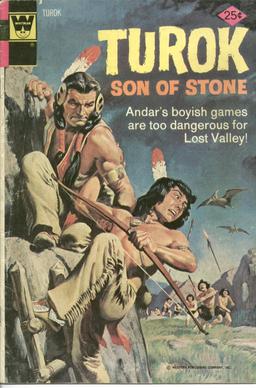
"Turok, Son of Stone" truly ennobled Native Americans

The cesspool of 1970s thinking suggested that comic books were trash. A college professor would scoff at this literary form and scoff at my use of the term "literary form."
The intelligentsia of our society scoffed at a great many things in that era. I remember a professor scoffing at the "Hardy Boys" series of books for kids. Let's not forget "Tom Swift" too. If something was commercially popular, it was scoffed at. The voices of common sense seemed muffled in the 1970s.
Perhaps my criticism is directed mainly at college campuses. But perhaps our whole society was adrift to a degree, burned by the Viet Nam War and other troubling things (stagflation?).
In the current age in which we're all empowered by tech and the Internet to impress our own ideas, we can unabashedly state what we like. I'd like to trumpet the quality and imagination behind "Turok, Son of Stone." It was an adolescent delight of mine to follow this Gold Key comic. I can't quite shake some of the old defensiveness talking about this. A comic book? To heck with the defensiveness. Comics like "Turok" and "Magnus, Robot Fighter" did a lot to advance my literacy in my youth. Such entertainment outside the classroom was indispensable.
A progressive college teacher from those old days should actually have been impressed by "Turok." Let's examine why. We see Turok, a wise father figure type of man, with his youthful brother Andar, trapped within danger. Somehow these Indians have ended up in an isolated valley that is a total world apart. It's Jurassic Park many years before the novelist Michael Crichton gave us that story. Jurassic Park totally captivated us with the concept of humans among dinosaurs. That story theme was anything but new.
Many kids became fascinated as Turok and Andar made their way among creatures they called "honkers, hoppers, flyers and sea demons." The velociraptor which came to be so well-known through "Jurassic Park," was called a "screamer."
College teachers of yore would admire the resilience of Turok and Andar who are pre-Columbian Indians. The indigenous civilizations are as-yet undisrupted. Turok and Andar are Kiowa Indians.
In total contrast with traditional popular entertainment which has Indians disadvantaged because of their "primitiveness," Turok and Andar are actually more advanced than the other humans they come upon. The Lost Valley has humans that are early in the ladder of development. They are dangerous. While I'm not sure they were actually cannibals, they remind me of the cannibals in the Robinson Crusoe story. You get the feeling that even though Crusoe is seeing other humans, he isn't, really. He's still isolated.
Turok and Andar get no comfort being around these other humans. The two have wandered into a savage prehistoric land they call Lost Valley and are cut off from their homeland and people. They wander, encountering cave men and hungry prehistoric creatures, trying to get out.
Our heroic Kiowa warriors adapt, discovering toxic berries which they can smear on the tips of their arrows, stunning and killing even the nastiest dinosaurs. The berries seemed to work almost too well, becoming a magical, almost instant way of stopping those big, dangerous beasts.
I have stated before that the artwork for many comic book covers, "Turok" a prime example, was terrific. It would be effective as stand-alone art. Of course, college art teachers, at least the ones I remember, would be harrumphing and even laughing. The profs I remember laughed at a lot of things, especially if it came from popular culture like Leroy Nieman. I think today, those instincts have lessened. Our teachers have changed through either pressure or enlightenment, to respect art and culture that may have been parlayed into profit for the creators.
Artist Alberto Gioletti did a lot of the work with "Turok, Son of Stone." We can credit Paul S. Newman, not to be confused with the actor, for a lot of the writing. Newman was a wellspring of creativity for the comic book industry. "Turok" was his longest-running series, of 26 years.
I am most familiar with the Turok storyline as it existed in the 1960s. It did get some major tweaks or revising through the years. Gold Key was one of several publishers handling Turok, the others including Dell, Whitman, Valiant, Dark Horse and Acclaim. The whole story had such staying power, I'm disappointed it couldn't leap onto the big screen with the same acclaim as what greeted "Jurassic Park."
"Turok" is a story empowering Native Americans, showing them at the top rather than lower down on the developmental ladder. It shows them industrious and resilient as Native Americans having no distraction of Europeans around them. This is North America in its proud, unadulterated, long-ago incarnation. Whites not only had an invasive effect, they spread disease, wiping out huge swaths of the indigenous people.
Turok and Andar are pure heroes. They come across as compassionate too.
How did the seeds get planted for this story? Why come up with a premise of two Indians in a "lost world" of dinosaurs? The mind of Gaylord DuBois can be credited. He visited the Carlsbad Caverns of New Mexico and became intrigued. He came to envision his "lost valley" which he in fact placed in New Mexico.
DuBois was an early writer for "Turok, Son of Stone." My, his idea had staying power. By the 1990s, when I of course had become detached from comic books, "Turok" had taken on quite a different tone and backdrop as a "Valiant" publishing line character. Now our heroes are surrounded by demons, dinosaurs and even space aliens! The concept of time itself is different in this land. Time has no meaning! We learn of a cosmic anomaly that has time moving in a self-contained loop. Millions of years pass in the outside world, while inside, time barely moves! There's a villain called "Mothergod" who operates out of the "lost lands."
The story seems to get a little crazy, as this "mothergod" outfits dinosaurs with intelligence-boosting implants! They become "bionisaurs" (the actual term used, not passing spell-check of course). At this point I might not blame a college prof or anyone else chuckling a little. But this is not the "Turok" that I came to know and enjoy.
The Valiant comic incarnation has a "final battle" between Mothergod and the Valiant Universe heroes. The lost lands begin to fade away. Our friends Turok and Andar are tossed into a post-apocalyptic "future Earth," and a group of bionisaurs makes this transition with them. If you think all this sounds like a drug-infused fantasy, I won't blame you. Perhaps a whole new generation of youth - and of course, generations think differently - understands and was captivated by the new premise. I'm left behind, I guess, preferring the more conventional framework of storytelling as represented by the 1960s Gold Key chapter.
Continuing with the Valiant incarnation, Turok and Andar become hunters contending with demons and aliens that exist in the future world. We also see "high-tech future warriors." Mothergod has succeeded to a large extent and is trying to hunt down our heroic Turok and Andar. Amazing imagination! The college profs who always used to admire literature that was socially uplifting and enlightening, should have seen merit in the comic book. But it was a comic book. The knee-jerk reaction among them would be to show derision. A pox on them.
The likes of Turok and Andar along with Magnus of the "Magnus, Robot Fighter" comic series, enriched my youth and greatly advanced my grasp of writing and the English language. This went light years beyond any "suggested literature" put forth not only by college teachers but by public school teachers. How else would I know the definition of "snafu" or "doomed?"
Another favorite of mine was the "Sergeant Rock" series based on World War II. Remember the machine guns that would go "rat-tat-tat?" I'm a little ashamed remembering Sergeant Rock because WWII reflected so much of the dark side of human nature, and it was real, not the wild product of a writer's imagination like "Future Earth" with bionisaurs.
Comic books were an essential, actually indispensable part of the literacy strides I made as a kid. I am unabashed talking about it. And I don't give a darn about what the intelligentsia in our society (less empowered today) thinks about it. Turok and Andar were amazing. "Turok, Son of Stone" remains impressed on my mind.
Trivia question: What sound did the dinosaurs often make? Answer: "Runk." Oh, and what sound did the robots in "Magnus, Robot Fighter" make when they were being beaten? Answer: "Squeee!" Sometime in the future I'll write about "Space Family Robinson" too (similar but distinct from "Lost in Space").
- Brian Williams - morris mn minnesota - bwilly73@yahoo.com