History-making music group for UMM - morris mn

History-making music group for UMM - morris mn
The UMM men's chorus opened the Minnesota Day program at the 1962 Seattle World's Fair (Century 21 Exposition).

Wednesday, February 17, 2016

Austin VerSteeg's '3' wins for Minnewaska over Tigers

Minnewaska Area 47, Tigers 46
The Tigers' home game against Minnewaska Area last Thursday (2/11) had a dramatic ending. It was not the kind of ending that had the home fans standing up and cheering. No, it was the Minnewaska Area fans who whooped when their Austin VerSteeg connected on a fadeaway '3'. The time remaining: nine seconds. It was the game-winner.
The Lakers came away with a 47-46 win over our Tigers. The win for 'Waska was good therapy for them: they had been on a skid, losing five of six leading into the Thursday contest. The skid didn't hurt the Lakers' record much. They came out of Thursday with a 16-7 record (6-6 conference). Our Tigers stayed over .500 too at 13-10 (a sub-.500 mark in league at 6-7).
Eric Staebler did all he could trying to prod the Tigers to victory, as he made four 3-pointers - quite the exhibition. He was complemented by these three Tigers each of whom made one '3': Robert Rohloff, Jacob Zosel and Camden Arndt. Staebler topped the scoring list as he often does, this time with 22 points, the only Tiger in double figures. Cam Arndt put in nine points. Then we have Zosel (6), Tim Travis (4), Rohloff (3) and Philip Anderson (2).
Staebler led the rebounding effort with 13. Zosel had four assists and Rohloff had three. Arndt stole the ball twice. We trailed by one point at halftime, 19-18.
The winning 'Waska effort was paced by two Lakers each with 14 points: Matt McIver and Austin VerSteeg. Greg Helander scored eight points, then we have Brandon French (4), Michael Gruber (3), Justin Amundson (2) and Jake Peters (2). Gruber, McIver and VerSteeg each made a three-pointer. VerSteeg snared seven rebounds. McIver set the pace in assists (3), and it was VerSteeg topping the steal effort with three. (I always wonder if there should be a space between "Ver" and "Steeg." I've seen it both ways.)
 
Breckenridge 74, Tigers 72
Another hard-fought game developed for Morris Area Chokio Alberta on Saturday, as they continued a pattern of playing on Saturday often this season. I'm not sure I like it. The frequent games seem to turn into a blur sometimes. On Saturday, Feb. 13, the Tigers dropped another close one. A fine Breckenridge team got its 14th win by a margin of two over our orange and black. The final horn sounded with the score 74-72. The score was deadlocked 32-32 halfway through this non-conference affair.
Breck was a prime district-level rival of our Tigers in my youth. We'd get irritated by that "green" color!
Eric Staebler kept demonstrating what an offensive force he can be. He poured in 25 points but it wasn't quite enough. Camden Arndt was quite on the mark with his offensive execution. Camden's point total: 21. Philip Anderson climbed into double figures with his ten points. Jacob Zosel put in eight points, then we have Tim Travis (4), Connor Koebernick (2) and Lukus Manska (2). Oh, this game was played in Morris. Let's enliven an otherwise sleepy Saturday!
Staebler made ten of 14 field goal attempts. Arndt was seven of 13. Zosel made two 3-pointers. Arndt and Staebler each made one long-ranger. We were four of 16 in three-point shooting. In freethrows our numbers were 12 of 17.
It was Arndt topping the list in rebounds with eleven. Staebler and Travis each collected nine rebounds. The top assist producer was Zosel with eight, and Travis had five. Rohloff, Arndt, and Staebler each had one steal.
 
Morris newspaper under duress?
This past Saturday's Morris newspaper was 22 pages, two less than the usual. The surprising thing is that this edition included the two tax pages, so you'd think they could actually bump up the size of the paper. But no, it's shrinking evermore, steadily, and should we really be surprised? Coborn's left us several years ago. Morris Auto Plaza deserted us for Alexandria. Cullen's closed up shop here. And then another significant advertiser, Thrifty White Drug, basically deserted us, downsizing to a degree that it's a tiny shadow of its former self.
It seems Thrifty White Drug pulled the rug out from under this community. It left a void in our main street, to be sure. The old drugstores were places that attracted a good amount of people traffic - you'd bump into your neighbors there and say "hello." No, it's a wasteland now. We can all go to Alexandria to be around people, including former Morris residents.
Let's all support the ShopKo pharmacy. The Morris newspaper still has "ad salespeople?" What are they selling?
- Brian Williams - morris mn minnesota - bwilly73@yahoo.com

Monday, February 8, 2016

Jesus Alou came along when name was an issue

I enjoyed the publication "Baseball Digest" in my youth. It was a collection of human interest articles about major league baseball. The publication appealed to true readers, not people who were turned on by lots of pictures and graphics.
I came across an article about the youngest of the three Alou brothers one day. I think I can remember the headline word-for-word. Surely this is the gist of it: "The newest Alou presents a problem." My, what was this problem? His first name was "Jesus." Several players with that name have come into the major leagues since. Jesus Alou was the first. Today we think nothing of the name, just like we think nothing of all the non-Anglo names that have become common in pro sports.
Let's backtrack to the 1950s and early '60s: major league baseball had what some people would call a "white bread" look, like an extension of "Father Knows Best" or other like shows, described by one cultural observer as "benevolent Aryan melodramas." Anglo names predominated.
I would suggest that big league ball was more of a dichotomy: the prevailing white players with names like "Bob Allison," and of course the black or "Negro" players who made inroads (not good enough, I'm sure) in the 1950s. The dichotomy in our society allowed the Jim Crow system in America's South. Being able to clearly differentiate between "white" and "black" made the system serviceable in its ugly way.
Society was of course headed toward change. the dichotomy was going to break down. The human race in the U.S. was going to become much more diversified.
Jesus Alou was part of the first great wave of Dominican players who came to the major leagues. Jesus was the 13th player with this background to join the bigs. His first name is not connected to the Christian savior. It's not pronounced that way either. The pronunciation is "hay-SOOS." The writer of the article in Baseball Digest was concerned about that first name, its identical spelling to the Savior. He was not alone. I am not going to fault him for his thinking at the time. Ethnocentric attitudes must often be considered in the context of the times. I must admit I wrinkled my forehead when first seeing the name.
 
Reacting to "different" names
Non-Anglo-sounding names often had us young white kids wrinkle our foreheads. Unfortunately we'd often react in a smart-aleck teasing way about such names. We might want to mock. Such was the outlook us boomer kids would have. We're ashamed reflecting on that now. We might not want to admit we reacted with amusement to the name "Bombo Rivera." Rivera was a Twin, remember? I remember a cringeworthy headline in the Star Tribune: "Bombo, Twins bomb Seattle." Ugh. first off, it's disrespectful in a headline to have a reference to someone by his first name. We all know what the paper was up to: finding levity in a name that seemed foreign to us. I seem to recall a Bombo Rivera fan club forming on the Twin Cities campus of the University of Minnesota. It would not have existed were it not for the then-novelty of his first name.
These non-Anglo players must have felt offended and hurt. "What a strange land we're in now." Indeed, strangers in a strange land.
American writers and broadcasters were uncomfortable with the "Jesus" name, even though it was pronounced so separately from the Bible person. I read about this issue in Jim Bouton's seminal book "Ball Four." Bouton was a teammate of Jesus on the Houston Astros late in the 1969 season. Given that Bouton was a character with a "back of the bus" sense about things, he and his like fellows called the Dominican fellow "Jesus" with pronunciation like the Savior, or just "Jay." It seemed to be not out of dislike at all, rather it was out of a feeling of fun or irreverence.
I refer to "Ball Four" as seminal because it was a pioneering sports book that presented athletes as multi-dimensional human beings with faults.
Bouton informed us that Jesus was sensitive in the sense he might get sick or throw up easily. So when Doug Rader presented a birthday cake to someone in the clubhouse, a cake apparently decorated with a fake turd, Jesus had to run to the bathroom stall and throw up when everyone discovered that the turd wasn't fake! Rader then commented that he was "trying for a bow" with his decoration but that "I didn't make it." I think clubhouses are more serious places today. There's more money in baseball.
Baseball today is also a virtual rainbow of races, ethnicities and names. None of this turns heads anymore. "Father Knows Best" tried introducing us to multi-ethnic thinking with its Hispanic character "Frank Smith," remember? Well, the name wasn't ethnic.
 
Resistance to the name, but happy ending
When Jesus was about to begin his first season with the San Francisco Giants, a local writer asked local religious leaders about the situation. They all agreed he needed a nickname. They couldn't stomach a newspaper headline like "Jesus saves Giants." Writers often opted to call the young man "Jay."
In 1965 the player was quoted saying "what is wrong with my real name, Jesus? It is a common name in Latin America like Joe or Tom or Frank in the United States. My parents named me Jesus and I am proud of my name."
It took time, but by the end of his career, no one had any reservations about his real name anymore. Happy ending.
Jesus was one of three famous brothers to play in big league ball. There is an issue or quirk with the last name too. It should have been "Rojas" as in "Cookie Rojas" who I remember with the Philadelphia Phillies. Cookie played in the same infield as Bobby Wine, thus one clever writer came up with "days of Wine and Rojas." Rimshot.
Let's look at the "Alou" name issue: The family name in the Dominican Republic is the paternal family name. Jesus, Matty and Felipe should have been known as "Rojas." But, eldest brother Felipe and hence his brothers became known by the name "Alou" when the Giants' scout who signed Felipe mistakenly thought his matronym, "Alou," was his surname. The Rojas Alou brothers' maternal grandfather, Mateu Alou, was an immigrant from Felanitx, Spain, who emigrated to the Dominican Republic in 1898.
Felipe was the first Dominican to play regularly in the major leagues. Moises Alou is Felipe's son. Jesus had a 15-year baseball career, playing for the Giants, Astros, Athletics and Mets. He was a fine player but with one notable weakness: no inclination to draw walks at all. They say "a walk is as good as a hit" but that's not exactly true. A walk puts you in position to score but it can't drive in runners from second and third.
On July 10 of 1964, Jesus went six-for-six with five singles and a home run. He had a tic when batting: jerking his neck, which he said was just a mental thing. Such are the kind of things we remember about our old baseball heroes.
Jesus was a very friendly and sensitive player who teams just liked having around. Even in the midst of gags like with the birthday cake.
 
Addendum: When my ninth grade French teacher wanted us to adopt French names, I was read a list and picked "Philippe" because it sounded like "Felipe" of the Alou brothers! I didn't realize until later the spelling was different.
 
- Brian Williams - morris mn Minnesota - bwilly73@yahoo.com

Tuesday, February 2, 2016

Let's revive memory of "Doc" Ederer, gifted author

Dr. B.F. Ederer
I had the pleasure of meeting Dr. Bernard Ederer in the 1980s. His hair was white but his mind was sharp. I met him at an event at the Morris American Legion. "Doc" was a life member of our Post 29 of the Legion.
I became familiar with the dentist/author in my youth. Our family obtained his book "Birch Coulie" from either the public or school library. It is a terrific historical novel. It tells about the Dakota War of 1862.
Ederer's choice of spelling, "Coulie," has not taken over. "Birch Coulee" has become the norm. The spelling issue might stand in the way of Ederer's book being discovered easily. Ederer could not have foreseen the Internet. Precise spelling is of course helpful when using search engines. "Birch Coulie" isn't likely to get high placement on search pages, when the preferred spelling has become "Coulee."
Ederer argued for his spelling in his book's preface. He quoted "the Honorable Chas. Flandreau," identified as a writer:
 
The French verb couler, to run, indicates a slow, trickling stream in a ravine, and wherever such rivulets were found, the voyageurs called the ravine a "coulie," probably a "coulee" as pronounced by them. There is no authority that I can find that justifies the spelling of the word "coolie." I therefore take the liberty of using what I regard as the true spelling: "coulie." I regard the battle of Birch Coulie to be one of the most desperate Indian encounters that ever occurred on the American continent.
 
Jim McRoberts is a long-time Morris resident who remembers the author well. His references to the man as "Doc Ederer" make me want to call him that too. It makes the doctor sound agreeable which I found he definitely was. He practiced dentistry in Morris at a time when I'm sure I wouldn't have looked forward to seeing the dentist. He provided a valued service to be sure. Oh, and he was a lawmaker. He represented our area in the Minnesota legislature from Jan. 5, 1943, to Jan. 1, 1945. He served in the U.S. Navy Reserve as a Lieutenant in World War II.
This fascinating fellow was born in Morton MN just as the new century dawned, on Jan. 20, 1900. His occupation, as given in his legislative bio, was: "dentist, arctic explorer, lecturer and author." Quite consistent with Ernest Hemingway.
  
Toward lure of the sun belt
We need a little reminder of Dr. B.F. Ederer's significance in Morris history, IMHO. He did leave Morris for warmer climes. Our local media reported in 1957 that he was a "former Morris dentist now living in California." "Birch Coulie" was coming out at that time, published by Exposition Press Inc. of New York.
Another book by Dr. Ederer
Ederer had his first book published in 1940: "Hunting the White-Tailed Deer." This book was published by University of Minnesota Press. His second book, "Through Alaska's Back Door," was published in 1954 by Vantage Press of New York. "Birch Coulie" was book No. 3 (1957), and finally his fourth and final offering, "Bingo, Gallant Reindeer Dog" in 1977, published by Exposition Press. How could the "Bingo" book be anything but a total delight?
Ederer wrote his significant historical novel "Birch Coulie" well before the age of political correctness. Today we're in an age where Native American logos/mascots are being eradicated at schools, quite appropriately. "Doc" was an enlightened and compassionate man, sad for the losses on both sides of the conflict, and his first childhood friend was a Native American. Yet he doesn't always use the most delicate language. This may hinder the book in the contemporary environment. But you cannot find a better way to gain insights into the Dakota conflict, than to read "Doc" Ederer's "Birch Coulie."
The author had strong personal interest in his subject. He in fact was born at Birch Coulie, first seat of government in Renville County. His grandfather Francis Ederer homesteaded there. Francis brought his family from Wisconsin to Minnesota in a covered wagon shortly after the conflict. He "settled upon one of the knolls upon which the Sioux chiefs had sat upon their horses while they planned the attack on the Fort Ridgely wagon train," we read in the preface.
Continuing:
 
It was in a log cabin on this hill that my father and his brother and sisters were born. In 1900, upon this old Indian lookout, now called Woodside Farm because of the acres of cottonwood trees planted by my grandfather, I arrived on the scene. When I started school in the little village of Morton, it was fitting that my first acquaintance and friend should be a Sioux Indian, Andy Goodthunder. Through the years I learned much about the Sioux from Andy and his Sioux relatives, especially Charlie Goodthunder, adopted son of Chief Goodthunder.
As a boy I had my opportunities to sit spellbound in our farm kitchen while visitors, many of them survivors of the "Outbreak," related their harrowing experiences. I can well remember helping move the mass of horse bones from the battlefield of Birch Coulie so that corn could be planted on the "hallowed ground." It was my privilege to meet and talk to men like J.J. Egan and Bob Boyd who came to visit the battlefield. From them I added to my store of incidents about the Outbreak. Knowing them inspired me to continue looking for more data. I memorized the legend on every granite marker, placed by the Renville County Historical Society on nearly every important site.
 
A simple glance at random pages of "Birch Coulie" reveals that Dr. B.F. Ederer was a master of words - a gifted writer. I'd love to have such talent with writing fiction style.
(Some of my detractors might say I often write "fiction" (LOL). Del Sarlette once feigned ignorance by saying "go out to de barn and get de tractor?")
 
Mid-19th Century: much bloodshed
The Dakota conflict was massive and tragic. It is upstaged in historical annals by the U.S. Civil War that engulfed the eastern states. How young was our nation? When you're referring to the western theater of the Civil War, you're referring to Tennessee! But here in Minnesota, the advancement of white civilization was quite underway. The schism of civilizations brought bloodshed.
Am I correct in saying the term "Sioux" has been phased out in favor of "Dakota?" Am I correct there is no grounds for ever using the term "squaw" in historical writings? Is it taboo today to refer to efforts to "civilize" the Indians? Should we even say "Indians?" "Redskins" is off the table.
Our language evolves as do all our cultural understandings. Like it or not, history is a messy story of the strong exploiting the weak. We cannot erase certain things because of their unpleasantness. I read this argument once in connection with historical preservation efforts at Fort Snelling. The fort is in fact iconic in Minnesota history regardless of insensitive things that were perpetrated.
I strongly recommend Ederer's "Birch Coulie" even if some cultural rough edges might be evidenced there. You get a taste of the suspense in "Birch Coulie" by reading a sample passage I'll share here. You'll see the word "roan" in the first sentence, a reference to a type of horse. "Doc" was young at a time when horse travel was still common, and the terms for such travel were many and various. Please read:
 
The hoofbeats of Hugh's swift roan had kept cadence with the distant drums all the way from Birch Coulie, but Hugh's heart pounded double time as he hastily dismounted before Wapasha's tepee and lifted the tent flap to enter.
The chief and his squaw were seated before their smoky little fire, puffing on their pipes. Winona and Little Deer sat together in the shadows, their hands clasped tightly in their laps.
Hugh extended his hand, palm outward, in greeting.
"Ho, friend Brandon," Wapasha said, offering him his pipe.
Hugh accepted it and puffed on it once for courtesy. He returned it, and squatted beside the fire on his heels, resting his elbows on his knees. He glanced around at the blank, still faces of the little group and then asked, "What is the meaning of the war drums?"
Wapasha replied stiffly, "You have nothing to fear, my friend. It is good you are here. I have spoken to my village this night, urging them to keep the peace. They see you here, they will be more willing to heed my words."
Hugh understood that shame and foreboding made Wapasha answer his question evasively, but he persisted, "Wapasha's village will keep peace then. But what about the war drums in Little Crow's village?"
Heavily, Wapasha confessed, "I do not know. Many of my braves have gone to the Soldier's Lodge at Little Crow's village. I think maybe Cut Nose has fire-water there. I do not know what the war drums will mean."
 
Here's another gripping sample. Now, wouldn't you want to read the whole book?
 
The charging Sioux presented a formidable spectacle to the few defenders of the corral. Most of the Sioux were on foot, some wearing blankets around them. Those on horseback carried lances topped with many-colored streamers. The horses and riders were bedecked in bright colors. The full war regalia added to the awful pageantry.
"There they come!" Captain Grant said clearly and calmly. "Give it to them when I say 'fire!' "
The air resounded in the bloodcurdling war whoops, the pounding of horses' hoofs on the prairie, the crackle of Indian rifles. The prairie appeared alive with moving Sioux.
Strangely silent, the corral made up of overturned wagons and bloated carcasses of horses seemed pitifully inadequate to stop such a surge of humanity.
Hugh clutched his revolver. Ole's lay beside him. The Indians were closer now. He could see the hideous war paint on their faces.
"Fire!" Captain Grant shouted.
The big rifles belched flame. Pistol fire rattled. Before the smoke had lifted, another volley poured into the charging redskins.
It was more than the Indians could take. They broke and fled.
"By God! That was splendid!" Hugh heard Captain Anderson say.
Hugh agreed. But it had taken most of the ammunition, he knew. The order came around to fire only when sure of a target.
The Indians were apparently having difficulty regrouping their forces. They stayed at a safe distance from the corral.
 
The battle of Birch Coulie (or Coulee) happened on September 2, 1862. It was the most deadly battle for the U.S. in the Dakota War of 1862. The battlefield is listed on the U.S. National Register of Historic Places.
Online searches about Doc Ederer reveal rather spotty and limited information. In addition to the "Coulie" vs. "Coulee" issue, there is the question of how exactly to refer to the author, as he commonly went by "B.F. Ederer." You can also search with "Bernard Ederer" or "Bernard Francis Ederer."
He gained his post-high school education at Creighton University (Omaha NE) and Marquette University. His legislative bio reports Clara (Wendling) as his first wife and Antonette as his second. His obit in 1992 refers to Toni as his spouse. He passed away in January of 1992 at the age of 91 in California. Funeral services were on January 19, 1992, in Bonita CA with interment in San Diego.
I thank Melissa Yauk, Morris Public Library director, for assistance in research for this post. She retrieved the book "Birch Coulie" from the back room. She noted "someone thought enough of this book to have it re-bound." There is a library display where this book would fit right in. Now that she knows of Ederer's importance with Morris, maybe we'll see his books readily available there. I don't know if they have "Bingo, Gallant Reindeer Dog." But what an irresistible book to pick out for your child. Sounds like it'd make a good Walt Disney movie.
I treasure the encounter I had with the fascinating author at our Morris Legion Club. I haven't been able to pin down how many years "Doc" was in Morris. His too-brief obit appeared in the Morris newspaper. It would be great if a comprehensive biography could be posted sometime. I would not have been overjoyed visiting him in his dentist's role, unless maybe I took a swig of alcoholic beverage first. A root canal in the 1930s or '40s would be arduous, surely. But I'm sure Ederer's standards were the highest, just like how he crafted his books. I wish he had written more.
Dr. B.F. Ederer, RIP. I hope you're with your childhood Sioux (or Dakotah) friend in heaven. We appreciate your life-long support of our Post 29 of the Legion.
- Brian Williams - morris mn Minnesota - bwilly73@yahoo.com

Friday, January 22, 2016

Becca Holland makes three 3's in road triumph

Tigers 58, ACGC 42
MACA gained its fifth win in WCC play Tuesday evening (1/19) at ACGC. It took a strong second half. In the first it was the Falcons of Atwater-Cosmos-Grove City with the edge. The halftime score was 26-23 with ACGC having that three-point edge. The second half was a different story. Coach Dale Henrich's squad surged to score 35 points compared to 16 by the host. MACA improved to 5-2 in conference play with this 58-42 victory.
Becca Holland was an offensive force, making three shots from 3-point range. Becca scored a team-high 17 points. Ashley Solvie scored 13 points to sit at No. 2 on the list. Also contributing were Correy Hickman (9), Moira McNally (8), Riley Decker (7) and Nicole Solvie (4).
Holland was joined on the three-pointer list by Decker (two makes) and Hickman (1). Holland set the pace in rebounds with eight followed by Ashley Solvie with six. Hickman passed deftly to get nine assists. She and Jenna Howden each stole the ball four times.
Hannah Wilner and Kendra Miller stood out on the ACGC scoring list with 16 and 15 points, respectively. Miller sank three shots from 3-point range, while Maree Lee made one long-ranger. Wilner led the Falcons in rebounds with nine, and Lee was tops in assists with seven.
 
Boys: Tigers 59, Benson 56
The MACA boys impressed with their Tuesday play as well. The boys' story was a 59-56 win over the Braves of Benson, at Benson. The success put us back at .500 in conference play.
MACA got the edge it needed in the first half as we outscored Benson 34-31. The Tigers marked time through the second half which was a 25-25 stalemate.
Jacob Zosel was dead-on from three-point range. Jacob sank three long-rangers and scored 15 points. Eric Staebler made two 3-point shots and scored a team-best 23 points. Lukus Manska had one 3-point make and scored five points. Camden Arndt added eight points to the mix. Sean Amundson and Robert Rohloff each put in four points.
Staebler led in rebounds with 13 while Arndt collected six. Three Tigers each had one assist: Rohloff, Arndt and Staebler. Staebler contributed a steal.
The Benson scoring list was topped by Adam Lindahl with 20 points. Zack Sonnabend had double figures too with 14. Layton Connelly, Adam Lindahl and Josh Manzke each made a 3-pointer.
Special note: the scoring list in the Willmar newspaper has two "Adam Lindahls," so I don't know what's up. The paper reports someone named "An. Lindahl" leading in rebounds with seven. Then there's "Ad. Lindahl" leading in assists with two. In steals it was "An. Lindahl" with four and "Ad. Lindahl" with three. Strange. Can't they just type out the full name? It certainly can't be a space issue. I used to wonder about this with the Holland girls of Morris: Beth and Becca. Just type the full name.
The Tigers came out of the night at 10-6 in overall won-lost, 4-4 in conference. Benson is below .500.
 
Girls: Montevideo 46, Tigers 43
Fans at the home gym saw a hard-fought game between our Tigers and the Thunder Hawks of Montevideo on Thursday (1/21). Neither team could get a sense of command in this WCC hoops contest. The Monte girls had the edge at the end. The Thunder Hawks prevailed in the 46-43 final score at the MAHS gym.
Monte is having a fine season and came away with its ninth win. The Tigers came away with a 7-9 overall record.
A sense of drama gripped fans at the end, as MACA had a chance to tie with a three-point shot. The shot rimmed off. Monte led 28-26 at halftime and outscored the Tigers 18-17 in the second half.
The MACA scoring list showed balance. Here are the totals: Becca Holland (11), Ashley Solvie (10), Riley Decker (8), Correy Hickman (7), Moira McNally (5) and Nicole Solvie (2). Decker made two 3-point shots followed by Holland and Hickman each with one. McNally led in rebounds with ten followed by Ashley Solvie with eight. Hickman had three assists and Decker had two. Holland was aggressive to accumulate five steals, while Decker had two.
Monte's Abby Olson scored 13 points. She made one 3-pointer as did teammate Nikki Erickson. Ashley McKee was the top T-Hawk rebounder with eleven. Olson was team-best in assists (4) and steals (4).
- Brian Williams - morris mn minnesota - bwilly73@yahoo.com

Wednesday, January 20, 2016

On Don Riley, powerball, "car clumps" and et cetera

Our Morris MN water tower is a true landmark.
Here's another of my anthology posts, or what the original host of "Jeopardy" would have called "Bits and Pieces." Much of this stuff appeared on "I Love Morris" on an addendum basis with youth sports reviews. Our Tigers help make the winter shorter. Thanks so much for visiting and reading. - BW
 
Remembering "Eye Opener" (published January 18 on "I Love Morris")
We lost Don Riley recently. I don't expect many young people or young adults to remember the old scribe. He had a popular and idiosyncratic column in the St. Paul Pioneer Press. On many an afternoon I'd buy the St. Paul paper at the student center at St. Cloud State, mainly so I could read Riley's "Eye Opener" column in sports.
You could expect humor. You could expect irreverence. You could also expect politically incorrect assertions, certainly by today's standards. Riley covered women's golf as if his only interest was in the athletes' looks. The criterion was of the type you'd expect as applied by the Dean Martin Variety Hour.
I remember him writing of women golfers: "My God but they're ungainly and crude." He picked out Laura Baugh as a nice sexy exception, and said of this blonde: "She's the only one I'd care to share a rhumba with." Try getting that past a copy desk today.
Women's athletics in general was a novelty that the well-established sportswriters of the time just didn't know how to handle. The one thing they had trouble doing was writing about female athletes like they wrote about all other athletes. And when they did start taking it seriously, they could still be condescending at times. They couldn't keep from attaching an asterisk of sorts to women's sports.
I remember myself, being surprised that female hoops players could even make 3-point shots. Mary Holmberg would want to bang me over the head for sharing that memory.
Don Riley had these offbeat subheads in his column that could be such a delight: "I'll talk, you listen." "Scatter-gunning from the catbird's seat." "Behind the lockers." "Don't print that." I remember coaxing Bart Hill to use one or two of these in his youth baseball submissions to me at the Morris paper in the1980s!
Riley set up this amusing adversarial relationship with Wisconsin and the Green Bay Packers. It was faux teasing and anger, of course. He just seized on a rivalry. He would sometimes publish angry feedback from a Wisconsin fan, and then react with his own (faux) vitriol. He'd respond by saying, for example: "And you'll love the view at Happy Acres." Of course that's politically incorrect humor too.
Yes, it was a more innocent and naive time in the history of our civilization. We worshipped the Vikings back then in the 1970s. We didn't know those poor men were being physically and mentally hurt to such a great degree by their sport. Fred McNeill the linebacker recently died because of degenerative brain problems. Alzheimer's or CTE? Lou Gehrig may not have died from Lou Gehrig's Disease.
The Star Tribune has had some long-time survivors from that era. I wonder if Sid Hartman has a ghostwriter today. At least there must be a very vigilant editor. Sid is at a very advanced age and should just be enjoying retirement. He has stayed at the dance too long, just like Herb Carneal did. Some people just cannot let go.
Patrick Reusse is a holdover from the Riley era, and he often strikes me as a throwback with his cynicism and incisive eye. My generation when young understood and accepted that cynicism and frankness. Young people of today who have studied "conflict resolution" are far less understanding. Today's youth are encouraged to be "glass half full" types. It was impossible to be like that in the age of the Viet Nam war.
Don Riley belongs in another age. He did give spice during that age. Don Riley RIP.
 
Powerball adventure (published January 14 on "I Love Morris")
Why does the Powerball have to have such a high jackpot? Instead of one staggeringly big prize, why not split it up so you create a whole bunch of millionaires? In theory this argument is so strong. But the people who run these things know better: the one astronomical prize has an allure that attracts all the suckers, excuse me, "customers."
I once knew Willie Martin well so I'm inclined to use the word "astronomical." Maybe I should say "super astronomical." Willie would say "have a super astronomical day." I don't think he'd be fond of the Powerball, a phenomenon that maybe says something about the desperation of living in America. We buy into an elusive dream, a dream as likely to come alive for us as seeing a unicorn.
Morris native Dom Klyve reminds of the futility of buying tickets. Klyve is a mathematical genius, quite the opposite of yours truly. I reject the Powerball on the basis of common sense. Klyve can help us reject it using numbers logic. Dom's father Bill used to arrange for me to come and cover Pheasants Forever banquets.
I once worked with Dom's mother Lynn at the Morris Sun Tribune. Lynn said "good morning" to me in a way that made me feel more buoyant than anything in the world. Those times are gone with the wind now. Lynn once said that years hence, "no one will remember I worked at the Sun Tribune." Well, I remember. She got attuned to the Internet early-on. She helped me learn the ropes. It was through emailing with Lynn that I learned that you can send and receive email from anywhere in the country, using a Yahoo or Gmail account. I was amazed discovering all this. I was so used to old, analog systems of communications. Finally I got "hip." Thanks Lynn.
Is it realistic to hope to win the Powerball? Is it realistic to hope to come in contact with space aliens?
"It's hard to come up with words for how unlikely this is," Dom Klyve of Central Washington University said. "You could try flipping a coin, calling it in the air, and your odds of getting it right 28 times in a row are better than your odds of winning the Powerball." Only one combination out of 292 million will win.
The more tickets you buy, the better the odds? Not by much, Klyve advises. If one person buys a single ticket while another person buys 20, Klyve says "they have a 20 times better chance of winning, but 20 times approximately zero is still approximately zero - neither of you are going to win tonight."
I remember the young prodigy Mr. Klyve working along the checkout line at Pamida in Morris. Pamida you'll remember was the predecessor to the more high-class ShopKo. Pamida was notorious for having such gaping potholes in the parking lot, it was dangerous. 
Dom has a sister Danika who you might remember too. Danika is in the TV media field in the Twin Cities. Each year I email a Christmas greeting to Lynn and I see that she gets a link to my new Christmas song. She has stopped answering those emails. I'm sure she's very busy. She's a good friend of Judy Diehl of Morris.
 
Christmas season intensifies (originally published on December 2 on "I Love Morris")
Christmas shines with its vitality between Thanksgiving and the magical date itself. When I was a kid, the day after Thanksgiving was considered a decent day to shop and it was just common sense. We saw no need to make a mania out of it: "Black Friday." And now we have "Cyber Monday" and "Small Business Saturday."
There's a person in Fargo leading an effort to get main street stores to be open on Sundays, all the time. It's about time someone made note of this. The big box stores with their substantial hardware departments are open on Sunday, while the traditional little main street hardware stores aren't. It's a head-scratcher. I suppose it's a reflection of blue laws, seen as more and more quaint.
The Morris newspaper prior to Black Friday was loaded with a ridiculous number of those ad circulars. This is a head-scratcher for me. The papers brag about how many circulars they are offering their customers. So I suppose it's good for the papers. But if I'm an individual advertiser, I'd be concerned that my circular would get lost in the shuffle. Who on earth is going to page through all that crap and then drive to Alexandria and spend hundreds of dollars all over the place? And if you did, would all that "stuff" really make you happy? 
It's odd because we now live in a time when communications are so easy and economical because of the electronic media. And yet we seem to be showered with those ad circulars more than ever. It seems environmentally stupid.
I suppose people still buy the Morris paper so they can see if anyone they know got a seat belt citation from police. It feeds the gossip mill and isn't good for much else. If enough people stopped buying the Morris paper, maybe it would just disappear.
 
A nice Thanksgiving regardless (published November 30 on "I Love Morris")
Our family had leftovers for Thanksgiving. We had sufficient food and we gave thanks for it. There was only one restaurant open in the Morris area for Thanksgiving, to my knowledge, but the price it charged for the meal was prohibitive. We would have enjoyed going for a reasonable price. Did they have a children's price?
I wonder how much food that restaurant had left over at the end of the day. I wonder what happened to it. Maybe in the future something could be worked out where the Senior Community Center kitchen could put out something for Thanksgiving. No point in that building just sitting there empty and locked up.
I'm at the senior center now typing this, recalling that last night we got a robocall notice that a big winter storm was moving in. Better stock up etc. It's around noon now and I see no sign of anything bad. Let's be careful that a "cry wolf" syndrome doesn't set in.
 
Here's a post from April 4, 2014, on "I Love Morris" that I feel is apt since our church, First Lutheran, canceled services this past Sunday, such is the wear and tear of winter on our souls.
We used to talk about Siberia like this. The weather has made our Upper Midwest seem a forlorn and desolate place.
We have had winters with more snow. But there is something about the sheer persistence of this past winter that has gotten into our psyche. It's something we can't even dismiss with the "sing-song" voice cadence revealed in the movie "Fargo." A new TV series continues the legend of "Fargo." It continues the themes of that movie but with all new characters and story line. Get ready for more of the "sing-song" voice. The voice cadence belies the burden we feel as Minnesotans, scraping ice off our windshield or walking over snow with the "crunching" sound underneath.
We kick the "car clumps" off the bottom of our vehicles. Sometimes we walk over snow that seems hard enough to support our weight, when suddenly we find it isn't quite that hard. We have to "extricate ourselves."
We talk about the weather like it's an ominous ghost that is about to inconvenience us again. Sometimes we look to the horizon and don't really see the horizon, we just see a shade of blue. The western Minnesota landscape becomes totally non-descript. A famous quote about Oakland CA is that "there is no 'there' there." Whoever said that should have driven from Glenwood to Sauk Centre this time of year.
Our ability to be in denial about the weather vicissitudes is tested. We use the sing-song voice to try to be upbeat about things that are happening in our community. We talk about church. We ruminate about our heating bill staying higher than it should be.
I have sworn that we aren't going to use our air conditioner this summer. However hot it gets, it'll be fine by me.
Keep in mind that the upcoming summer exists only in theory. We only assume it will come. We use faith to assume summer is coming. Stubborn patches of snow remain, which we learn to just disregard. The snow of early spring is ugly snow. The drifts get dirty. New snow is wet and disappears fast.
Calvin Griffith had to get used to Minnesota weather when he came here. Calvin brought major league baseball to Minnesota. Baseball symbolizes summer. He once recalled an early Saturday morning game his Twins had to play, in order to accommodate the Gophers football game that afternoon. The Twins were playing Detroit.
In the fifth inning the snow started cascading down. The game was called off. Calvin could have used the sing-song voice to indicate "life just goes on," or to change the subject. He recalled thinking to himself: "What the hell have I gotten us into out here in Minnesota."
Looking back years later, Calvin, the acclimated Minnesotan, said "Now I know better." (Us Minnesotans always "know better.") He added: "My memories are pleasant."
In 1962 when the Twins were in their second year, a storm on April 12 snowed out the opener vs. Los Angeles. The storm dumped a foot of snow on the southern two-thirds of the state. The Twin Cities recorded six inches by 6 p.m. on the 12th, making a total of 81.3 inches of snow for the year. Then on the 13th, we got the coldest April 13 on record. A look at the thermometer showed two degrees above zero early on the 13th.
In May of 1976, in the midst of those disco '70s, when we took in those "Smokey and the Bandit" movies, a Twins game was snowed out at Metropolitan Stadium. The Twins were marking Bat Day, a day of some annoyance if you sat under one of the decks. The boys loved it I'm sure. A quick spring storm left 1.2 inches of snow in the Twin Cities that morning. It was May so of course most of the snow was melted by game-time, but the field was soggy and there was snow on the shadowed ground.
These images inspired us to get the Metrodome built. The Metrodome was like a "Fortress of Solitude" (from "Superman") that we could present the world as a way of showing defiance vs. the weather elements.
We never want to admit we've been overcome by the weather. We're aware that there are times when it challenges us, when we come close to saying "uncle." We essentially hunker down.
We ensure the basic health and safety of all of us. School can get canceled or delayed often. When I was a kid and school got called off, the announcement was made on KMRS Radio which had a song all set to be played, beginning with the lyrics "That's what happiness is." That was probably the name of the song. Inspired by the Peanuts comic strip?
Us kids were happy when there was no school in the '60s. That's a politically incorrect attitude today. Today the kids are supposed to appreciate every minute they spend in school, as they are filled with knowledge helping them "succeed in the world of tomorrow," when in fact they'll enter a world ruled by corporate puppetmasters who won't want to pay them a dime more than necessary. The workplace of tomorrow will ironically be "dumbed down," ironic because we're telling ourselves that education (and college) are so important. Lemmings, we are.
We are dazed as we look back on the winter of 2013-14. Eventually we'll be able to put on those sandals and T-shirts. We swear we should have been able to do it by now. Before we know it, the University of Minnesota-Morris graduation will come and go, with a good chance it'll be held inside again. The UMM graduation has a bad track record with the weather.
The high school graduation will then come and go. By then the weather should be accommodative.
 
Sports suggestion (originally published April 4, 2014, on "I Love Morris")
I have made this point strongly before, that the early spring weather is unacceptable for trying to launch spring prep sports: baseball, softball, track.
Where there is a problem there is a solution. Let's have a one-month indoor season with the boys playing volleyball and girls playing floor hockey (unless you have better suggestions).
Then, in May the baseball and softball could begin and continue all the way through August, with the state High School League coordinating with the American Legion. Track would weave its way in somehow. But these early April games are so tentative on the schedule, it gets discouraging. You look at the game results and you see "PPD" next to several of the early games.
I once heard about the U of M-Duluth baseball team making the normal "southern trip" in early spring, like to Florida, but when they got back, weather was so uncooperative, they had to start getting in shape again before playing games.
Our athletic systems must adjust. More indoor sports would be a solution. A "post-season" wouldn't be necessary as the kids could just play within conference, the accent being on fun. That's a novel idea, isn't it?
 
Here's an email I sent to well-known media analyst Alan Mutter of the "Newsosaur" blog. He teaches at UC-Berkeley.
Quick note: I'm not Brian Williams the anchorman.
Hi Mr. Mutter: I enjoy reading "Newsosaur." I am a 1978 graduate of St. Cloud State University (MN) in mass communications and worked 27 years in the community press.
Here's a question: Is there one funeral home in the U.S., just one, that has contacted its local newspaper to say: "You can publish our obituaries if you want, but we aren't going to pay you." I think this would be a fascinating experiment. It was in about the year 2006 that papers and funeral homes all across the U.S. adopted this new system whereby funeral homes would take complete responsibility for writing obits, to the extent the papers aren't allowed to edit them - amazing - but then the papers would get paid to simply publish them. Yes, a "win win" for the papers: no need to pay an "obituary writer," plus they get paid. Nice work if you can find it. In the old days the obit writer position was sort of low status and you might grimace if doing it. It was a blessing that a writer could even be employed doing it.
I suspect funeral homes are under great pressure to keep prices down. The big trend is toward cremation and lower expense, for a variety of reasons that aren't pertinent here, except to accent how funeral homes are having to adjust. My Dad died three years ago and I don't want to tell you what it cost. Our family isn't going to pay that again, I guarantee you. So, might funeral homes not be as enthused about taking money from the grieving family and then relaying it to the newspaper?
Am I the only one asking these questions? A general economic collapse would intensify these pressures.
Topic No. 2: I don't think enough has been said about the tremendous economic boon for community newspapers in not having to pay for a photographic darkroom anymore. Those things were the epitome of "Rube Goldberg." Hell, I'd get a big thick catalogue from Cedar Falls IA just full of "junk" to buy for your photography and darkroom systems. And it's all gone now, gone with the wind, like buggy whip manufacturers. The cost savings has helped papers survive.
Topic No. 3: A couple of the top media analysts, Jeff Jarvis and Michael Wolff, made predictions a few years ago that went laughably wrong, yet they retain their top-tier status and respect. I guess they have been "let past the velvet rope" - something that was supposed to be harder to accomplish in this new age of the online meritocracy. Mr. Jarvis predicted several years ago that newspaper preprint ads would completely disappear within two years. Hell, those ads are more polluting than ever, just observe on "Black Friday." And Mr. Wolff predicted a long time ago that "80 percent of all newspapers will go under in the next 18 months." I'm sure these are smart people, and maybe they just suspected they'd stay famous if making profound, drastic predictions. Oh, I'm too cynical I guess.
The big picture: After a decade of doomsaying about newspapers, where are we? Yes, the numbers show a great many newspaper people have lost their jobs. Granted. But, go to any community in America and you'll see the old reliable paper for sale at the convenience store, like always, maybe a little smaller, but still just as viable for all practical purposes. All the bombast over the Seattle Post-Intelligencer and Rocky Mountain News seems rather frivolous now - those papers were anomalous anyway. But there was so much breathless reporting at the time, like by my namesake at NBC News! "We're at a milepost." Well, I'm not so sure.
Anyway, good luck to you as you continue your writing and observation! I had a roommate for a summer job in 1972 who was headed to UC-Berkeley, and I hope it worked out for him!
 
In response: I got a nice response from Mr. Mutter and I won't share the whole thing, as it was intended as one-to-one, but I'll post the final sentence which contains an online link that is recommended and enlightening, so I'll encourage you to follow the link.
I never have tried to pick a date when print will fade away but the day is getting closer all the time. See this:
http://www.mediapost.com/publications/article/254228/kantar-marketers-backing-away-from-coupons.html. 
Regards,
adm
Alan D. Mutter 
- Brian Williams (not the anchorman), Morris, Minnesota, USA

Tuesday, January 12, 2016

"Jurassic World" (2015) seems a "movie by committee"

"Jurassic Park" probably should have been called "Cretaceous Park." "Jurassic" was the middle period of the dinosaurs' heyday on this planet. It would seem these curious animals had their peak in the Cretaceous. The creative world of today, beginning with the late author Michael Crichton, realized that "Jurassic" was an easier word to handle. It rolls off the tongue a little easier.
For the record, "Triassic" was the first of the three dino periods. I remember all this from a junior high science project that I did.
Today we have the movie "Jurassic World" which, belatedly it seems, continues the whole phenomenon begun by author Crichton. I read the book with great interest before seeing any of the movies. He is missed in the world of literature. He admitted he wasn't a great writer. He was a superb storyteller and had an insatiable scientific mind, probing what was possible on the edge of known science.
An op-ed writer poked fun at Crichton's writing, making note of the two-word sentence "(insert name) sighed." Once I read that, I couldn't put it out of my mind when reading Crichton's stuff. Successful creative people always invite some derision. The op-ed was a typical pooh-pooh job.
All of Crichton's books lent themselves to movies. The mix was totally perfect for "Jurassic Park." Not that dinosaurs were new to movies. Anything but. Remember "The Valley of Gwangi?" We can go all the way back to "King Kong" which had some scary dinos. The advent of CGI made the concept more powerful. The time was right for "Jurassic Park." And then we got the two sequels.
In this day and age in which Hollywood desperately tries sticking with "branded" stuff, stuff with a proven track record, it's amazing we've had to wait so long for the next movie. But finally in 2015, this franchise came alive again. Maybe the pause was due to Hollywood realizing there might really be a limit to our enthusiasm about the dino theme.
The 2015 movie does prompt nostalgia. I would suggest the nostalgia isn't prompted so much by the movies themselves. The new movie makes us look back in our own lives, to remember the stage in our lives when the first three "Jurassic" movies came out. Those three belong in a certain window in time. Our family had our dog "Sandy" for the first three movies - he is of course gone now. I was with the Morris newspaper at that time. I made the trip to Alexandria MN to see the first movie, accompanied by the newspaper custodian, Howard Moser. Howard is in a nursing home today. I'm not in the workforce.
I saw "Jurassic Park 2" in Alexandria too. And then for the third installment, I waited to see it on VHS tape at home. "Jurassic Park III" seems to be having a good run on cable TV. My opinion of that third movie has gone up since I first saw it. Initially I thought the movie was conflicted, since it had humorous or absurd aspects that seemed incongruous. Over time I have learned to overlook that apparent weakness. The movie has charm with its ending of a reconciled married couple, putting a joyful smile on the face of the son who had been through all the travail with those pesky dinos. It might seem silly that a single family's issues would seem so important in the face of the enormity of an island filled with flesh-eating dinos. Call "Jurassic Park III" an acquired taste. I eventually acquired it.
OK, so what's the verdict on "Jurassic World?" I watched it a few nights ago, having checked out the DVD from our Morris Public Library. For one thing, this is a movie that will not stick with me. I give it an 'A' for effort. The moviemakers give us an elaborate product in which surely there are no problems with special effects. We are spoiled with the quality of CGI. It isn't enough to simply see good CGI. Scenes that would have made us practically faint with fascination in the 1960s, make us yawn today. One truism remains: There is no substitute for a good story.
I had to strain to try to follow the plot details and character relationships in "Jurassic World." In this sense it seemed like a "movie made by committee." It's a common problem in Hollywood.
The movies whose story lines grab you, do not make you work to understand the stories or characters. "Jurassic World" definitely tried to set up some interesting character relationships. Not only did I feel confused at times, I just didn't care enough about the characters to try to sort it all out. It felt like work.
In "Jurassic Park III," one could easily see the issues of the central family, and feel some emotions about it. We all know people like that, people who get married but mysteriously encounter issues that prevent a comfortable ongoing relationship. We learn in that movie that the ultimate cement for fixing that marriage was the son, the son who smiled so warmly at the end when he saw the hurdles were overcome.
The "bitch" character in the new movie, that obsessively career-centered woman, evokes no sympathy from me at all. Many of us have had to work with someone like that. It leaves a bad taste in my mouth. We see this military-oriented guy who we know has a target on his forehead for ultimately being dino food. I wasn't certain of his exact status: Was he just military-minded or did he represent the military, ready to try to employ dinos in wartime? He was too obviously constructed as an unsavory character. Oh, the movie needs that.
The theme park in the movie has a new hybrid dino, designed I guess to be more fascinating than a T-Rex. If the public can't be wowed by the standard T-Rex, I would suggest there's no hope. I guess the public was getting bored with the standard dinos, just like we get bored by CGI. What does it take to entertain people nowadays? I would suggest a good story with good, believable characters. Maybe it makes too much sense. I guess it's hard to promote such movies in the "coming attractions" portion of a night at the movies.
Plenty of us are still entertained by a good story and characters. We're huddled away in a refuge somewhere, or something.
Naturally "Jurassic World" gives us a couple of charming kids, boys, one of whom has long hair that makes him look like he belongs in that famous Life Cereal commercial of the 1970s. We see the boys in a gyrosphere ride. The new hybrid dinosaur, having escaped, attacks them. The boys escape and find the original Jurassic Park visitor center. They repair an old Jeep? Would it really have been functional after so much time? We know they'll survive. The island's dino birds get loose. They descend on the park's visitors. I wonder what insurance companies were willing to have policies on that place?
The unsympathetic lawyer character in the original "Jurassic Park" movie had concerns about safety. He thought it might threaten the whole financial enterprise. Turns out he was no dummy. He's the guy, you remember, who got eaten by the T-Rex. He was caught sitting on a toilet, remember? Someone was trying to send a message about lawyers. This was not lost on Weird Al Yankovic.
That military guy directs that the raptors be sent to attack that big bad new dino (called "Indominus Rex"). But alas, turns out the new dino has raptor components in his DNA, so it communicates with the raptors, dulling their will to attack. Instantly I was reminded of the dog who communicated with the bears at the zoo in "Anchorman."
Well, the movie continues on with these filthy and violent dinos attacking all over the place, until I have completely lost interest in such stuff. I suppose we will yet see another "Jurassic" movie. It's irresistible because of the fame of the franchise. Hollywood is wedded to known quantities. I might take a pass on the next one. Maybe instead I'll seek a DVD of "The Valley of Gwangi."
The comic books of my youth were full of interesting creatures, characters and story lines that I would swear would make for great contemporary movie fodder. Think outside the box, please.
- Brian Williams - morris mn minnesota - bwilly73@yahoo.com

Monday, January 4, 2016

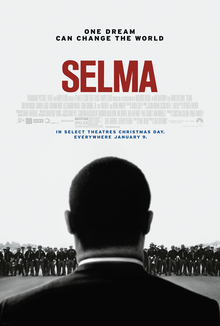
Movie "Selma" (2014) reminds of labored progress

It's obvious to state that "Selma" is about injustice. About man's inhumanity to man. How might we find other layers of meaning in this 2014 movie?
The more the years go by, the more we see the dysfunctional nature of the 1960s. In the "Selma" story, I see the last real vestiges of the U.S. Civil War. Tony Horwitz wrote a whole book about this, about the cloud of the Civil War and its issues persisting for so long, even into the present. His book: "Confederates in the Attic."
The South lost the Civil War but wasn't going to capitulate, not in the manner it should have. Subjugating "black people" was a way of trying to cling to the "Lost Cause," as it was called. I put "black people" in quotes. So odd that we look at a whole swath of our society and simply characterize them by their skin color. Skin color? Today in 2016, we have a rainbow society in which there are shades between so-called "white" and "black." There are dark-skinned people not of African descent, obviously. There are dark-skinned southern Europeans et. al. It doesn't matter anymore, expect in those extreme backwater places in the Deep South.
The old dichotomy of white and black seems quaint now. The term "negro" had currency when I was young. I guess whites were "caucasian." Young people today would wrinkle up their foreheads with such talk. In the '60s, progressives had a dream of a color-blind society, while realizing simultaneously that it was probably an unattainable ideal. Folks, it has been attained, certainly with our youth. The youth embody our hopes and dreams. Us older folks just move on. In the meantime, we can look back at the mess that was, thanks to the "Selma" movie directed by Ava DuVernay and written by Paul Webb. I checked out this DVD from our Morris Public Library.
We were shocked by the confrontational events of the time. Today I think we're more puzzled and humbled, realizing the depths of depravity in the human soul, particularly those losers of the Deep South.
I dismiss George Wallace as rather a scapegoat or straw man. He was a product of his culture. I have researched the man and found that deep down, he realized the folly of the attitudes he espoused. He was an opportunistic politician, ready to say what his constituents wanted. He was a political animal. When these instincts are unleashed in a constructive way, such people are most admirable. In the Deep South, the positive scenario was untenable. A black lawyer once said that "Wallace was the first judge who ever called me Mister in a courtroom."
Getting shot had the effect of humbling Wallace. Wallace was totally comparable to Donald Trump today, and by that I'm not suggesting any racist slant. The two are comparable in that they are politicians as showmen, politicians with a drive to impress audiences with their organically articulate nature. An ex-wife of Wallace once said of him: "He didn't want a marriage, he wanted an audience." I smiled when considering this. Such people are fascinating to observe.
Wallace ran for president in 1968 as an independent, remember? I think the slogan was "Stand up for America." I was in the eighth grade. I was taken by him, not knowing all the ugly racist background of the Deep South. I just saw him on the TV news with great frequency, and his oratory was entertaining. His words seemed to spring from some primal place, in contrast with the "typical politician" whose words are poll-tested. Had I been backgrounded with all the Jim Crow stuff, I would have put Wallace's words in their proper context. I impulsively found him amusing and interesting.
And after all, who are we comparing him with? Lyndon Johnson? Johnson held the office of president for the escalated Viet Nam war debacle. Countless young men died. It has been said the war ran Johnson rather than the other way around. But he was commander in chief. Johnson is easy to upbraid today, just as Richard Nixon is, because their presidencies were flawed.
Johnson comes off as not very sympathetic in the cinema I'm reviewing here. Instead of walking a tightrope, the Texan comes across more as seeing the civil rights movement (at least for a time) as annoying. Like a fly buzzing around your head. At the end he makes a triumphant speech. But he has rather been dragged to that point.
Today we have an overt racist on the Supreme Court: Justice Antonin Scalia. Hurdles are still out there.
"Selma" helps preserve the historical legacy of Dr. Martin Luther King, played in a classy way by David Oyelowo. President Johnson is played by Tom Wilkinson, who starred in one of my favorite all-time obscure movies: "An Angel for May." Tim Roth gives a crisp performance as Wallace. Carmen Ejogo is Coretta Scott King.
"Selma" removes all doubt about whether we should feel any nostalgia about the '60s. The Beatles were an oasis of joy in a time when politics failed our way of life in America. It failed us in the halting progress of the civil rights movement, and it failed us monumentally in Viet Nam.
As a kid I soaked in the TV news very regularly. I watched the Today Show when Barbara Walters was up and coming. I watched the Huntley and Brinkley evening news. Our family only got the NBC channel in those days. So I got to watch Brinkley crack up with the "maraschino cherry" story. I absorbed so much conflict when watching the news. The war and its protests seemed surreal with their dominance. How could we live with this horrible situation for so long? And why was the struggle for basic human rights to arduous? We saw black people get beaten down in the South.
The media were so essential. Awareness of the media's power comes through in the movie "Selma." I laud the movie for that.
"Selma" faces the challenge of captivating viewers when it presents a known story with a known outcome. I worried that the movie might become tedious. It did not. Real human emotion came through. We feel suspense despite knowing that good was going to prevail over evil. We see the white racists for what they are: losers. Just like they lost the Civil War. Losers, losers, losers. All the Dixiecrat Party did, was lose.
The movie shows us the attempt to cross the Edmund Petters Bridge just outside of Selma AL. We see cops in riot gear. Just as importantly we see the TV news journalists, watching vigilantly.
"Selma" was nominated for Best Picture in the 87th Academy Awards. It won for Best Original Song in the Golden Globe Awards.
The portrayal of Johnson ended up as the movie's biggest controversy. I have to admit I don't trust Texans very much. Johnson and JFK were at opposite ends of the charisma spectrum. Johnson came on the TV looking like he might be constipated. All he ever needed to tell us was that "our troops are coming home." Five words. The Smothers Brothers had more wisdom than the president. It seems so mild now, what Tom and Dick Smothers said. Hey, maybe a movie should be made about that episode too: the controversial "Smothers Brothers" TV show! I'm serious. Didn't they have a routine called "Mom always liked you best?"
Would that we could embrace such innocuous memories of the '60s, like the Beatles. Kids of today, you have no idea what it was like being alive then.
 
Addendum: Chris Matthews of MSNBC said that when Johnson was done with his presidency, he "went home to Texas and smoked himself to death."
- Brian Williams - morris mn minnesota - bwilly73@yahoo.com