History-making music group for UMM - morris mn

History-making music group for UMM - morris mn
The UMM men's chorus opened the Minnesota Day program at the 1962 Seattle World's Fair (Century 21 Exposition).

Monday, September 21, 2015

Five touchdowns by MACA at Yellow Medicine East

Tigers 34, Sting 0

The MACA boys rolled over Yellow Medicine East in Friday football action. It was win No. 4 for the surging Tigers. Remember when Granite Falls by itself was a football power? Today, folded in as part of YME, a lot of the firepower seems to have been lost. I remember in the late 1980s, the Tigers used a trick play to beat Granite Falls in a highly memorable game at Granite Falls. That era is fading into the past.
Today, MACA is certainly connecting on all cylinders. The Tigers improved their season record to 4-1 with this 34-0 triumph. We scored in every quarter. We accumulated 279 rushing yards. The passing game, while not used often, was efficient and effective. Quarterback Trent Marty completed three passes in six attempts for 93 yards. Eric Staebler had two of the catches for 59 yards. Andrew Ulrich had the other catch for an ample 34 yards.
The Tigers capitalized on YME turnovers. We intercepted three passes and recovered three fumbles.
Jacob Zosel bulled forward, getting 101 rushing yards on 14 carries of the football. The balanced rushing attack also featured Chase Metzger getting 73 yards on four carries. Connor Koebernick added 52 yards to the mix on seven carries. Signal-caller Marty was effective with 41 rushing yards on eight carries. Kyle Staebler rushed for nine yards and Taylor Staples added five. Eric Staebler did the Tigers' punting.
The first quarter ended with MACA up 6-0. It was Metzger scoring that touchdown on a 19-yard run. Zosel was off to the races on a 42-yard scoring run in the second quarter, and he carried again successfully on the conversion play, so halftime arrived with the score 14-0.
MACA momentum grew into the second half. Metzger had two rushing touchdowns in the third quarter, the first covering 17 yards, the second covering eight. Ryan Dietz ran for the two-point conversion after the eight-yard scamper. MACA made its final scoring statement of the night when Taylor Staples ran the ball into the end zone from the three.
MACA had just two successful scoring plays among the five touchdowns. We accumulated 12 first downs en route to the win. We lost one fumble and were penalized nine times for 70 yards.
YME was not able to establish any sort of passing game. That's an understatement, really, as the Sting had no completions and three interceptions. Ballcarriers who gained yards for the host Sting were Jordan Odegard, Austin Friese, Bryce Schmidt, Garrett Nordang and Miles Kattevold. Garrett Schmitz was the YME quarterback. Bright spots for YME were Jordan Odegard with an interception and Miles Kattevold with a fumble recovery.
 
Volleyball: Tigers 3, Minnewaska Area 0
The Morris Area Chokio Alberta volleyball express rolled forward on Thursday, Sept. 17, with a sweep on the road. The success was versus Minnewaska Area. The 3-0 win came by scores of 25-14, 25-9 and 25-22.
Karly Fehr was the set assist machine with 20. Lindsey Dierks executed two ace blocks. One ace block each came from Brooke Gillespie, Ashley Solvie and Moira McNally. Gillespie had ten digs followed by Dierks with eight and Decker with seven. At the serving line, Riley Decker pounded two serve aces. One ace each came from Gillespie, Fehr, Dierks and Carly Maanum.
On to the hitting department. Here it was Gillespie and Dierks setting the pace, each with six kills. Solvie and Haley Erdahl each pounded four kills. Jenna Howden delivered three kills. One kill each came from Fehr, Maanum and McNally.
Abby VerSteg had seven kills for the host Lakers. Emma Middendorf had six ace blocks. Bailey Stewart topped the Lakers in digs with 22. Taylor Amundson was the chief 'Waska setter with 14 assists. And in serving, VerSteg led the 'Waska effort with two aces followed by Kaylee Glover and Marie Styve each with one.
The Tigers enter the new week with a 6-0 overall record, 5-0 in conference.
 
Cross country: meet at NL-Spicer
Cross country action had the Tigers testing their stamina in the New London-Spicer Invitational on Thursday. Maddie Carrington and Savannah Aanerud were headlining performers for the Tigers. Carrington placed third with her time of 20:51.1. Aanerud was the No. 4 performer with her time of 20:55.8.
Malory Anderson was No. 11 to the finish line, clocked at 21:41.0. Kylie Raths turned in a 21:52.7 time, good for 13th; and Midori Soderberg was 32nd with her 21:19.2 clocking. Anna Donnay of Eden Valley-Watkins was the first place girls runner, timed at 18:50.9. The runner-up was Carissa Vanderwal of Ortonville with her time of 20:32.6.
The boys race was won by Keiser Freetly of LQPV/DB, timed at 17:25.5. His Eagle teammate, John Wagner, was runner-up with a 17:32.0 clocking. Tate Nelson of the Tigers led our orange and black efforts, placing ninth at 18:32.8. Ryan Gray placed 17th (19:06.1) and Noah Stewart was #18 (19:10.3). Also representing the orange and black were Cam Arndt (20:34.5) and Tyler Reimers (20:47.0).
Lac qui Parle/Dawson-Boyd topped both the boys and girls standings. The MACA girls were No. 2, while our boys were fifth.
- Brian Williams - morris mn minnesota - bwilly73@yahoo.com

Monday, September 14, 2015

MACA volleyball stays on roll, sweeps Benson & ACGC

Tigers 3, Benson 0
MACA volleyball has been hitting on all cylinders thus far in the still-young 2015 season. MACA not only won twice last week, they did so by sweep both times. The roster is blessed with inspired talent.
The Tuesday (9/8) story was a 3-0 win over the Braves of Benson, at Benson. Scores were 25-14, 25-19 and 25-14. Karly Fehr was in her usual role as setting master, and on this night she produced 23 set assists. Moira McNally had one set assist. Brooke Gillespie came through with three serving aces, and Lindsey Dierks had two. Jenna Howden executed two ace blocks followed by Gilliespie and Carly Maanum each with one.
Riley Decker was the whiz when it came to digs - she had 16. Lindsey Dierks had eight digs, Gillespie had seven and Maanum six.
Let's conclude this stat report with hitting. Here the Tigers unleashed a balanced attack -a key ingredient in their dominance. Here's the rundown in kills: Dierks 7, Ashley Solvie 6, Gillespie 5, Howden 3, Fehr 2, Maanum 1 and McNally 1.
Sophie Ascheman led Benson in kills with six. Megan Amundson and Ascheman each had two serving aces for the Braves. Addie Forbord produced 12 set assists. Victoria Pagel had two ace blocks for the host team. Megan Amundson had nine digs.
 
Tigers 3, ACGC 0
The Thursday story had the MACA girls getting past the ACGC Falcons with another sweep. This success on the road came by scores of 25-20, 25-9 and 25-17.
Karly Fehr was the set assist machine with 29. Brooke Gillespie came at the Falcons with three serving aces. Carly Maanum and Riley Decker each had two serving aces, and Koral Paulson had one. Gillespie went up to execute two blocking aces. These Tigers each had one ace block: Fehr, Ashley Solvie, Haley Erdahl and Moira McNally. In digs it was Decker setting the pace with 13 followed by Gillespie with 12, Fehr with eight and Lindsey Dierks with seven.
Gillespie was at the fore in hitting with eight kills. Jenna Howden batted seven kills. Dierks and Solvie each had five while Fehr and Maanum each had four. Erdahl and McNally each had two kills, and Nicole Solvie produced one.
The top kill producers for the host Falcons were Kendra Miller and Taryn Reinke each with four. Miller topped the Falcons in blocks with four. Maree Lee was busy as setter for the host, picking up 18 set assists.
The Tigers entered the new week with a 4-0 record and building hopes for a sterling season.
 
Football: Minnewaska Area 29, Tigers 20
The MACA gridders were dealt their first loss of the season Friday (9/11).
We struck with a very exciting play on defense: Toby Sayles intercepted a pass and was off to the races with a 71-yard return for six. Our 6-0 lead was not an indication of how the game would turn out. Host Minnewaska Area was the 29-20 victor in this Mid-State contest. Both teams came out of this game at 3-1.
The first quarter ended with the score 6-0. But 'Waska answered with nine points in the second quarter. Chris Clausen kicked a 31-yard field goal. Michael Gruber threw a 30-yard touchdown pass to Justin Amundson. MACA blocked the PAT kick try. The Lakers kept flexing their muscles as Gruber connected with Austin VerSteeg for a 45-yard scoring aerial. Clausen kicked the PAT.
The Tigers fought back with a two-yard scoring run that had Ryan Dietz clutching the football. Trent Marty ran for two on the conversion. The Lakers struck with a one-yard TD run that had Greg Helander carrying the football. Clausen kicked the point-after.
The back-and-forth game continued with a 12-yard scoring run by Jacob Zosel of the Tigers. The evening's final score was by Minnewaska Area: Ryan Christianson found the end zone on a run from the nine. 'Waska could savor its winning margin of nine points.
Zosel received 15 handoffs and charged forward for 86 rushing yards. Ryan Dietz carried the football eleven times for 49 yards. Conner Koebernick had five rushing yards and Chase Metzger one. I was chatting with a friend at McDonald's recently and mentioned that I remembered covering Conner's older brother. The friend clarified, saying that I was remembering covering Conner's father. Time marches on.
Trent Marty completed eight of 16 pass attempts against the Lakers. His aerials picked up 76 yards and he had no interceptions. The receivers were Eric Staebler (two catches, 38 yards), Sean Amundson (2-19), Metzger (3-14) and Zosel (1-5). Remember Roger Metzger, shortstop for the Houston Astros in the '70s?
Staebler handled the punting. Sayles had two interceptions and Metzger had one. The tackle chart showed Metzger with six solo tackles and two assists. The list continues with Brady Jergenson (5-4), Cole Watzke (3-4), Taylor Staples (3-4) and Ryan Dietz (1-7). Watzke sacked the quarterback three times. Staples had one quarterback sack.
Minnewaska had two major ballcarriers: Ryan Christianson (12 carries, 109 yards) and Greg Helander (19-86). Gruber has a major factor with his passing arm: nine completions in 16 attempts for 256 yards, but he did have three interceptions. VerSteeg was a favorite target of Gruber's, as he gathered in five passes for 135 yards. Amundson had three catches for 85 yards, and Matt McIver rounded out the list with one catch.
Viva Morris Area Chokio Alberta fall athletics!
 
What's going on with newspaper?
I took a glance at the Morris newspaper when at church a couple weeks ago. Something jumped out at me. To those of you who still look at the paper: did you notice it too? The obituaries were boxed and the type size looked smaller. The type size looked smaller! This at a time when everyone knows the audience for newspapers is aging. More of us are having to turn to reading glasses every day.
Don't we all assume the paper is getting paid the same for running these obits, as when the type was larger and more user-friendly? When I was at the Morris paper, we didn't even charge for running obituaries.
I think it is ethically questionable for papers to charge for publishing obits. The papers would say, well, everyone knows newspapers are having tough sledding now because of the Internet. How is that the problem of the families of deceased community members? No one is obligated to "subsidize" the newspapers. The way the system works now, as I understand it, is that the funeral home takes complete responsibility for writing the obits, and then collects payment from the families which then gets transferred to the paper. I suppose they all feel it would be "tacky" for the families to be forced to go to the newspaper office to pay. The system removes some of the unseemliness.
I have been arguing that the funeral home should actually charge the newspaper for the service of writing the obit. The funeral home does all the work. The paper is relieved of even paying an obituary writer.
The new system has developed with funeral costs getting sky-high. I imagine that funeral homes are under pressure to keep prices down. I have suggested before that funeral homes should affix a copyright notice to the obits they post on their websites, and then they could tell the paper not to publish them unless paying a fee. That would be a fascinating experiment.
A steadily growing percentage of people are just going online to read the obits anyway. Also, the obit gets published on the funeral program. Also, we're living in an age when more and more people simply value privacy. Is a death in the family really "community news" at all? Might it be seen as a private family tragedy? Friends and relatives can be informed promptly. Beyond that, I'm not sure it's the public's business. What do you think?
For the time being, I think we can all look down on the newspaper's practice of reducing the type size for obits, as a simple ploy to just try to keep raking in the same amount of money for a reduced service.
It's the same principle as what we're seeing Thrifty White Drug doing in the community: phasing out their two vibrant downtown stores in order to move to the outskirts in a drastically scaled-down facility. Money. It's all about money.
- Brian Williams - morris mn Minnesota - bwilly73@yahoo.com

Thursday, September 3, 2015

Sandy Valdespino had his moments with 1960s Twins

Sandy Valdespino hit a pinch-hit single off Sandy Koufax in the 1965 World Series. That's something you can tell your grandkids about. All baseball fans were awed by Koufax (of the Dodgers) in the 1960s. He loomed as the barrier in the Minnesota Twins' quest for the world championship in '65. His manager, Walt Alston, had to adjust the rotation for the Series due to Koufax's need to observe a Jewish holiday. Koufax was at the peak of his skills at that time. Valdespino could feel pride connecting for that base hit in the Fall Classic.
Twins fans of the '60s still remember Valdespino, I'm sure. We might remember him better if the Twins had won the pennant in '67. He was part of that '67 ride under manager Cal Ermer that ended in heartbreak of the first order. We faded at the end just as the Boston Red Sox with Carl Yastrzemski had a surge. Boston was a media darling. Well, they're part of that East Coast power/media corridor. I'm not sure that corridor wields its presence that much anymore, due to the democratizing effect of new media. In '67 the Midwest could feel rather on the defensive. If the oddball Fenway Park had existed here - well, such an oddball stadium wouldn't even be tolerated here. But out East? It was a charming oddity (with its Green Monster).
The media even helped fans fall in love with the early New York Mets. Had such an expansion team existed here in Minnesota? That's an interesting question because I'm not sure Minnesota could have even supported such a mediocre unit. Could Minnesota have supported a typical expansion team of that era? How much patience would big league baseball show for our team on the Upper Midwest windswept prairie? We got the Twins, of course.
A friend of mine once chatted with Jim Kaat who said: Our '67 team was even better than in '65. We had Dean Chance. Kaat himself pitched like Koufax in September, until finally, in desperation due to the closeness of the pennant race, the manager overworked Kaat's arm with consequences that possibly stretched over a long time. Had we won, the script of Twins history would be different. Chance and Kaat would have a position like Koufax and Drysdale.
And Sandy Valdespino? The little Cuban would be remembered much better. Fame in baseball can be painfully transitory. Valdespino signed with the old Washington Senators way back in 1957. Kaat once said that the "TC" on the Twins caps stood for "twenty Cubans." Of course it stands for "Twin Cities." The visionaries who brought the Twins here were walking on eggshells with sensitivity re. Minneapolis vs. St. Paul, in a way that I think seems quaint now. Today, any big league team gets so much of its profit from TV, the old parochial obligations are no big deal. The Twins had a logo that showed two generic Twins players shaking hands "across the river."
I suppose Sandy Valdespino cannot be considered an original Twin because he toiled in the minors. He plugged away, finally making an impression in 1964 with a spectacular showing with the Atlanta "Crackers." Sandy batted .337 for Atlanta, a city which like Minneapolis/St. Paul was able to lure the majors in the '60s. The Braves left Milwaukee for Atlanta. How could Milwaukee have let the Braves slip away? With Hank Aaron?
Valdespino hit 51 extra-base hits for Atlanta's minor league "Crackers" in '64. On came '65 and its scenario of destiny for our Minnesota Twins. We won the pennant for owner Calvin Griffith. We should have won at least one more pennant in the Griffith era. It was frustrating seeing the franchise come up short despite fine players.
Valdespino got established with our Twins for three seasons: 1965 through '67. Only in '65 did he produce adequate offensive stats. He batted a passable .261. In the next two seasons he struggled with averages of .176 and .165. But he wasn't totally insignificant in those last two seasons. He is remembered for making an absolutely spectacular outfield catch in '67. Kaat was pitching for that June 18 game. The big lefty took a 4-0 lead into the bottom of the eighth. The Cleveland Indians produced two run-scoring singles, and "Kitty" got the hook. The bases were loaded with two outs. Manager Ermer decided on a double-switch. Like the bunt, the double-switch has been oft criticized for being more trouble than it's worth. Anyway, the ploy had Ron Kline coming in to pitch and Valdespino getting sent out to left field.
(Thinking about the double switch gives me a headache. Managers in "old times" didn't want to think about it.)
Larry Brown came to bat for Cleveland. He crushed a drive to left. Sandy tore for the fence, his back to the field. It was like that famous Willie Mays catch. Sandy leaped, actually digging his spikes into the wall, and caught the ball over his shoulder in midair. Kline closed out the game with a perfect ninth inning.
As a footnote, let's remember that Kline, considered a premier relief specialist in '67, was a goat at season's end. Oh, I'm sure he was trying hard. Griffith spoke publicly of his frustration with the rather portly man. Oh, 1967: Not only was it a nightmare with how our superb team got edged at the end (in the days before divisional playoffs), it was the apex of the Viet Nam war. Those two "tragedies" of course cannot even be compared. I wonder how LBJ is reflecting in his afterlife.
Sandy Valdespino was a native of San Jose de las Lajas, Cuba. "Diminutive" surely describes. He stood a mere five feet/eight inches. A minor league manager nicknamed him "Sandy." His real name, as baseball card collectors of that time will remember, was Hilario. Sandy reminded the minor league league manager of Sandy Amoros, also diminutive.
 
Immediate impact in the majors
When finally Sandy arrived in the majors in '65, he reached base in his first four plate appearances. He was a pinch-hitting specialist initially. He got a start on May 19, 1965, and responded with a three-for-six showing including a double. He scored one of two Twins runs in the 12th in a 3-1 win over the Angels.
Valdespino appeared in 108 games for the '65 Twins. He drove in 22 runs. He appeared in five of the seven World Series games, going three-for-eleven including that hit off Koufax. Three-for-eleven was nothing to sneeze at against the likes of the Dodgers' pitching. (Amoros had played for the Dodgers.)
Valdespino became a journeyman after his three years with the Twins. He had 38 at-bats with the Seattle Pilots who had just one year of existence. The Pilots were of course grist for Jim Bouton's groundbreaking book, "Ball Four." I read the book more than once but, sorry, I don't remember Valdespino being mentioned. Former Twin Rich Rollins was on that team but I don't remember him being mentioned much either. Former Twin Garry Roggenburk was on that team too. I do remember him in some stories.
The '71 season would be Valdespino's last. With the Royals he hit .317 in 18 games for a nice little closing chapter. His last home run was on September 13, 1971, and it tied the score vs. the Athletics 1-1 in the fourth, and spoiled a shutout bid by Catfish Hunter. Hunter pitched ten innings that day to get his 20th win with a 2-1 score. Quaint: Hunter pitching ten innings. In the '60s, a complete game was a badge of honor for pitchers. "Hey, leave me in!" Today it can be foolish, as pitchers' arms are considered precious investments as well they should be.
I believe Mr. Valdespino is still alive and a resident of Las Vegas NV. Enjoy the glitter there, Sandy. We'll never forget that spectacular catch you made vs. the Indians, or your presence for that '65 pennant run. I was ten years old. The memories are golden.
- Brian Williams - morris mn minnesota - bwilly73@yahoo.com

Monday, August 24, 2015

We love music but overlook lyrics too much

Johnny Paycheck: a real genius
I discovered a website back in the early days of the Internet about "misheard song lyrics." It's interesting how, in the craft of songwriting, such importance is placed on quality and depth of lyrics. It's interesting because, how many people pay that much attention? People listen to these songs on a supermarket sound system, perhaps. We have all kinds of distractions. Background noise can be ubiquitous.
And yet the music pros say lyrics must be totally sharp. There are many rules. It is true that the best in the business occasionally break rules. But you can be sure they know what the rules are.
Paul McCartney crafted music for radio in the 1970s. His voice droned on. Many of us sought his music because he reminded us of the Beatles. George Harrison was certainly on that gravy train, more so even. McCartney is a fine artist. But when his "Silly Love Songs" came out, I felt it was just cynically crafted to be a radio hit. McCartney had the power to get just about anything recorded and promoted. The consistency of his product has probably been better in his post-Wings days. He probably feels more pressure to cut out the fluff.
In the '70s we'd go to the "record store" like Musicland at Crossroads Shopping Center, St. Cloud, and paw through the various bins. An artist's newest release would be on top. "Cover art" for an album was considered important. When a major artist came out with a new album, a large number of that album would be on top in front of the artist's name in that display. A new album seemed so fresh and invigorating.
I attended a workshop in Moorhead once where a music industry expert talked about how music goes from fresh to stale. Why do you think new tunes climb so much on the charts, replacing the old ones? It's kind of sad, really. A good song has its "run" which is really quite brief. It then descends on those charts. We have gotten tired of it.
Much is said about how much we love music. We paid close attention to Casey Kasem's show (and, what a textbook case of estate issues at the time of his death). Ah, his "long distance dedication." So, we love music, and there are achingly high standards for the creation of pop music. Songwriting is anything but an impulsive or whimsical craft. And yet. . . And yet we famously "mishear" song lyrics or fail to understand even the most basic premise of a song. Ronald Reagan considered the song "Born in the U.S.A." and judged it entirely for the title. He looked not at all at the lyrical nuances. Heck, ol' "Ronnie Re-run" (a nickname applied by a college friend of mine) seemed to miss the essence of the song. It wasn't nearly as patriotic as he thought. But, a president would have to love a song called "Born in the U.S.A." (Didn't Cheech and Chong satirize that song with "Born in East L.A.?")
Let's move on to the most famous example of a misunderstood song. Ahem. "Take This Job and Shove It." I'm sure the song was written with exacting songwriting craftsmanship. I am more fascinated with songwriting craftsmanship than I am with journalism. I spent 27 years working in journalism.
Many people believe Johnny Paycheck wrote the "Shove It" song. I thought that when I wrote the first draft of this post. Paycheck popularized the song. David Allan Coe wrote it. Paycheck was a superlative songwriter in his own right. These guys were precisely the type of songwriter I'd like to be.
I wonder if Coe/Paycheck realized the monster they created when they presented the "hook" line: "Take this job and shove it." It's like an anthem for people frustrated at work. The pre-cyber age was full of jobs that were tedious, dirty and boring. Not so much so today. Coe hit a nerve with what he created. I wonder how he wrote down the song originally. On a napkin? On the back of a receipt? Fascinating craft. I was entranced at a museum exhibit in Nashville once, where I could see the scraps of paper when songs were originally created, complete with crossed-out lines and corrections! It was like observing genius at its core.
Woodward and Bernstein's notes about Watergate wouldn't interest me at all. But I'm mesmerized by the inception of these tunes, so simple and yet so powerful and timeless. I think we got tired of Watergate just like we get tired of a song.
"Take This Job and Shove It" is only remotely, or secondarily, connected to the idea of hating your job. Really it's about the shallow feeling of when your significant other leaves you - the loss of purpose. The woman was your reason for being, after all. "My woman done left. . ." I once used the word "done" in that context - is it Southern? - in my song about Kirby Puckett which is on YouTube. Please listen.
Coe reportedly resented that people were of the impression Paycheck wrote the song. Paycheck may have laughed all the way to the bank, but I think he felt a bit haunted by the song too. People in the corporate world, and that includes music, aren't likely to fawn over a song where one disses his job.
I have a Johnny Paycheck CD, recorded late in his career - a live and definitive recording made in Branson MO. I'd be in seventh heaven if I could write one song like these. "Take This Job and Shove It" is not included! Paycheck probably did not want to be defined by that song with the cynical title. However, his money was in the bank. (Or, let's face it, he probably spent it.)
Paycheck had the "Shove It" song at No. 1 on the country charts for two weeks. It spent 18 weeks on the charts. It was his only No. 1 hit.
Johnny had the image of a hell-raising outlaw singer - something I wouldn't wish to emulate. Jimmy Carter professed a liking for such music, like for Willie Nelson. I'm in awe of Paycheck's songwriting touch as for Tammy Wynette's debut hit, "Apartment No. 9," in 1966. I also love "A-11" which is a lively, fun and moving tune that is on the Branson CD. Maybe God will someday allow me to "borrow" some of that talent. Songwriting has a divine spark.
- Brian Williams - morris mn Minnesota - bwilly73@yahoo.com

Monday, August 17, 2015

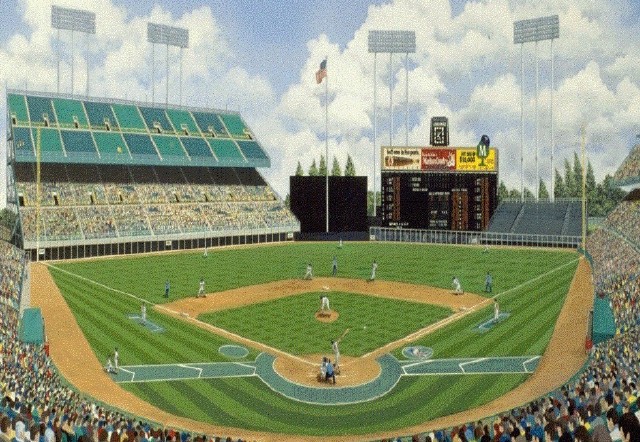
A stadium on the cutting edge, eventually to be razed

Metropolitan Stadium, Bloomington MN
Gerald Moore recalled his best memory of Metropolitan Stadium. Moore, who headed the Minneapolis Chamber of Commerce during the drive to build the Met, said "I guess it would have to be that pleasant setting." Moore gave these comments at the time we were anticipating the Dome's opening. He added: "I'm concerned about the move downtown. I think we're losing too much. . .of the flavor."
Met Stadium was truly hailed at the time of its opening. A major league baseball official proclaimed our Met was "as good as any stadium in baseball and better than most."
It's actually strange we had to wait until 1961 for "the bigs" to start here. Met Stadium opened in 1956. Our AAA minor league team, the Millers, played there. Surely the Met wasn't built for the Millers. Legend has it the Indians and Giants flirted with coming here. Had the Indians come, we would have had an established nucleus of stars to cheer for. Given the advantages of a brand new stadium, the owner could have augmented that group, perhaps well enough to win a pennant. Today we'd be reminiscing about Leon Wagner, Max Alvis and Sam McDowell. Instead we reminisce about "the Killer" (Harmon Killebrew), Camilo Pascual, Rich Rollins and others.
Had the Giants come? My, we'd have a giant statue of Willie Mays in the metro area. Maybe Orlando Cepeda or Juan Marichal too. Remember Marichal's "leg kick?" It was a diversion. I doubt it helped his pitching. Cepeda? Roger Angell observed that Cepeda wrapped his bat so far in back of his shoulder, it was surprising he could even hit a pitch. Most certainly he could hit a pitch.
 
"That pleasant setting"
"It was such a kick to see the place go up," Moore said of the Met's construction. "It was like making a million dollars and you know you've got the million, but you just don't have the money. We got a lot of compliments on the place over the years."
One of my top compliments would have to be "that pleasant setting." Yes we were on the fringes of the big, bad metro area. Nevertheless there was a pastoral air as we took our seats at the Met. The organist would play a gentle, traditional melody, perhaps "Jersey Bounce." Finally the voice of Bob Casey commanded our attention. The famous HBO video "When It Was a Game" included an old-timer commenting on the mesmerizing effect of that P.A. voice at the ballpark: "Like the voice of God."
Another comment was about the indescribable thrill, from the perspective of a child, seeing those big league players in the flesh, to simply realize they were real people. "I had heard about them, read about them, but there they were." Someone remembered arriving at the ballpark and seeing "Johnny Mize, big Johnny Mize, looking right at me from beside the dugout."
The Twins warmed up in front of me at Met Stadium. It was the mid-1960s. There he was: Rich Rollins! Nothing in West Central Minnesota could have thrilled me like this. Harmon Killebrew hit two home runs in the first game I ever attended. Al Worthington pitched the ninth. The Twins won. Our family had taken a bus from somewhere in downtown Minneapolis. On the way back, I remember fans humming around me, so enthused about the Twins and their performance. We remember staying at the old Drake Hotel way back when it was a real hotel, complete with a restaurant. I was disappointed years later to hear the place had become a homeless accommodation place.
I remember when we knew we were getting close to the Twin Cities when we saw those little billboards promoting the "Curtis" Hotel. And the Leamington? The Beatles stayed there. So gone with the wind. Just like Met Stadium, that stadium "as good as any, better than most" in major league baseball.
As it turned out, we in Minnesota fell into a pattern of building a stadium toward the end of each generation of sports stadiums - not a good deal. I think in Target Field we now have the ideal. But the Twins have not been competitive enough, not that I follow it a whole lot anymore. The strike of 1994 changed forever my orientation to big league baseball. The emotions were gone. Then the PED scandals came along and that was the final nail. I have nothing against big league baseball, really. It's fine if a substantial number of people still enjoy it. I've just moved on. I do have a dislike for pro football - it's a tragedy with all the head injuries.
As the days of the Met became numbered, Groundskeeper Dick Ericson said "I hate to see it go. It doesn't seem so long ago when it was built. I remember talking to the contractor when they were pouring cement, and I asked the contractor, a Mr. Drake - I can't remember his first name - I asked him how that cement would hold up. He said the cement would still be there in a hundred years. I guess not."
 
The apex year: 1965
The All-Star Game was played at the Met in 1965. Of course that was the year the stars all lined up and the Twins won the pennant. The stars didn't completely line up because we lost the World Series in seven games.
You would think the Twins could have won another pennant before the end of the decade. We came painfully close. Our talent suggested we could have won another flag. It was a tragic story as Calvin Griffith's Twins teased us but couldn't pull it off. Zoilo Versalles tanked. Doug Grow asked Griffith what happened with Zoilo. "Drugs," Calvin responded.
The Twins degenerated with internal politics and conflicts taking a toll. Us fans basically weren't aware at the time, though we know about the fistfight between Dave Boswell and Billy Martin. Bob Allison got caught up in that avoidable skirmish too. Coaches had conflicts. Johnny Sain reportedly wanted Sam Mele fired.
OK, what I'll offer as an assessment is that Griffith was of a generation that had trouble recognizing and solving such problems. Today we have "conflict resolution" techniques. Griffith just put certain people in certain positions and paid no mind. I've seen others of his generation be similarly clueless. Conflicts have to be avoided or else certain people just have to be shipped off. 
Why didn't the Twins use Jim Perry more in the mid-1960s? Indeed that's a mystery.
Us young fans were left flummoxed by our Twins getting edged out for the pennant in '67, and losing the divisional playoffs to the Orioles in 1969 and '70. Games 1 and 2 in '69 were decided by one run, then we were blown out in game 3. Dave Boswell threw out his arm by being overworked. It could drive one to drink.
The '70s were anticlimactic. The Twins no longer had the wizardry for attracting top talent. Rick Sofield? Glenn Adams? Gene Mauch seemed to put together teams with guys who could hit for a good average but do little else. He platooned so much, it made me sick. Kirby Puckett might have gotten platooned if Mauch were still around. All it would take was one 0-for-4 game against a right-handed pitcher. Lyman Bostock once publicly complained about being sat down by Mauch against a left-handed pitcher one day. Bostock would be murdered when still a young man.
Today the Mall of America stands where we were once enthralled by the Minnesota Twins. We had the Metrodome for a number of years, where the Twins won two world championships. But even the Dome is gone now. The only constant appears to be change.
But I'll never forget "that pleasant setting" and calming organ music of the old "Met." If I go to heaven, maybe God can allow me to re-live a few days there.
- Brian Williams - morris mn Minnesota - bwilly73@yahoo.com

Saturday, August 8, 2015

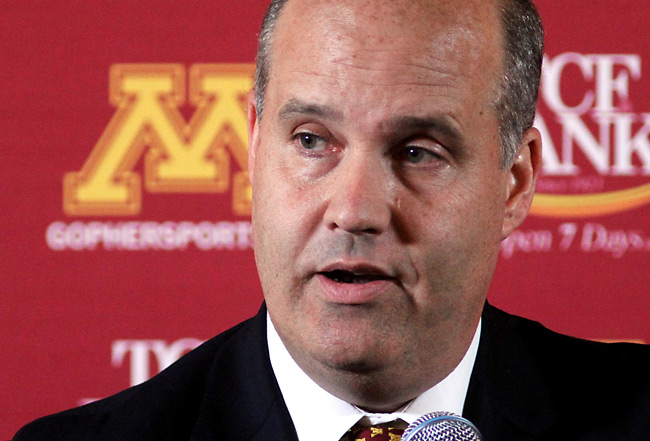
The U's Norwood Teague: we hardly knew ye

Norwood Teague (image from MPR)
Oh, my: there was an interesting item for the Friday night news dump: U of M athletic director resigns. He resigns amidst scandal!
Media people had to brew fresh coffee and charge their batteries to get engaged. These days there's no reason for media activity to slow down on weekends. In this new age of new and viral media, a scandal isn't going to be tamped down much.
Regents' Chair Dean Johnson got a breathless phone call I'm sure. This is the same Dean Johnson who got in sort of a scandal or at least a dust-up with the Minnesota Supreme Court about a decade ago. He knows how these brushfires can become pesky.
I'm sitting here like some kind of a guru on the mountaintop: I never consume alcoholic drinks. Is there any rational reason to do so? I often consume soft drinks to excess - a real risk in this age of unlimited refills in so many places. I remember when Jim Morrison, the old Morris Sun-Tribune boss, teased Howard Moser by saying "you'll get arrested for driving under the influence of Dr. Pepper!" Howard was our van driver.
Why couldn't the University of Minnesota athletic director consume Dr. Pepper or Mello Yello or some such thing? The World War II generation used booze as an escape mechanism for coping in their post-war (or post-Depression) life. We excused them for that, and for smoking. Weren't GIs offered free cigarettes in the war? Better to get them hooked, I guess (from the cigarette companies' standpoint).
Mike McFeely of KFGO Radio-Fargo has said "maybe it's time we made alcohol illegal." Alcohol is the cause for so much strife. It is being blamed in the current mess at the U that has the athletic director departing under a dark cloud.
I remember when Art Carney filmed a PSA about our attitudes regarding booze. He asked in the PSA: when you offer someone a drink, or are being offered a drink, why is there some sort of expectation that alcohol is included? I'm paraphrasing. "When you think of a drink," Carney continued, "why not assume the non-alcohol options are included. Soft drinks? Water?"
I suspect that today's young people are receptive to the Carney pitch, more so than my generation.
The U of M is in a defensive stance now. This is after the revelation that Norwood Teague is an unsavory, filthy boor, and disingenuous too. He submitted a formal statement that I'll theorize was written by a lawyer. He said he took responsibility for his actions. But in the next breath he suggested he wasn't really responsible, rather it was the demon rum inside him. Well, which is it?
I'm sure the women who were affected by this are enraged by Teague's assertion that the inappropriate behavior "doesn't reflect his true character." So, he wasn't consciously aware of what he was doing? What a convenient excuse. And now he's going to seek treatment? Does that mean he's an alcoholic? He says he has "alcohol issues." With that broad brush he laid his problems at the doorstep of demon rum.
U of M President Eric Kaler was even worse, so bad I actually hate quoting him here. The Man from Stony Brook suggested the problem was that Teague was "overserved" at a University-sponsored event. If it was a University-sponsored event, why did alcohol even need to be served? Why not Dr. Pepper instead? Just think how much trouble this would have saved our august University of Minnesota.
But if Teague's boorish behavior wasn't a one-time incident, the excrement would have eventually hit the fan anyway, right? Oh, but if this was an ongoing problem for this reckless Mr. Teague, shouldn't other U administrators have been aware? Was it their responsibility to be aware? Aren't these people all paid a fortune? Is the U of M devolving into some sort of charade, a charade in which, on another front, the regents feel they need to address how students get consent for sex (with the proposed "affirmative consent" policy)?
Teague's big thing was to raise money for the athletic village, an idea that sort of strikes me as Sodom and Gomorrah-like. Athletes needn't be so high up on a pedestal. The University doesn't stand for this.
The University should be making preparations for the day when football is discontinued, based on the terrible physical toll taken on participants. Instead we have Jerry Kill behaving like royalty, with inadequate justification for it. The U has fallen for this athletic "arms race" among Division I schools. We rig the non-conference schedule so we get four automatic wins. How satisfying is that?
Money becomes like water out of a faucet. The numbers get staggeringly higher. And for what end? Glorification of the U? Sports teams don't command our attention like they once did, due to diversification of the media - competition for eyeballs. What the U is doing might be considered harmless, or maybe a curiosity, but the U hired someone (Teague) unable to show the most basic respectful judgment in his behavior at a U function.
It's too convenient for him to hide behind the veil of alcohol. We have seen other public figures do the same thing through the years: call an immediate press conference and say they have a problem with alcohol. Teague was paid a fortune to at least be a custodian of the U's interests. It was a low bar. And Kaler uses the term "overserved."
Here's a suggestion: stop giving money to the U of M immediately.
And maybe Dean Johnson could get some advice from the Minnesota Supreme Court.
- Brian Williams - morris mn Minnesota - bwilly73@yahoo.com

Monday, August 3, 2015

Dean Chance: a Twins great who could have been greater

A neighborhood kid once talked about how "Dean Chancellor" was in trouble at the Republican national convention. His astute mother, Virginia, was ready with a clarification. "Oh, you're thinking about Dean Chance."
Our neighborhood had its share of baseball interest. For the record, John Chancellor was arrested at the 1964 GOP convention for refusing to cede his spot on the floor to the "Goldwater Girls." When security came to get him, he was forced to sign off. "I've been promised bail, ladies and gentlemen, by my office. This is John Chancellor, somewhere in custody."
The fellow whose name might be confused with the journalist wasn't yet a Minnesota Twin. Dean Chance was having an outstanding season with the Angels. He was high on our thoughts most likely because he started the All-Star Game.
Virginia was to be complimented for her knowledge outside our Minnesota Twins. All the mothers of the boomers were to be complimented for putting up with us. Us boomer kids lived in a laissez-faire world in which adults didn't fuss much over us. The boomer boys of Minnesota in the 1960s loved the Twins.
I'm amazed reading about a game that Chance pitched for the Angels on June 6, 1964. Chance's mound opponent was the one and only Jim Bouton. Bouton would because famous or infamous by the end of the decade by writing a groundbreaking sports book: "Ball Four." The book tore away the pretense from professional sports. It showed the athletes as human beings with flaws. They had petty conflicts and felt insecurity just like the rest of us. Bouton had his last good season for the Yankees in 1964. 
 
Pitchers could be handled recklessly
If you read Ball Four, you'll remember that Bouton fussed much over his sore arm. How might he have gotten a sore arm? Well, let's consider that June 6, 1964, game at Chavez Ravine in California. It was a duel for the ages. Chance and Bouton were overpowering, so much so, neither team could score a run.
The two aces matched zeroes for 13 innings. Bouton was then removed. Chance pitched one more inning before departing. The Yankees scored twice against the Angels' bullpen in the 15th and won 2-0. Any pitcher is put at great risk, being asked to pitch 13 innings, or even ten. I have written about how Twin Dave Boswell threw out his arm in a playoff game vs. Baltimore in 1969. He struck out Frank Robinson on a slider. His career was effectively over.
I have written about how Jim Kaat's arm got overworked at the end of the 1967 regular season. In that frantic pennant race for the ages, the Twins desperately tried getting a little more out of "Kitty's" arm. Kaat didn't tumble out of baseball but he had an extended case of "dead arm" after that.
Bouton was never the same after the 1964 season. He'd have to learn the knuckleball to achieve a bit of a resurgence. It was in that knuckleball phase that he took notes (and talked into a tape recorder) for "Ball Four." I say he "wrote" Ball Four but there were other, more professional writing minds in on this, most notably Leonard Shecter. Shecter was in a group of avant garde New York City writers called the "chipmunks."
I read Ball Four and maybe I shouldn't have. It built up my cynical and skeptical attitudes I had at that time - a common affliction among the young, I might add.
What? You say I'm still cynical and skeptical today?
Chance eventually succumbed to physical issues. He hurt himself by holding out prior to the 1969 season. He rushed his body into shape. Chance was having to bargain with Calvin Griffith, Twins owner, about whom Jim "Mudcat" Grant once said "he threw around nickels like they were manhole covers." I once had a boss like that.
It's a crying shame because Chance never should have groveled trying to get Griffith's generosity. My opinion, which I've stated before on my blog sites, is that guys like Chance should have simply tried to achieve as much fame as possible, because they could later parley that into a fortune going to sports memorabilia shows. "Just win, baby." Just take what ol' Calvin offers you and then go out and win.
Chance had a golden opportunity to build on his fame in 1969. It was the first year of the divisional format in baseball. The Twins were in the West. We had an outstanding team in '69 as you'll gather reading Ball Four. We had the likes of Tony Oliva, Harmon Killebrew and Rod Carew. We were awe-inspiring. Just one problem: the Orioles out of the East were at least as good. The Twins in '69 and '70 wowed everyone in the regular season but couldn't scratch their way past the Orioles in the playoffs. Those were excruciating losses for us boomer boys of Minnesota to digest.
 
Close your eyes, imagine. . .
What if Dean Chance had been able to pitch two more stellar seasons? Yes, we could have won the pennant. We would have had a chance to beat those Cinderella Mets in '69. For Chance personally, two more stellar seasons would have put him in the top tier of the pantheon of Twins greats. I think it's sad he didn't make it. He was an interesting and exciting pitcher.
Remember his distinctive delivery? He turned his back to the hitter before releasing the ball. He'd "whip his glove back." He threw a sinking fastball, a sweeping curve and a slider. He had a good fastball and could also throw a changeup screwball. He had a "swing arm" motion, a three-quarters delivery. He never threw pitches above the waist. He was able to pitch like a smaller man, employing a "bent body."
There were two dubious things associated with Chance: he fielded his position poorly and was a famously bad hitter. It's strange because he had a background as a superb all-around athlete. He was a basketball forward who made his name at Northwestern High School in Wooster OH. His family owned a 166-acre dairy farm there. When he wasn't milking cows, Chance was absorbed in sports, but when it came to baseball, he had a narrow priority: firing unhittable pitches. I guess hitting and fielding got overlooked some. He was an all-state basketball player.
Chance's breakout year in the bigs was in '64 when the Republicans opted for their "pure" candidate, Barry Goldwater, and "Dean Chancellor" - excuse me, John Chancellor - had his woes at that excited convention. Dean actually had a slow start in '64 due to a blister on his pitching hand. He had a 5-5 record on July 1. It was on July 11 that Chance found the kind of groove that would make him a sterling all-star. He pitched three consecutive complete game shutouts. He fashioned a 15-4 record over the remainder of the season, putting him at the 20-win plateau. His ERA in the second half of the season was 1.29. Eleven of his 20 wins were shutouts.
The '60s were a time when shutouts and complete games were deemed important for pitchers, not like today when pitchers' arms are nursed and rested so much more. I seem to recall many promising pitchers ending up on the scrap heap, sadly. Bouton described how his arm "felt like an alligator was biting it." It was pathetic, the picture we got of Steve Barber in that book. Same with Jim O'Toole. I can't blame any of those guys for wanting to "tough it out," being willing to spend countless hours in the "Diathermy machine" as we read about in Fall Four.
 
Putting on the Twins uniform
Dean Chance became a Minnesota Twin on December 2 of 1966. Jackie Hernandez joined him in that trade. I remember writing a letter to my uncle and aunt in Oregon wondering if Hernandez was going to help us at shortstop. Alas he was an anemic hitter. The Twins sent Pete Cimino, Jimmie Hall and Don Mincher to the Angels.
Wearing a Twins uniform, Chance earned American League Comeback Player of the Year honors in 1967. He had another 20-win season. We loved seeing that no-look windup. His ERA was a fine 2.73. He started his second All-Star Game. Those were the days when baseball's All-Star Game was really a big deal among us kids. It was rare we could see these players playing in live action on TV.
I remember listening on the radio, outside, to Chance's rain-shortened five-inning perfect game against Boston on August 6. He pitched a nine-inning no-hitter against Cleveland on August 25.
All this is fun to recall, and I'd like to go no further, really, but the end of the '67 season might be the saddest chapter in all of Twins history. It seemed every bit as heartbreaking as our Game 7 loss in the '65 Series, or the playoff losses of '69 and '70. The Twins had such a superb team, Chance being a major reason. Chance was handed the ball for the final game of the '67 season, matched vs. Boston and Jim Lonborg. We led the Red Sox 2-0 heading into the bottom of the sixth. But the destiny-propelled Red Sox rallied for five runs to drive Chance from the game and ultimately win the game and the pennant.
That was Carl Yastrzemski's prime year, remember? The Red Sox were a fairy tale type of team. The Twins had a chance for fame and glory. We ended up in the ashes. Chance might have made a bid for eventual Hall of Fame status. If he hadn't held out against against the austere Griffith in '69, well. . . We can only wonder.
It would have been so terrific, that no-look windup doing its thing as part of the Twins' glory in '69 and even in '70. The Hall of Fame could have put out the welcome mat for ol' Dean, the dairy farmer guy from Ohio.
The history of baseball has countless "what might have been" stories. Yes, it could have been wonderful. It would have been more wonderful if the U.S. had stayed out of Viet Nam. That's the most significant "might have been." Sigh. 
 
Casting a spell vs. the Yankees
Mickey Mantle hated batting against Chance. In fact, Chance showed particular mastery vs. the Yankees. It was observed that Mantle had a hard time vs. Chance because Chance threw pitches low and outside at the knee. Mantle, at that point in his career, could not get under the ball. Mantle was quoted saying of Chance: "Every time I see his name on a lineup card, I feel like throwing up."
If you saw Billy Crystal's movie about the 1961 season, you know the main reason why Mantle was inclined to throw up, and it had nothing to do with a failure to get under the ball.
Let's acknowledge Chance's 1968 season with the Twins. That was "the year of the pitcher," remember? Chance fit right in, still 100 percent in his prime, fashioning an ERA of 2.53. He hurled for 292 innings but managed only a 16-16 record. It was a hard luck story. The Twins were hurt not having a reliable shortstop. We went back and forth among several players, none able to really settle in. Zoilo Versalles in his prime would have been nice.
In '69 Calvin solved the shortstop situation by acquiring Leo Cardenas, who I consider perhaps the most underrated player in Twins history. Everyone talked about Mark Belanger of Baltimore. I got upset because Leo wasn't even mentioned in some of these conversations.
Dean Chance eventually left the Twins and toiled in obscurity for other teams. Sometimes these washed-up pitchers can tease us. In his first start of the 1971 season, with Cleveland, Chance faced New York in Yankee Stadium and pitched seven innings of shutout baseball to get the win. The Indians won 3-0. I would have loved to see ol' Dean get revived, even if it was at the expense of our Twins a little. But it was a mirage. The years had taken their toll. Chance went 9-8 with a 4.21 ERA in 1970, not exactly terrible. But his stardom time had been exhausted.
In 1971 with Detroit, Chance went 4-6 with a 3.51 ERA, still not terrible. He got his final win on July 28 when Al Kaline hit a game-winning homer to make Dean a winner in relief. He pitched his final game on August 9 at Fenway Park, Boston.
Dean had 128 career wins and a super 2.92 ERA. Against the Yankees he had a career ERA of 2.34.
Chance has had many interesting endeavors since leaving baseball. He was a midway barker on a large scale. He founded the International Boxing Association in the 1990s. He managed many fighters. As part of the Angels' 50th anniversary, Chance threw out the first pitch before the June 4, 2011, game vs. the New York Yankees. What a full and successful life. 
I could cry as I reflect on the Twins slipping at the very end of the '67 season. I could cry as I reflect on Chance getting hurt most likely because of a holdout in 1969. Yes, he could be in that pantheon of immortal Twins. But still we savor the memories.
- Brian Williams - morris mn minnesota - bwilly73@yahoo.com