History-making music group for UMM - morris mn

History-making music group for UMM - morris mn
The UMM men's chorus opened the Minnesota Day program at the 1962 Seattle World's Fair (Century 21 Exposition).

Thursday, October 10, 2013

morris mn - essays at most pleasant time of year

A glimpse of autumn nature, out by Pomme de Terre North Lake. (B.W. photo)
Note to readers: "Morris of Course" is a companion website to my older site which is called "I Love Morris." Thanks a lot if you've visited both! Local sports reviews generally go on "I Love Morris." Because I have posted more frequently on sports this past fall, and because many of the sports reviews aren't particularly long, I have inserted some general interest commentary as sort of a post-script. If you are not interested in reading the game reviews, you may not have been aware of the unrelated stuff. Assuming you might be interested, I have assembled much of that here today on "Morris of Course," as sort of a compendium or potpourri or whatever you might want to call it. Why am I posting more often on sports? It is because of the often-sluggish performance of the local newspaper with its website.
 
Nice name for a lake - let's revive it? (posted October 2)
The "Lake Crissey" name has faded from general use through the years. I don't think it was ever cancelled. It's the name for what we would otherwise call "the Pomme de Terre reservoir." You know, it's that body of water out at Pomme de Terre City Park. It was once a state park. It once had a popular "earthen pool" right next to the river.
You see, "Lake Crissey" is a wide spot on the Pomme de Terre River. So is Pomme de Terre (or Perkins) Lake north of Morris, along with "Middle Pomme de Terre" and "Pomme de Terre North."
I have suggested before that "Pomme de Terre" gets used too much and thus we can get confusion. Whatever, the city park has wonderful aesthetic qualities that attract campers, walkers, bicyclists and everyone.
Our city park out there once had the name "Riverside Park." The local Kiwanis coined that name in the mid-1930s. The dam was not yet fully constructed. Oddly the name didn't catch on. Once the dam was fully up and running, the lake and beach became a magnet for people. The lake (or reservoir) took on the name "Lake Crissey." It was named for A.D. Crissey who was the region's state representative and who supported the creation of the dam and park.
It's a nice name, isn't it? It rolls off the tongue easily. It's nicer than "Pomme de Terre Reservoir," wouldn't you say?.
I first heard the name when I was doing an article for the local print media on the biking/walking trail. I was handed a map that had "Lake Crissey" on it. I was intrigued, asked a question or two, and got some background.
It turns out "Lake Crissey" had faded from popular use years earlier. Perhaps one reason is that this lake doesn't really seem like a lake. It doesn't seem quite big enough and it hasn't been used for swimming in a long time. There was some swimming there when I was a kid, enough to justify a diving raft. Today the feeling you get when visiting there, pleasant as it is, is that it's just a wide spot on the river.
So what? I would like to suggest here and now that "Lake Crissey" be fully restored as the name for this body of water. It's a reminder of our history. The City of Morris should put a sign up. How about it?
  
Whither old school property? (posted September 18)
The recent suggestion of an outdoor pool for the old school property should have many of us feeling like Bill Murray in "Groundhog Day."
I mean, the proposal has come up with regularity through the years. It's almost embarrassing because we can't seem to realize this goal. We eventually did realize the goal of an indoor ice arena. Perhaps we all take that for granted now. That's fine, but I remember well the days when hockey was kind of a "church mice" sport in Morris - a sandlot type of sport.
It was "mission accomplished" with the ice arena, our Lee Community Center, but the outdoor pool continues as kind of a mirage in our heads. It's a lofty idea or goal, and we have in fact flirted with success.
We had the "earthen pool" out at Pomme de Terre City Park for a time. It was all the rage when it opened but then it faded.
More recently we have gotten the "spray park" built at the city park. I don't know to what extent that has been successful. But I doubt many of us judge that as a substitute for a real outdoor pool. So we hear again that clarion call that a new pool is needed in Morris, an echo of many such cries through the years.
I remember writing a feature article about this for the local print media back in about 1980. I remember two female lobbyists showing up at a city council meeting. They much appreciated the attention I gave the subject. But there was no immediate action.
We eventually got that earthen pool. For some reason that couldn't get established for the long term. So a void is once again seen.
And now we hear the call for a new pool on the old school property. I'm not sure why we had to wait for this property to become available. I'm not even sure why the City of Morris ended up with the property dumped in its lap. But whatever, we're moving forward and now there's the high-profile suggestion of getting this new pool.
A good idea? Naturally, but it's much easier coming up with new ideas than paying for them.
Had the community really wanted this asset, why not initiate it at Green River Park? Green River is quite ideally located in terms of being convenient for residential neighborhoods. The old school property is on the northern end of town.
I'm skeptical about whether there's potential for any kind of development on the old school property. A new outdoor pool? Maybe it's worthy of looking at, but we as a community need to reach a resolution on this. Let's either get one or move on from this dream.
The suggestion has one feeling like Bill Murray (listening to Sonny and Cher at wakeup-time).
 
McDonald's not enough? (posted October 5)
I'm healthier today than I should be. I attempted to have my evening meal at McDonald's in Morris on Thursday and Friday nights, but I had to depart. Customers were crowding there. As I left on Friday, I noticed cars backed up for what seemed like a block from the drive-in window. Had I waited to be served, the wait would have been too long and uncomfortable.
I have noticed that sometimes McDonald's has only one cash register going when they should have two. A customer waiting in line behind me pointed this out once. Sometimes a customer will be at the counter being served a large and complicated order. It takes time.
So, maybe there should be benches for waiting, or maybe the place should operate like a traditional restaurant where you take your seat and get "waited on." At least you could sit and relax.
But McDonald's is "fast food." Problem is, fast food establishments are not as fast as they used to be. One reason is their menus have gotten larger. It's a trade-off: Do you want to emphasize speed of service or variety of selections? I don't know, but the glut of business that sometimes happens at our McDonald's is calling for some sort of remedy.
It was kind of sad Friday night, seeing this little oasis of a business with bright lights on the north end of town attracting such a crowd of people wanting a service, while the rest of the town seemed deader than a doornail. Something is out of whack in terms of supply and demand. 
Either we need a second fast-food restaurant, like we had for a while with Burger King, or McDonald's needs to expand or otherwise adjust its service for those "runs" of business.
A bus pulled in while I was there on Thursday. Buses are to be expected from time to time. Like any business, McDonald's should strive to serve all its customers in an effective way all the time. It's a community or Chamber of Commerce issue.
Bring back Burger King? Is it true our local McDonald's pulled certain strings to see that the Burger King would leave? That's fine as long as McDonald's can handle the demand henceforth. I'm not sure it can.
If anyone associated with our local McDonald's reads this, don't cuss or gnash your teeth. You should be thankful for people like me who care about your business.
"I'm lovin' it?" Well, not all the time.
Oh, what did I end up having for supper on Thursday and Friday nights? A bowl of Grape Nuts Flakes and whole wheat toast.
 
Fan mail from some flounder (posted September 13)
I was walking home from my breakfast at McDonald's the other morning when a car pulled up beside me and the window rolled down. This charming citizen informed me that in her view, the Morris newspaper isn't nearly as good as when I was there.
Obviously there is a lot I could say about this. The reason I have rolled up my sleeves of late writing about Tiger sports is that the newspaper has seemed to exude more lethargy than usual, certainly in terms of its website. If the coverage isn't later, it's minimal or skeletal. It might have originated from the Willmar newspaper.
I learned long ago that the Willmar paper is quite fallible when the Tigers play on the road. That's because the home team coaches call in.
But even if the material weren't fallible, we have kind of an empty feeling when our own Morris paper relies on material from Willmar. I assume the Morris paper has an employee who "gets in free" with a "press pass" for home games. Thus there's an expectation that the Morris paper will give a rip.
If this attitude is not forthcoming, then I have a theory as to why. I shared this with a sports parent at the Morris Public Library recently. The day may come when the newspaper pleads that it really can't do a good job without "sponsorship" (i.e. sponsorship specifically of sports coverage). I guarantee you this is their mindset these days.
And don't think my theory is outlandish. Who would have thought ten years ago that people would have to pay for obituaries? Today they do, by paying something like 50 bucks to the funeral home which then pays the paper.
We already have "sucker businesses" in Morris who pay to be in the paper's "sucker ads." This is the term used by some in the newspaper industry for those "ads" which are just a block of space with some benevolent or promotional theme at the top, and then you see lists of businesses below. I'm sure you know what I'm referring to.
Even the MACA sports schedules appear each season in a "sucker ad" form, with those tiny - yes, very tiny - boxes along the edge with businesses' names. If you have paid for such an ad, think of how you might spend this money better. You could give it to the Sports Boosters or the Morris Area School Foundation, where the money would have tangible results. You don't have to send it to Fargo where the newspaper is owned out of.
Just stop and think, please.
And most importantly, keep supporting the Tigers!
 
Should "visitors' comments" be re-visited? (posted September 7)
I'm starting to get the notion that our Morris Area school board will rue the day it began the "visitors' comments."
The public has historically not made a big deal of this, or at least that's my impression. Lately, though, I get the impression that "visitors' comments" might be becoming a forum in which parents with a variety of beefs are going to show up and hang them out to dry.
Free speech? Of course we have free speech. The question is process. Should anyone just be allowed to show up and squawk about something? This perhaps isn't even the crux of the problem.
The crux may be the inclination of a certain media business in Morris to highlight a "squawk" in its subsequent coverage, as if that item had the most gravity on that night. A parent will come and vent and then see that subject get headline treatment. The public observes and realizes this is a platform for getting grievances aired.
Which is fine, but grievances could get disproportionate attention in the scheme of things. We all know it's tremendously easy for school parents to develop their little gripes, not that they are all to be dismissed, of course, but it's impossible running a school to please everyone all the time.
Here's the danger I see now: A pattern of complaints getting disproportionate attention in the press, could get administrators discouraged, feeling under siege as it were. They might become jaded and cynical before their time. And we don't want them to have that kind of outlook. We want them to be cheery and idealistic as long as possible.
I have seen certain school administrators get worn down in my life. It's a daunting job they have. And I'm not sure school board members should have to sit there listening to comments on subjects that may not be under their direct purview. Many such comments ought to go directly to an administrator, perhaps via email, and get a response on those terms with no newspaper headline involved.
It is ridiculous that the school's most reasonable no-hat (in classroom) policy became a tempest in a teapot recently. A certain media manager in Morris greased the skids on that, crossing a line in terms of propriety, in my view. I don't think this community has been torn apart at all on the hat policy.
This pass-fail hubbub of late could probably be adjudicated without the public demonstration at the school board meeting. Parents who wish to speak for "visitors' comments" should perhaps at least be screened beforehand, to see if the subject is really proper for the board to listen to in such a formal setting.
Other than that, let's have a happy and successful new school year at MAHS!
 
Anniversary of infamy today (posted on September 11)
I'm writing this post on September 11, 2013. I remember showing up at the (now vacated) Morris Sun Tribune building on the morning of September 11, 2001, entering through the back which was typical, and being told a plane hit the World Trade Center (or "Twin Towers").
I remember being in New York City in the summer of 1972 and using my Kodak Instamatic to shoot a photo right from the base of the towers, which were at the time new and I don't think even fully implemented yet. It will be haunting to look at that photo.
Instamatics were the "camera for the masses" at that time and not real impressive. We're so spoiled today having digital cameras with quite fine quality, ease of operation and economy! Of course I don't have one yet. I always trail fairly far behind when it comes to technology. I use my Canon AE-1 35mm camera at Tiger football games. I feel rather like Paul Bunyan and his axe competing with the folks with chainsaws.
But I'm proud of my work.
I wrote a 9/11 remembrance post in 2011. Here is the permalink to that. Thank you for reading. - B.W.
 
Newspaper publishes paean (posted on September 20)
I noticed a feature article on a former superintendent in a recent Morris newspaper. I don't buy the paper but I can occasionally page through at a public place.
I saw a feature article on a fellow named Frank Fox. He is deceased.
I wondered at first if this was the first in a series of articles on former supers. That would be an interesting concept. I wrote a blog post at the time Dennis Rettke passed away, sharing some personal recollections and acknowledging what I felt were his strong points. All supers have strong points or they wouldn't have reached that level in their careers.
I'm starting to think the newspaper feature on Mr. Fox was a one-shot deal. It was written by someone not on the newspaper staff. Maybe someone with personal connections to Frank Fox just wanted to see this article, written as a paean, done. I don't blame them.
But I'm not sure that Fox, who really wasn't here that long (1947-56), needs to be put on a pedestal relative to any other supers. I suspect he worked in a time when people in his position had greater latitude to run the system, as opposed to a later time when unionization and the empowerment of unions created a quite different complexion.
I was in high school when a fellow named Fred Switzer was superintendent. I think Mr. Switzer had the misfortune of working in a time when the teachers union really had its claws out. I remember a time when the spectre of teacher strikes seemed to be looming quite regularly around Minnesota.
I remember attending a public discussion at the Grant County Fair, Herman, one year where an exasperated individual (I believe either an active or retired superintendent) talked about how teacher strikes were "tearing apart" small communities. Charlie Berg was part of that discussion, I recall.
Teachers unions still exist. But it seems the system has been tweaked so that their activities aren't as disruptive as they once were. Oh, we all love teachers. But we want to stay on an even keel.
Fred Switzer himself told me about the tremendous amount of time required to get every "i" dotted and "t" crossed in negotiations with teachers. I also seem to recall there was a nucleus or clique of teachers here - I could name names but I won't - who were aggressive and parochial on these matters, pursuing sort of a scorched-earth policy vs. that big bad administration (and board).
Working under these circumstances, it would have been impossible for Mr. Switzer to have wrapped up his career here drawing such warm feelings as did Mr. Frank Fox (evidently).
I would say Mr. Switzer was a "maligned" superintendent. Which means that he got criticism but that much of it was undeserved or overstated. He was here a long time. I think he knew the ropes.
It is true that some phases of extracurricular declined during Fred's tenure. Even here I'm not sure he deserves much if any of the blame. Schools were going through retrenchment that meant they'd have to bite the bullet and allow volunteers to play a bigger role, especially with elementary athletics.
Morris dragged its feet on this, and it was that nucleus of activist and parochial teachers, that I have already alluded to, that bears the blame. Volunteers were anathema to all their aims. I'm quite sure that if a volunteer were walking down a school hallway and said "hello," many of the teachers wouldn't say anything back.
I think this climate has been addressed now. The MACA extracurricular is right in line with other schools, maybe superior. But it was a tough battle to fight for a long time. I was there. I was at that sports banquet/program of infamy back in about 1987. Many of you not familiar might not even believe me, if I were to tell you bout it. It's not a "tale from the crypt" but it's close.
Mr. Switzer should get his due. Maybe the newspaper can continue a series of profiles of former supers. It's really a pretty good idea. That paean about Frank Fox was quite fine. Now let's see some more.
 
What's in a name? (posted October 4)
The Washington D.C. team of the National Football League has always given us interesting stories. The current one has to do with the nickname. 
That name has the same unsavory air as the "Charlie Chan" movies. You know, those Charlie Chan movies that now appear to have been blackballed, all because a certain cable movie channel once announced plans for a "Charlie Chan Marathon." There was a tempest of a reaction, just like when Trent Lott opined that America would be better off if Strom Thurmond, the old Dixiecrat, had been elected president.
Old westerns are treading rough water in terms of still having circulation among the public or getting on television, "marathon" or not. The Washington D.C. team of the NFL is of course called the "Redskins." The name is right out of an old John Wayne type of western, right in there with other terms like "pale face" and phenomena like smoke signals and "Indians lining up on the hill" (ready to charge and scream).
No doubt there was conflict and misery in the old west. But to take a term like "redskins" and attach it to a contemporary sports team, making Native Americans a sheer mascot, is unacceptable in the year 2013.
I remember when Charlie Berg, a long-time politician from West Central Minnesota, used the term "smoke signals" in a quote of note. Berg has an uncanny talent for delivering the quotable quote. He even continued that during the big local protest vs. the proposed jail in Stevens County.
He once talked about how his constituents might get lost trying to find a big league sports stadium in Minneapolis. Dick Guindon of the Star Tribune did a cartoon on this, showing Berg delivering this statement not in the capitol but in a nearby church cathedral (i.e. with dome), because he had gotten lost.
Remember Guindon? He did the famous cartoon of Minnesota kids "walking to school backwards" against a wind in mid-winter, part of the panorama of our (beloved) Minnesota lifestyle.
"Redskins" should be ushered aside. The new name for the Washington D.C. franchise should be "Red Tails," honoring the Tuskegee Airmen. This suggestion is being put forth strongly vs. the stubborn owner of the team.
When I was a kid, the Washington NFL team was known as the "over the hill gang," a group of older players who were more than the sum of their parts, coached by the eccentric George Allen. I believe Allen eventually got blackballed from the league because, legend has it, he made a coaching decision based on the (gambling) pointspread for a game. That's an utter no-no.
The Redskins also gave us the ungodly sight of Joe Theismann experiencing a compound fracture in the leg on national TV.
The Redskins also made it clear through Doug Williams that African-Americans, lest there be any doubt, could man the quarterback position with 100 per cent capability and acceptance. It took a while.
Today the Washington quarterback is the African-American "R.G. III" who has found himself in controversy not because of his skin color, but because he was likely exposed to unreasonable risk of aggravated serious injury in last year's playoffs, perhaps jeopardizing the rest of his career.
The "Redskins" name might be the least of the NFL's problems now, as the revelations keep coming on the unacceptable health risks all players have playing the game.
Go Vikings? I couldn't care less.
 
Media happenings (posted September 24)
Looking at the want ads in the Morris newspaper, it looks as though turnover is happening at the Morris newspaper.
It is my opinion that the newspaper is not a pleasant work environment.
We all know changes are happening with newspapers. The Internet has been a highly disruptive force for this medium. This is a good development for the general public but it creates obvious stress with the print media. Newspapers no longer have the entitled position they once did. They are trying to preserve whatever niche they have left.
Technology has allowed more work to be consolidated, to be done in central locations (like with Detroit Lakes, relative to the Morris newspaper). History books may someday tell us that networked computers were the biggest job killers of all time.
The Morris newspaper is owned by a chain which means it can harness all of the current trends. Does that mean it puts out a better product? Heavens no. But it can use synergy to cut costs.
Being an employee in a business that aggressively seeks to cut costs means watching your back. The modern corporation works the numbers constantly to optimize profit. Employees are statistics.
The heroes in the movie "Moneyball" (Brad Pitt) weren't the players. Rather we saw the cutting-edge approach with numbers analysis, using computers, trumping all the judgment that the scouts once made. It was a numbers proposition. You plugged in certain players that together had the odds favor them vs. most opponents.
But it wasn't about the players, not about their hopes, their dreams or their families. It was about the numbers and ultimately the money.
I don't know all the details about what is happening at the Morris Sun Tribune. I could scrounge around but have felt no strong impulse to do so. I suspect there is an atmosphere of instability and never reaching a status quo that can be comfortable for an indefinite period.
Should we care? Historically we have felt we should care about the stability of our newspapers. But that was when papers were in their entitled era, when they performed functions that couldn't easily be duplicated in any other way in the community. We have come light years from that.
People can get information at the micro level from their computer. The systems may have been a little specialized at first. The average layman might have been a little slow catching on to it.
I remember about seven years ago telling a friend that my photos were being posted on the Morris Eagles baseball website. This individual, who had a good education and worked at the soils lab, said "how do you find it?"
The average person is far more well-versed today "finding stuff" on the world wide web. Search engines are anything but a mystery. (We can be nostalgic about "Alta Vista.")
"Friday Facts" from our Morris Area Chamber of Commerce is getting better continually, as a bulletin board for upcoming events in our community.
I have continually needled the school district about how it should make its website more of a PR and outreach tool to the whole community. I have continually needled businesses in Morris to quit supporting those "sucker ads" in the Morris newspaper, which simply extract money from businesses with no tangible return.
Old habits fade slowly. Let's hasten the process.
I'm delighted to perform journalism with no need for a printing press. It's the year 2013. If you are going to spend money on advertising in print, then do it with Heather Storck's "Morris Area Merchant" publication. It's entirely local in its orientation. It doesn't exist to serve Fargo, ND.
 
In the days before Peyton Manning (posted September 27)
"The Book of Manning" is a much-promoted special on ESPN these days. I remember Archie Manning not as the revered patriarch but as a young quarterback coming out of Ole Miss, much heralded.
It seems we'll never know how good ol' Archie could have been. His pro career was quite full, lasting 14 years. You'd think at some point he'd be part of a team that could assemble winning pieces. Instead, he seemed destined to play in situations where his talent was held back. Clearly this is how football history portrays him.
Many of us might not remember he had a stint with our Minnesota Vikings. He came here in a celebrated trade, joined by Dave Casper who was another huge name. I remember the Star Tribune headline word for word: "Vikings get Manning, Casper in trade." It made our jaws drop.
Trades involving big names often aren't what they seem. Players get nicked up through the years. Far from leading Bud Grant's Vikings to the summit, the pair limped along in a mostly forgettable phase.
What fun it would have been had Manning been in top form at quarterback and led the Vikings to some glory. Maybe he was just disoriented being north of the Mason-Dixon Line. This was a man of the very Deep South having played for Ole Miss and then the New Orleans Saints.
As a Viking I recall him getting sacked often and violently, so much so, I remember Del Sarlette saying that the sight of Manning at the end of a sack was like Beetle Bailey having just been beat up by Sarge.
I also remember a "highlight scene" where Manning, on the run, made an awkward and inappropriate, for him, underhand pass attempt. It was a blooper candidate.
Manning's time with the Vikings isn't recalled in ESPN's "The Book of Manning." Today his reputation is probably inflated. Minus the wins, we just can't assume how good he really was. His sons carry the football banner to be sure.
Peyton threw seven touchdown passes in the season opener. The previous pro QB to do that? It was Joe Kapp of our Minnesota Vikings. Yes, I remember Kapp as something other than an old man getting into a fight with another old man in a YouTube video.
Kapp threw seven touchdown passes on September 28, 1969, in a 52-14 win over Baltimore (the Colts, not the Ravens). His feat was on a warm Sunday afternoon at Metropolitan Stadium, Bloomington. Kapp threw passes to 12 different teammates that day.
Jim Souhan sketches a history of Vikings quarterbacks in his column today (9/27). He might have written more about the season when the position was up for grabs among three players. I remember that season well because it was the first when I really followed pro football and the Vikings. It's not so much that I reached a certain age, it was more of a case that we had just gotten the "able cable" (cable TV).
Coach Grant had acquired Norm Snead in the off-season. Many of us assumed that the well-established Snead would take over. Grant wasn't completely sold. Knowledgable friends told me Snead threw over the middle too much to suit Grant, who was very risk-averse. Remember, the rules didn't favor passing in those days so much as today.
Grant set up a three-way competition for the starting quarterback job. Gary Cuozzo was in this along with Bob Lee, who also punted. Lee had an advantage of height and stature. He ended up winning out.
Those were the days of the heralded "purple people," when our defense could really apply a vise. Alan Page was a long ways from showing his sober wisdom as a Minnesota Supreme Court justice. He was a supreme lineman, not always quite on the same page with the stoic Grant.
Us boomers have fond memories. We have seen many quarterbacks come and go since. For the record, Archie Manning is in there, unfortunately as a footnote, perhaps worthy of a Beetle Bailey cartoon.
- Brian Williams - morris mn minnesota - bwilly73@yahoo.com

Monday, October 7, 2013

That amazing 1967 American League pennant race

Image from "Classic Minnesota Twins" blog
Once upon a time our Minnesota Twins played on the Bloomington prairie. We saw a billboard sign as we approached the stadium, proclaiming Bloomington "Minnesota's fourth largest city." A friend of mine sniffed at that, saying Bloomington wouldn't even exist were it not for Minneapolis-St. Paul. No point quibbling about that.
Metropolitan Stadium was originally the home of the AAA Minneapolis Millers, about the best minor league team you could find. But my, Minneapolis-St. Paul was oh so ready for the big leagues. The Twins were born and we won the pennant in 1965.
Boomers like me remember Sam Mele as the early manager. Technically he wasn't the first. Cookie Lavagetto is a trivia answer now.
Owner Calvin Griffith called on Mele to replace Lavagetto in mid-1961. It would be a long run. Mele had the reins for the Twins' storied World Series campaign of 1965. The Dodgers' Sandy Koufax stood in the way of the absolute summit.
Mele and football's Bud Grant became like father figures to us boomer males, pillars with their leadership.
But pro sports are a rough and tumble world with capriciousness. Griffith wasn't about to get out his checkbook just because the team had soared to great heights. We remember Calvin - often the reference was just with his first name - as a curmudgeonly throwback. Baseball commissioner Bowie Kuhn, in his autobiography, described the Griffiths as "church mice" with their resources. It wasn't an atmosphere conducive to getting pro players to be totally happy and committed, much as us fans desperately wanted them to be.
Our hearts got broken.
In 1967 the Twins appeared to be at least as good as in 1965. Talent and reputation had no shortcomings.
But, there were chinks in the armor early in that season. Mele became sort of a fall guy. It comes with the territory in managing. Mele was fired in early June of 1967.
There were morale issues. One had to do with whether the venerable Mele would be eligible for a World Series share. The veterans were sympathetic to the guy, but their argument didn't carry the day.
Those were days when the owners could truly be nickel and diming. Players hadn't gained their empowerment yet. An analogous situation today might be NCAA Division I football players, who are steadily getting restless and turning to possible legal remedies. In baseball we had the Curt Flood case. The college football remedy appears inevitable.
It seems quaint to reflect on major league baseball as it existed in 1967. We were far from the tech revolution that would allow fans to follow sports through myriad media channels. Money didn't seem to be the be-all and end-all. For example, World Series games were played in daytime as a matter of principle. Principle? The word might not even cross the lips of the sports movers and shakers of today. It's a Machiavellian world. So let's step into the time machine and go back to 1967 and get a taste of a previous era.
It's not hard to feel nostalgia about 1967. But we have to blot out one thing: the Viet Nam War. The war was arguably at its worst in that year. Us boomers were ready to object to that war with every fiber of our energy. Still, ordinary life had to go on. We followed the Minnesota Twins as if they were going to follow the same route as in 1965: to the World Series. Without the extraneous issues brought about by ownership's penny-pinching, we could well have celebrated that summit. The Twins of '67 were boffo with their talent. They might as well have pulled away from other contenders. Instead we got one of the most suspenseful pennant races in history.
Had the Twins won, I'm sure whole books would be written for the Minnesota audience. I might not have to write this post as a reminder of that season. Pro sports are wild with the pendulum of fate. Can't we all imagine Gary Anderson's field goal try going through the uprights (vs. Atlanta)?
 
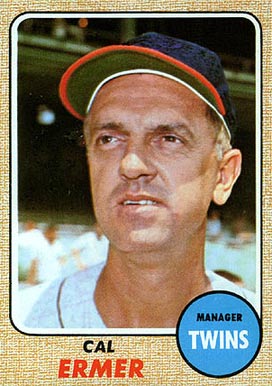
Meet Cal Ermer, man of (possible) destiny
We had a manager for the bulk of the '67 season, Cal Ermer, who is remembered today as a minor league fixture. The '67 summer was his big chance to find the limelight. He's a trivia answer today. He would not be a trivia item, had his Twins won just once over their final two games. The scene was Fenway Park, Boston. The Twins and Red Sox were two of the four teams scrapping desperately down the stretch. It was suspenseful but not artful. Chris Jaffe wrote that the four teams "fought like junkyard dogs."
With a week left, all were within a game of first. From September 15 until the last day of the season, all were within two games of each other.
"High noon" arrived at Fenway for those last two games. I remember.
Us boomers of Minnesota had an emotional tie with our Minnesota Twins. Being a fan seemed more emotional then than today. We rarely saw teams other than the Twins on TV. TV broadcasts could be crude, often with no center field camera position (which we take for granted today). The broadcasters weren't as analytical about baseball as they are today. You might call it vapid banter, the equivalent of what we saw on the Tonight Show Starring Johnny Carson. The media tailored their products for a mass audience. Thus the "least common denominator" often ruled.
Halsey Hall entertained us as we followed that incredible '67 pennant race. Hall was as much a throwback as Griffith. We loved him. He came to Morris in 1969 to help honor our native son Jerry Koosman (pitcher with the Mets). He joked about whether Koosman's "key to the city" would open a certain establishment across the street which was of course the liquor store. We laughed about alcohol consumption in those days. I suspect Calvin Griffith enjoyed his afternoon cocktail.
  
"Yaz" vs. Kaat at the end
The stage was set with those final two games left in 1967: Twins vs. Red Sox.
Carl Yastrzemski, the iconic Red Sox star, was 28 years old and patrolling left field at Fenway. He was a total clutch performer in 1967.
It's now forgotten that Jim Kaat was a similarly clutch performer for the Twins in that stretch drive. Kaat had a super September with a 7-0 record, 65.7 innings pitched and a 1.51 ERA. His arm was overworked. He had to leave the game on Saturday when the first of those two fateful games were played. He injured his elbow and exited in the third inning. Minnesota took a 1-0 lead into the fifth inning. Boston plated a couple runs but Minnesota got the score tied in the sixth.
Ron Kline pitched in relief for the Twins. George Scott of the Red Sox homered to center on Kline's first pitch. Our great shortstop Zoilo Versalles committed a bad error in the seventh that resulted in two runners on for Boston. Boston's great Yastrzemski brought his lumber to the plate. He homered into the bullpen. We lost that game 6-4.
We tuned in for Sunday's game with some unease. Many of us felt the baseball gods just weren't going to be kind to us. Just like on Saturday, Minnesota got an early lead. "Yaz" committed an error that helped us go up 2-0. But in the sixth, "Yaz" singled with the bases loaded, getting the score tied. The rally continued. Minnesota was down 5-2 at the end of the rally, and the forces of destiny seemed not on our side.
Then Yastrzemski made a perfect throw in the seventh to nail Bob Allison at second.
Ermer in pre-game had made an unusual comment, that the moment of truth in bullfighting arrives at 4 p.m. Indeed, late-afternoon at Fenway Park brought resolution to a degree, although four more hours would pass before Bostonians could truly break out the champagne. Bobby Knoop of the Angels fielded a grounder 700 miles west of Fenway, at Tiger Stadium in Detroit, and started a double play that knocked the Tigers out of a possible tie. Boston had achieved what came to be known as "the impossible dream."
Boston's Sunday win over the Twins was by a score of 5-3. Fenway had a crowd of 35,770 which was beyond capacity. The fans had been starved for success. Yastrzemski had seven hits in eight plate appearances over those last two games. He had two infield hits, a double, three solid singles and a dramatic three-run homer.
Yes, there were four teams scrapping down the stretch and although it was undoubtedly exciting, the teams were not playing what you would call artful baseball. That's easy for us to say. Let's see us try to go out there and do it.
Yes, teams were fumbling away opportunities. The White Sox were a half-game out with five games left vs. weak sisters Kansas City and Washington, and had their best pitches rested. The door was open for them. Chris Berman of ESPN always proclaims "That's why. . .they play. . .the game." The White Sox got shut out three times in the last five games, and lost all five. That's why they play the game, indeed.
Detroit kept challenging but was erratic. Meanwhile our Twins gamely held on to first, sole or shared, for nearly all the stretch beginning on September 2 up to that "high noon" time. We can reflect on one pivotal series. We dropped three to the White Sox and in the middle game, we collapsed in the ninth, allowing a four-run rally and losing 5-4. Were the baseball gods at work? 
 
Ermer, Kaat and Chance - can they win?
This was Cal Ermer's time to try to carve out a niche in baseball history. He entered those last two games ready to deploy his best two pitchers: Kaat and Dean Chance. The Twins had a history of doing well at Fenway. In '65 they beat the Red Sox in eight of nine games there, and 17 of 18 overall! Where did that magic go in 1967? One writer suggested "bad luck and bad morale" for the Twins. A veteran Twin said of the thumbs-down on a World Series share for Mele: "I was never so ashamed of anything in my life, and we had enough problems even before that came up."
Today the issue of an extra World Series share would seem like pocket change. Mountains of money accumulate around big league sports today. Griffith cut his teeth as owner when concessions sold at games was a big part of the team's financial fortunes. No ESPN.
Bowie Kuhn called the baseball owners of that time "sportsmen." Their motivations went beyond money. World Series games stayed in the afternoon time slot, until that finally ended with Kuhn famously wearing his long underwear to stay warm, sans jacket, at night World Series games. He was pooh-poohed for that. Call Kuhn a fall guy.
Dave Barry has joked that the baseball post-season games of today are played "after everyone has gone to bed." When the Twins played in the '65 Series, I'd get all the details when getting home from school. I was in the fifth grade.
I was in junior high (that awful phase of life) for that '67 campaign. We saw those disturbing headlines about the Viet Nam War. Seeking to put that aside, we enjoyed songs like "A Whiter Shade of Pale" by Procol Harum. We ate up the Monkees and their songs like "I'm a Believer." Oh, the Beatles were still together and they produced "All You Need is Love," "Hello Goodbye" and "Penny Lane." We'd turn on our transistor radio and hear "San Francisco (Wear Some Flowers in Your Hair)." The dark Doors gave us "Light My Fire." Frank Sinatra and daughter Nancy sang "Somethin' Stupid."
But the war loomed, even invading our supposedly escapist entertainment world. Carl Wilson of the Beach Boys was indicted for draft evasion. The draft board of Louisville KY refused an exemption for Muhammad Ali.
On TV we followed the shows on the big three broadcast networks. "The Newlywed Game" premiered on ABC. The Rolling Stones appeared on Ed Sullivan. Super Bowl I was played in 1967! Green Bay beat Kansas City 35-10 in Los Angeles. Verne Gagne beat Mad Dog Vachon in St. Paul to become NWA champion. Wilt Chamberlain of hoops made 35 straight field goals.
Ermer became Twins manager as a promotion from Denver of the Pacific Coast League. Baseball was his life, at least professionally speaking. He was married to a former Miss Chattanooga (TN) and Miss Tennessee! As a player Cal was in just one major league game. Post-1967 he would manage the Twins' AAA affiliate in Toledo OH. As Twins manager he won 66 of 112 games. One more win would have put him in Minnesota history annals in an indelible way.
But the baseball vagaries would send glory in another direction. It seemed capricious, or was it a matter of Griffith's skinflint reputation? I think the latter. Pitcher "Mudcat" Grant, in protest, considered going full-time with his entertainment pursuits ("Mudcat and the Kittens"). In retrospect, these guys should have gone all-out to win, undistracted, not because of the money they'd make then, but because of the fortune they could make down the road as famous former big leaguers, going to card shows etc. Denny McLain could have done that but he evidently found crime more attractive.
Cal Ermer served with the U.S. Marines in World War Two. He left us for that diamond in the sky in 2009. Cal Ermer, RIP. You didn't deserve such heartbreak as what came down in 1967. Why not a world in which the Twins could win and there was no war? "Imagine," as John Lennon prodded us.
- Brian Williams - morris mn minnesota - bwilly73@yahoo.com

Monday, September 30, 2013

1962 New York Mets had their place amidst Camelot

I had a plastic Mets helmet like this.
The ways of the business world puzzle me sometimes. How can Los Angeles be without an NFL team? I remember when both the Rams and Raiders made L.A. home.
Let's look back to a previous era when New York City of all places had a void. How was that possible? So much romance surrounded the New York Giants and Brooklyn Dodgers.
The West Coast was beckoning. The days when a trip to St. Louis was "a trip west" would begin looking quaint. Quaint, too, was the image of teams traveling by train.
Change is as irresistible as the flow of a river. Major league baseball would plant itself firmly west of the Mississippi. Two of the New York teams pulled up stakes. The New York Giants with Willie Mays got settled in San Francisco. We have heard rumors in Minnesota that those Giants almost re-located to Minnesota. Our Metropolitan Stadium got built in 1956. It wasn't until 1961 that the big leagues came here in the form of Calvin Griffith's Washington Senators. But big league baseball waited not a moment to see that Washington D.C. kept its presence. A new "Senators" franchise was created although that, too, would not be permanent.
The Giants and Dodgers headed west in the late '50s. The Dodgers who had ushered in integration of the races, settled in Los Angeles.
New York City had been the home for three big league teams for over 50 years. "The cheese stands alone," indeed, and this was with the grandiose New York Yankees franchise and "The House that Ruth Built." The movie "61+" was set in that period when the Yankees were the lone team in the Big Apple.
Los Angeles has gotten along for some time without pro football. But New York City wasn't going to tolerate its baseball void for very long. We even saw the prospect of a new league which would naturally tap into New York City. William Shea, a New York City attorney, was pushing this vision. It would be called the Continental League with teams in NYC and seven other cities. No games were ever played.
Major league baseball reached a compromise with the would-be fledgling league. Certain cities that were ready for big league ball would have their wish granted, so our Minnesota Twins were born. Calvin Griffith was the hero owner in our eyes. The young baby boomers of Minnesota would be able to grow up with not only the Twins but also the Minnesota Vikings. It all started in 1961. The people who built Metropolitan Stadium were visionaries. Could we imagine the last 50-plus years without the Twins and Vikings?
New York City was smarting with emptiness and betrayal after the Giants and Dodgers left. These were storied franchises. Jackie Robinson is an icon out of U.S. history. New York City wanted the National League back. The dream was fulfilled in 1962. It was the time of JFK and Camelot. The Peace Corps presented our vision. John Glenn orbited the Earth. 
 
Who to don the Mets' uniforms?
The 1962 New York Mets were not the kind of team that Brad Pitt (OK, Brad Pitt as Billy Beane) would have put together. Assembling an expansion team is never easy, although we learned with the birth of the NFL's Carolina Panthers and Jacksonville Jaguars that the road needn't be entirely futile. Perhaps the thinking has changed some. It's not written in stone that an expansion team must be an abject failure.
It's almost as if the fans are supposed to pay dues. "Wait your turn" (to be a contender).
The puppetmasters behind the '62 New York Mets were not carefully calculating to maximize wins, it appears. Marketing was a big aim. Or, let's say drawing fans was a big aim. This was done by stocking the roster with cast-offs and has-beens from the former Giants and Dodgers plus the Yankees. Nostalgia was tapped.
Pitcher Al Jackson would say years later: "They wanted names, especially ones that identified with New York, so fans would come out."
Of the nine starters on opening day, only one, shortstop Felix Mantilla, was under age 30. That seems utterly shocking for an expansion team. One might think that veterans would be sought to promote stability. Alas, stability was not an attribute of the 1962 New York Mets. It has been written that America could "take a joke" at the time of Camelot. The '62 Mets indeed became the butt of jokes. But history has judged that team to be charming with its futility.
Jimmy Breslin wrote a book about the team called "Can't Anybody Here Play This Game?" The title is a Casey Stengel quote. The fatherly, or should we say grandfatherly, Stengel was the manager of the '62 Mets. He carried himself as a promoter which was what the team needed. He bantered with fans. After a loss he said "the attendance and Mrs. Payson got robbed." The Mets owner was Joan Whitney Payson. The general manager was George Weiss. One of the radio voices was Ralph Kiner who is associated with malaprops on the air. Also at the microphone were Lindsey Nelson and Bob Murphy. What a spectacle these three described.
The Mets played in the old Polo Grounds in Manhattan while Shea Stadium was being built. Shea Stadium would be very close to the New York World's Fair grounds. I remember being in NYC with my family for the World's Fair in 1964, and we almost worked in a Mets game. The Mets still had their image of futility. We didn't see a game but we had a wonderful time at the Fair. My father Ralph directed the University of Minnesota-Morris men's chorus which performed on the fairgrounds. In 1962 the UMM men's chorus performed at the Seattle World's Fair.
Those 1962 New York Mets at the Polo Grounds became the poster boys for abject failure. So what? This was not a winning cast that was assembled. But they were pro players who were doing the best they could. They only won 40 times. But I'm sure there's an interesting story behind each of those 40 wins. The Mets were a way for NYC fans to enjoy the National League again.
Stengel, known as the "Old Professor," deflected attention from the futility with his antics and quotes. Supposedly he had been fired two years earlier for "being too old." America didn't have its grasp of political correctness yet. The boomer youth probably equated "old" with anyone over, say, age 45. Stengel turned age 72 during that maiden voyage of the Mets. He managed his first big league team in 1934. He led the Yankees to seven World Series titles.
He couldn't have been as absent-minded as many of his quotes suggested. Quotes like: "Good pitching will always stop good hitting and vice versa." And: "I don't know if he throws a spitball but he sure spits on the ball." Let's keep going: "If anyone wants me, tell them I'm being embalmed."
Between Stengel and Kiner, the language got abused to no small degree. Oh, it's no matter. The '62 Mets were "a lovable loser." The team reflected American optimism in the face of hurdles. Pitcher Jay Hook would say "the beauty of baseball is that it's a new game every day." This is the quote I would place front and center in connection to the 1962 New York Mets.
The team was like "The Little Engine That Could" even though success seemed stuck in the distance. But success would prove to be in the not-so-distant future. In 1969 we saw the Mets with Jerry Koosman, a player with West Central Minnesota connections, win the World Series (over the Baltimore Orioles). This is likely the most fondly remembered World Series in the minds of the boomers. The Mets! Winning it all! Those "Amazin' Mets." 
 
Players of limited skills
If the Mets were a poster child on a team basis, Marv Throneberry was probably the individual. The first baseman was called "Marvelous." It was wishful thinking. He had been a backup with the Yankees. He hit 16 home runs with the '62 Mets but committed 17 errors in 116 games. He once hit a drive into the gap, extra bases for sure, but he was declared out despite arriving at third with no tag attempted. Alas, he had failed to touch either first or second bases! The legend grew. Eventually "Marvelous Marv" could make a beer commercial.
Such episodes weave an image that seemed to invite fondness and not scorn. The Mets were "a flawed but embraceable option to the imperial New York Yankees," Mike Tomasik wrote.
Gil Hodges was Throneberry's backup at first base. Former Dodger Hodges was 38 years old. Hodges would become manager for the Mets' 1969 World Series run. The braintrust of the original Mets felt veterans like Hodges would give the team a patina of respectability. Richie Ashburn was a former "Whiz Kid" with the Philadelphia Phillies. But he was a kid no more. He played in 135 games with the '62 Mets and batted a quite fine .306, but this season would be his last.
Ashburn played outfield in the vast Polo Grounds where the center field fence was over 500 feet away! And to think that our Metrodome would be decried as the "homer dome" (i.e. flawed). It's harder to impress when you're in the Midwest. Defects in East Coast stadiums exude charm, whereas here they demonstrate we're bush (but not so much anymore).
Frank Thomas joined Ashburn in the Mets' outfield. He'd have his last good year in 1962, homering 34 times and driving in 94 runs. Jim Hickman was the other main outfielder and he lasted with the Mets until 1967. He had an aberrational year with the 1970 Chicago Cubs, when he drove in 115 runs. His previous high was 57 and his next best total after 1970 was 64.
The three outfielders had 22 errors among them. Alas, the infield didn't offer any relief. There was the "Marvelous" man at first. At second we had Charlie Neal and Rod Kanehl booting the ball around (35 errors between them). At shortstop there was Elio Chacon, a good name for a shortstop I might add, doing the best he could but committing 22 errors while batting .236. Neal was the backup at short and struggled similarly.
The former Milwaukee Brave Felix Mantilla pulled his weight pretty well at third, supplying offense with his .275 average, eleven home runs and nearly 60 RBIs. Former Dodger Don Zimmer, a future manager of note, was a backup and offered no relief defensively.
Catcher Chris Cannizzaro was homerless in 59 games. Choo Choo Coleman offered a neat name at catcher, where he plied the glove for 44 games.
Pitchers paid their dues with this kind of backdrop. Roger Craig, one of those former Dodgers, is jokingly described as the staff "ace" and he did win ten games. But alas, ol' Rodg lost 24! Four Mets pitchers lost 17 or more games. Craig hung in there, going on to post a 5-22 record with the '63 version of the Mets.
I have heard it said "it takes a pretty good pitcher to lose 20 games." What's meant, I guess, is that you have to show the tools in order to be sent out to the mound so often. You have to be a gamer. Roger Craig had 13 complete games among his 33 starts in '62.
The staff ERA was 5.04. Al Jackson had an 8-20 record and would eventually end his career in a timely way, one loss shy of a hundred. Jay Hook went 8-19. Bob Miller hung in there through a 1-12 record. Reliever Craig Anderson lost 17 games but somehow managed to pick up four saves.
The Mets' team batting average was .240. They were able to out-homer four other National League squads. But the record shows these Mets were in the shackles of futility, posting a 40-120 record and finishing in tenth and last, 60 1/2 games behind the champion Giants, and 18 games behind the ninth place Cubs.
It was the Cubs who the Mets chased down and surpassed in the 1969 divisional race, in the first year of East/West divisions. Leo Durocher managed the collapsing Chicago Cubs of 1969. Us boomers sat mesmerized as the Mets ascended to the top of baseball in '69, boosted in no small way by our Mr. Koosman, a graduate of the West Central School of Agriculture in Morris. Koosman was the big lefty, complementing the righty Tom Seaver. Seaver was the celebrity and Koosman the big, stable quiet man.
Hodges was the skipper in '69, probably looking on in wide-eyed fashion, perhaps wanting to pinch himself once in a while. Hodges had the success but Stengel had his niche carved out as the first, guiding his team of guys who were either on the way down or (possibly) on the way up - the classic state of affairs for expansion teams.
Stengel understood the role of failure in setting the stage for ultimate success. He once said: "You have to go broke three times to learn how to make a living."
"Make a living" the Mets did. The rest is history. It all started during Camelot.
In closing:
"The secret of managing is to keep the guys who hate you away from the guys who are undecided."
- Casey Stengel
 
- Brian Williams - morris mn minnesota - bwilly73@yahoo.com

Monday, September 23, 2013

1953 "War of the Worlds" (George Pal) the real deal

Boomers sat transfixed watching the 1953 "War of the Worlds" movie. We sat transfixed not in theater seats but in our families' living rooms. The heralded movie turned up on TV during that medium's first major decade of existence: the 1960s, when color got ushered in.
The '60s were also when my generation by sheer force of numbers began shaping entertainment tastes. Our parents didn't really eat up sci-fi. We did. Sci-fi movies that had already had their run on the big screen got a whole new lifespan. Once boomers discovered this fare, it became timeless. It made such a stamp, re-makes were considered a must years later when boomers were in middle (or much older) age.
We started coming into the world in 1946. So the oldest boomers were a mere seven years old when George Pal's "The War of the Worlds" came out. Television is where we really discovered this gem. Same for "The Day the Earth Stood Still" (1951) and "The Time Machine" (1960).
Television gave us its own sci-fi fare, "Star Trek" atop the list. Remember the sound of the "photon torpedoes?" That sound might have seemed familiar. It's the same sound we heard when the Martian war machines in "War of the Worlds" fired the "green ray" from wingtips. It was created by striking a high-tension cable with a hammer.
The 2005 re-make of "War of the Worlds" has not seemed to have staying power. I remember looking forward to that movie, traveling to Alexandria to see it, and not being much moved. The 1953 George Pal version is the one continuing to stick in our minds. It had inspiration, first of all as an unabashedly Christian movie, not that I say this as some sort of Pat Robertson. I don't, but the tone of the movie reflected conviction, not merely an assemblage of Hollywood ideas to try to garner box office.
I admire conviction. A church is a true sanctuary at the end of the movie. The weak and the hurt are comforted. Humanity finds a new wellspring of hope.
George Pal was the producer of the cinema classic. Lest there be any doubt about its staying power, it was chosen for the National Film Registry in 2011. The movie was inspired as a reflection of the apocalyptic paranoia of the atomic age. Here you are probably instantly reminded of "The Day the Earth Stood Still" also.
The world was still in the recovery spasms from World War Two. The forces of good had to crush the menacing Axis powers. Was the conflict truly behind us for the foreseeable future? We couldn't be sure. The Cold War meant that evil was still hovering over us. We weren't sure of the true nature of our enemies. The paranoia set the stage for the incredibly horrible and unnecessary Viet Nam War.
"War of the Worlds" showed us how a foreboding and mysterious enemy could surface. It was the Martians. The template would have been useful for other enemy entities. How about the "Klingons" from "Star Trek?" In real life, were our "enemies" really as sinister and threatening as the popular conception suggested? I mean, we learned that the "domino theory" that propelled the Viet Nam conflict was empty. We learned that Communists in Hollywood were a weird sort of boogeyman, convenient as some sort of political dart board used by the political right. Communism imploded on its own.
The Martians on the screen were done in by bacteria, not by military might. The military could do nothing vs. the Martian war machines. Was Hollywood trying to tell us something? The military was impotent in "The Day the Earth Stood Still." And in the comedic "Mars Attacks!" we see the invading Martians done in by yodeling! Again the U.S. military was impotent.
The military hasn't had the solution for lots of things. What if we took all the money we've spent on military intervention in Afghanistan, and spent it instead on lifting the standard of living and education in that country? Ignorance as opposed to education probably caused a lot of problems we had in the Deep South up through Jim Crow. Ignorance and poverty.
 
Conflict resolution minus guns
"War of the Worlds" projected hope and triumph without the strong arm of the military playing a role. We see the U.S. Air Force "Flying Wing" take flight in Pal's movie, dropping an atomic bomb. We admire the technology. The atomic bomb might have helped end WWII early, or was it dropped as a warning shot to the Russians?
The bomb did nothing to the Martians in the movie. Those war machines had protective "blisters." We learn the Martians can conquer the Earth within six more days. So, someone responds by making a comparison to how long it took God to create it! The religious tone prevails, not in a hectoring way but with a purposeful vision.
The Martians are extremely weak and anemic. Their machines cannot overtake us. People emerge out of the church as quiet takes over. The "crawling hand" of the dying Martian is a signature scene.
 
"H.G. Wells' War of the Worlds"
The movie is considered a "loose adaptation" of the classic novel by H.G. Wells. Wells was truly a genius ahead of his time. Both this movie and "The Time Machine" were promoted in many instances with H.G. Wells' name at the beginning, e.g. "H.G. Wells' The War of the Worlds."
The movie departs from the book in that Wells was a secularist. A divine presence was not part of his construction. Wells gave us a 19th Century journalist who journeys through Victorian London during the attack. Eventually the journo is reunited with his wife. The story is set in 1898.
Roger Ebert in his review of the 2005 movie said the "tripods" (war machines) were "state of the art" for Martian technology in 1898. Trying to revive those images for a contemporary movie doesn't necessarily work well, Ebert continued. He talked about "clumsy retro design."
I might suggest as one solution to have the movie actually set in 1898. I read this same suggestion in connection with the movie "The Lost World" based on a long-ago novel by Sir Arthur Conan Doyle. A remote plateau with dinosaurs might have been believable for Sir Arthur's time, not so much for 1960 when the movie was made.
So, should sci-fi classics be left in the time when they were written? The late Ebert certainly made us think, as he always did. Ebert's "gut reaction" to the 2005 movie (with Tom Cruise): "I do not like the tripods."
Three legs as opposed to four (or any number divisible by two) certainly seem a defective proposition, based on rudimentary engineering. The 1953 movie did not present the three legs in such direct form. Let's credit Pal for how he avoided this bothersome detail or at least shrouded it. His war machines essentially "floated in the air" on three invisible legs.
Steven Spielberg gave us the 2005 movie. Ebert described it as "big and clunky, lacking the zest and joyous energy we expect from Spielberg." Was Tom Cruise the best he could do? The actor brings baggage. He's shallow in the movie, an immature, divorced hotshot who has custody of the kids for the weekend.
The Martian invasion in the Cruise version is nothing but "malevolent, destructive and pointless" (Ebert's words).
In the 1953 release we at least appreciate the metaphors with the Cold War, and the wellspring of hope that humanity finds with Christianity. I wouldn't care if the wellspring had been Muslim, if it at least painted a picture of optimism vs. mysterious adversaries. We still hadn't gotten the Nazis out of our head. We still hadn't moved beyond that spectre when "Indiana Jones" resurrected it.
The military saved us in the 1940s. We call it "the good war" in a perverse sort of way. The scenario since then has been more foggy. It's how us boomers got disillusioned. 
 
Showcase for Barry and Robinson
We watched Gene Barry and Ann Robinson act in the George Pal movie. The movie's director was Byron Haskin. The Martians scrutinize our lush, green and blue Earth. Their preparation is meticulous in all versions of the story. Somehow they miss the bacteria. 
The setting is southern California in the early 1950s. Gene Barry plays "Dr. Clayton Forrester," and Ann Robinson is "Sylvia Van Buren."
A large object crash lands near a town called Linda Rosa. Dr. Forrester, a scientist, is out fishing at the time. He meets Sylvia at the crash site. Also present is Sylvia's clergy uncle, "Pastor Matthew Collins." The religious tone gets stamped.
Pastor Collins eventually recites Psalm 23 in the face of advancing war machines and is vaporized in a riveting scene.
Dr. Forrester waits in town overnight as the fallen object cools. The movie gets scary for kids when late that night, a hatch on top unscrews and falls away, and we see a pulsating mechanical cobra-shaped head piece emerge. Three volunteer "night guards" approach with a white flag in a scene that I remember my father laughing at. Dad probably figured the three were just volunteering to be toast. Indeed, these forlorn guys meet the Martian "heat ray." They're goners.
Three of the manta ray-shaped war machines rise from the gully and advance. Reports come forth from around the world. Our civilization is imperiled. Forrester and Van Buren, undaunted, take to the air in a spotter plane. The plane crash lands, the two heroic characters emerge unhurt and end up in a farmhouse, a scene reflected in the 2005 movie's much-derided (and long) "basement scene."
The 1953 movie has suspense in the farmhouse scene, the kind that might have kids getting nightmares. It works. We get our only real glimpse, fleeting, of a Martian. So, much is still left to the imagination.
Forrester and Van Buren get separated amidst all the panic as the story nears conclusion. They're in Los Angeles now, surrounded by ruins. Forrester remembers something Van Buren told him and realizes she might be found in a church sanctuary. There we find huddled refugees looking as though they were plucked right out of Europe at the end of WWII. The ruins are similarly haunting.
A war machine crashes just as the church seems about to come down. Viruses and bacteria have vanquished the Martians - "the smallest creatures that God in his wisdom put on this Earth," an unseen narrator tells us.
Disturbing as the Cold War was, the movie reminds us that man is an instinctively optimistic creature.
Spielberg's 2005 movie had a $135 million budget and didn't seem as interesting. Plausibility is an issue. The 2005 movie has Martian machines buried in many places including big cities. How could they have gone undetected? Tentacles suck our blood. "To what purpose?" Ebert asked.
Another review felt the Spielberg movie had potential but was "ruined by the 'I'm a bad father' subplot." And still another makes the cogent point: "Spielberg blew it by once again making the meat and potatoes of the film take a back seat to some sort of dysfunctional family crisis reunion."
I have hardly given another thought to the 2005 movie since seeing it. It was just a nice excuse to visit Alexandria where of course many Morris residents go to spend money without feeling any shame.
The 1953 George Pal movie is deservedly in the ranks of classic sci-fi films, filmed with genuine inspiration and not just with an eye toward opening weekend box office "pop."
They don't movies like they used to. Boomers know this full well.
- Brian Williams - morris mn minnesota - bwilly73@yahoo.com

Monday, September 16, 2013

Another dino hideout: "The Valley of Gwangi" (1969)

The blending of cowboys and dinosaurs was an idea waiting to happen. Fantasies involving dinosaurs had been irresistible for a long time.
You would think special effects would have to advance a long way before dinos on the screen would be workable. It's fascinating that in the 1933 "King Kong," various dinos including a flying one, came off on screen as good as you would want. We have Willis O'Brien to thank for that.
O'Brien became a mentor for Ray Harryhausen. Basically that relationship was a passing of the torch. The two gave us "stop-motion" special effects. "King Kong" does not need to be viewed in the context of archival movies, where we expect the craftsmanship to come off as primitive. It leaps off the screen at you. When that stegosaurus tail does its swipe as the creature is dying, we flinch in our seats.
Harryhausen gave us dinosaurs in "The Valley of Gwangi." His genius comes through in the roping scene. That signature scene was labor-intensive even by the standards of "stop-motion."
I have written before about two movies that had to scrap stop-motion because of its cost. One was "The Lost World," a 1960 release that ended up using real modern reptiles as dinos, filmed so that they might seem large. The other is "Mars Attacks!" which should need no introduction, but I'll note that CGI came to the rescue for that one.
In "King Kong" it was beauty that killed the beast. In "Mars Attacks!" it was yodeling that killed the invaders.
 
"Gwangi" in cultural/historical context
"The Valley of Gwangi" came out in 1969. America at that time was getting weary of the kind of monster movie that had become standard fare. I should emphasize that America was getting tired of lots of things in 1969. Our society was in flux. We certainly had become tired of "robes and sandals" movies typified by "Cleopatra" (with Liz Taylor).
Our society was in tumult in many ways. It's sad that "The Valley of Gwangi" came out when our appetite for this entertainment had diminished.
The movie had been conceived years earlier. As with many Hollywood projects, bumps in the road had to be navigated. O'Brien drew up this movie idea, decades earlier in fact, inspired by the Sir Arthur Conan Doyle book "The Lost World." That book led to the movie of the same name in 1960 (with Claude Rains). The premise of that book was one that could be mined further of course. It was mined for the comic book series "Turok, Son of Stone." Prehistoric creatures continue to live in some remote section of the Earth. It might be a "lost valley" or in the case of the 1960 "The Lost World," an elevated plateau in South America. (I'm not sure how the dinos could stay totally confined in such places.)
Willis O'Brien envisioned a movie called "Valley of the Mists." Who knows why it couldn't get a thumbs-up for making. O'Brien passed away in 1962. I'm not sure to what extent "The Valley of Gwangi" followed O'Brien's conception. But the 1969 American western fantasy is considered to be the fruit of that conception.
The public taste for such a movie was at a diminished level, and adding to the problem was a change in management at Warner Brothers and Seven Arts. The powers-that-be didn't have their hearts in this cinema. So, "The Valley of Gwangi" was released with little promotional effort on a double bill with a biker film! It thus missed its target audience and was not as successful as other Harryhausen efforts.
You'll remember that ol' Ray gave us the seven swordfighting skeletons. Who can forget that scream as the skeletons began their attack! America may not have been fired up about a movie like "Gwangi" in 1969. Little did we know that such movies would make a spectacular comeback! There is a scene in "Gwangi" that appears to have inspired a scene in the celebrated "Jurassic Park." The big dino in "Gwangi" appears from behind a hill and snatches a fleeing ornithominus in his jaw. Steven Spielberg gave us a scene almost exactly like this. Was he paying homage? It's possible because after all, he used the actual "time machine" from the 1960 movie in one of his "Gremlin" movies. 
"The Valley of Gwangi" with its unheralded release might have ended up in the dustbin. Except that it emerged in subsequent years drawing on its obvious appeal for sci-fi buffs or people who just like reasonably good action/horror movies. Because, "Gwangi" certainly delivers on these grounds.
Remember the 1980s TV series "Scarecrow and Mrs. King?" Any time a TV screen is shown in the series, "The Valley of Gwangi" is playing. An inside joke? Someone's attempt to pay more homage?
Let's give a tip of the hat to "The Valley of Gwangi" which is what they might call "a good popcorn movie."
Spielberg gave us the T-Rex as his headlining menacing creature - an obvious choice. What's interesting about "Gwangi" is that even though the star monster is like a T-Rex, it's not actually a T-Rex. I'm not sure why they bothered making this minor deviation. "Gwangi" is an allosaurus, which to the uninitiated would be considered a tyrannosaurus (T-Rex).
 
The story: rodeo is the backdrop
"The Valley of Gwangi" takes place in Mexico at the turn of the century. A cowgirl hosts a rodeo which isn't doing particularly well. She has a former love interest played by James Franciscus, an actor who we might say became famous for not being Charlton Heston in "Beneath the Planet of the Apes." Franciscus is a quite fine actor who for some reason - lacking intangibles? - got a 'B' movie tag. Hollywood bestows fame in mysterious ways.
Franciscus works in his character of "Tuck" in "The Valley of Gwangi." He's charming as a roguish individual. Actually, everyone in this movie seems to have venal goals. Perhaps that tone was a reflection of the times in which "Gwangi" was filmed. America was brimming with cynicism. It was easy to envision less than laudable motives on the part of everyone.
I have written before about the 1969 release "The Bridge at Remagen," a WWII flick that has cynicism stamped all over it. A reviewer has said of "Remagen" that "every character is pissed off all the time." Also, the military people give "lip" to their superiors constantly. Movies reflect the cultural tone and priorities of the time in which they were made. So, the tone of "Gwangi" can't be expected to be real uplifting. There's no uplifting feeling of the human character in triumph. The venal tone doesn't get impaled like it would in a contemporary movie.
I have written before about "Almost Famous," that movie set in the 1960s that has a happy ending for all of the sympathetic characters. Such optimism was the norm for when the movie was made (in 2000). I wrote that in the real-life '60s, happy endings were hardly frequent or to be expected.
"The Valley of Gwangi" doesn't have the uplifting qualities but it has action and horror attributes to guarantee its audience. We see the allosaurus fighting men on horses. We have gypsies who know all about the valley and its mysteries, and are superstitious about this.
Cowboys vs. dinosaurs is really great, a plot line waiting to happen. Cowboys vs. their ex-girlfriends wasn't quite as engaging.
There's a paleontologist in the movie just like in "Jurassic Park." "Bromley" the paleontologist shows "Tuck" fossilized horse tracks. Ergo, such a horse actually exists in the flesh in the traveling circus which is run by the seductive "T.J."
Bromley declares this little creature to in fact be an eohippus. It has a name: "El Diablo."
A gypsy named "Tia" claims the horse is cursed. The gypsies feel it needs to be released back into "the forbidden valley." Bromley learns of these intentions and feels it's just fine, as he can then follow them to find more such creatures. Tuck sets off after Bromley. Still others follow, including T.J., and eventually they all meet up.
A flying dinosaur swoops down at them. They follow a small dino which is then seized and eaten by "Gwangi," the star of the movie - that allosaurus (slightly smaller than a T-Rex). A styracosaurus appears and chases Gwangi away. The "sty" has horns that can fend off the largest predators.
Gwangi later pursues the humans back to their base camp. The cowboys try to rope him but he breaks free when the "sty" reappears. Gwangi with the help of a circus employee named "Carlos" finally disposes of the "sty." But Gwangi also dispatches poor ol' Carlos. Gwangi gets "knocked out" as it attempts to pursue the other humans as they exit the valley. Thus the humans can capture the dino, dollar signs in their eyes for sure.
The idea now is to have the dino in T.J.'s show. The gypsies still feel uncomfortable with the beast outside of its valley. So, a gypsy dwarf sneaks around and tries to free Gwangi from its cage. Gwangi breaks free and eats the gypsy. Bummer.
The crowd flees as Gwangi goes on your basic monster rampage. The crowd seeks refuge in a cathedral (inspired by "War of the Worlds?").
Gwangi is able to break in. Many of the people flee through a back exit. "Tuck" has a torch and starts an interior fire which eventually kills the dino. There's your plot synopsis.
Gina Golan plays the beautiful T.J. if you'll permit me to make a sexist observation.
A critic has written of "The Valley of Gwangi" that it's "a disposable piece of fluff, and yet there's something wholly appealing about it anyway." I have also read the following: "It's gratifying to see a movie that doesn't want to be more than it is."
And: "(It's the) kind of tossed-off ephemera that does right by the eight-year-old hiding inside all of us."
I think of "The Valley of Gwangi" as the kind of movie that was typical for the weekly "Taconite Theater" - I think that was its name - us Minnesota boomers watched when young. We also watched "Zulu" (Michael Caine) which eventually came out on VHS tape in a series called "Fun Time." That was a hoot: "Zulu" as part of a "Fun Time" video series! Ah, the movies. They aren't what they used to be. And that's a compliment for what they used to be.
"The Valley of Gwangi" gets plenty of barbs from the highbrow crowd, but I encourage a tip of the hat for such imaginative sci-fi. Now we need to get "Turok, Son of Stone" on the big screen. "Jurassic Park III" was an ambitious movie but it came off odd, like it couldn't make up its mind whether it was serious or somewhat farcical. It was schizophrenic. Such movies ought to be totally serious. Even if all the humans have venal motives.
"The Valley of Gwangi" passes muster by my standards. Even on a double billing with a biker movie.
- Brian Williams - morris mn minnesota - bwilly73@yahoo.com

Wednesday, September 11, 2013

Let's take "Voyage to the Bottom of the Sea"

The 1960s were a time for certain actors to get roles that would define them and endear them to a generation. William Shatner was "Captain Kirk." Lorne Greene was "Ben Cartwright."
These actors already had solid resumes. We might catch Shatner on an episode of "The Twilight Zone."
Television really felt its oats in the 1960s. It took on color. And most importantly, my generation - the boomers - was teeming in numbers, impressionable and a big target for marketers!
Richard Basehart became synonymous with a high-tech submarine. Irwin Allen, who crafted entertainment right in line with the boomers' tastes, gave us "Voyage to the Bottom of the Sea." It was a sci-fi series that grew out of a 1961 big-screen release of the same name. Allen was the creative mind behind both.
The movie's sets were used in the series. "Voyage" was the first of four sci-fi TV series given us by Allen. Comic books grew out of these ventures too.
The submarine "Seaview" had a stated mission of undersea marine research. Of course, the series wouldn't have lasted more than a few episodes if that were its only mission. The secret mission of this nuclear-powered vessel was to defend the Earth from all worldly and extraterrestrial threats. The story was set in the future, the future being the 1970s at that time! (Why couldn't the Seaview have saved us from disco, or the "Smokey and the Bandit" movies, or "Cannonball Run?" Rimshot.)
The underwater world is not as "sexy" as outer space. Therefore, "Star Trek" has left a more enduring impression than "Voyage to the Bottom of the Sea." Shatner become recognizable to everyone in the U.S., whereas Basehart, who died in 1984, never seemed to reach that level. Basehart played "Admiral Harriman Nelson" in the "Voyage" series. The series was satirized in Mad Magazine as "Voyage to See What's on the Bottom." I felt it was one of the magazine's better satires.
Yes, "Voyage" hasn't had the staying power in our memories like "Star Trek" (with Shatner). But a tip of the hat is certainly in order for the submarine series, based on how it lasted for 110 episodes. It lasted so long, its futuristic timeline had to be shifted to the 1980s (the last two seasons). "Star Trek" is on its pedestal, rightfully so, but "Voyage to the Bottom of the Sea" which ran from 1964 to 1968, was the decade's longest-running U.S. sci-fi TV series with continuing characters. Kudos!
Maybe we should see a contemporary movie "franchise" get launched from it. The formula certainly worked before. And, Hollywood likes nothing better than a proven formula these days.
"Voyage" was one of those '60s TV series that changed over from black and white to color. It's odd how the mere use of color could change the fundamental atmosphere of some of these series. Many critics say there's something to be said for black and white. The movie "The Longest Day" about the D-Day invasion was made in B&W long after color had become the norm. Oh, and let's acknowledge "Young Frankenstein" the same way. "Young Frankenstein" epitomized the kind of irreverent fare boomers really ate up when they were young and foolish.
I remember two other TV series that "morphed" into color: "My Three Sons" (Fred MacMurray) and "Combat!" (Vic Morrow). I always liked "My Three Sons" best when William Frawley was on it.
I recently wrote about the 1960 movie "The Lost World." Irwin Allen was director and had David Hedison in his cast. Allen enlisted Hedison again for the "Voyage" TV series, to play Basehart's right hand man. Hedison played Commander Lee Crane on the Seaview.
Hedison was one of those stable, clean-cut Aryan men who could play a reliable leadership figure. I'm prompted to use the word "Aryan" because of a book I once read that described TV sitcoms of the 1950s as "benevolent Aryan melodramas."
America wasn't ready for the top officer of the Seaview or the Starship Enterprise being anything but a white male. "Star Trek" pushed the envelope for that time - perhaps one reason it was canceled prematurely - by having several characters outside that mold in key positions, characters who were non-white, female or alien! "Voyage to the Bottom of the Sea" may have explored perilous depths in the ocean, but didn't venture into the same diverse casting as did "Star Trek." Basehart and Hedison were as "white bread" as Robert Young in "Father Knows Best."
Basehart was the killer in the 1948 film noir classic "He Walked by Night." He played Ishmael in the 1956 "Moby Dick." In 1980 he narrated a mini-series written by Peter Arnett on the Viet Nam War.
 
Basehart in role "above" the water
"Voyage to the Bottom of the Sea" had completed its run before I became familiar with Basehart's role in the 1953 "Titanic." He was part of a cast that was headed by Barbara Stanwyck and Clifton Webb. I was very impressed by Basehart's portrayal of a character inspired by the real-life Father Thomas Byles.
Fr. Byles was an English Catholic priest who remained on the ship as it sank, hearing confessions and giving absolution. He was a convert to Catholicism. Fr. Byles was on board the Titanic en route to officiate at the wedding of his younger brother William. He said mass for the second and third class passengers on the morning of the sinking. His sermon was on the need for a spiritual lifeboat in the shape of prayer and the sacraments, when in danger of spiritual shipwreck in times of temptation.
Fr. Byles was on the upper deck praying his breviary when the ship hit the iceberg. He assisted many third class passengers up to the boat deck, to the lifeboats. He twice refused a place on a boat. Toward the end, he recited the rosary and handled confessions/absolution to 100-plus who remained trapped on the stern after all the lifeboats were gone. His body, if it was ever found, was never ID'd.
The 1953 movie "Titanic" took artistic license with how it presented lots of things, including Fr. Byles. Nothing wrong with that as long as you realize it. The Basehart character is in a mood of despondency, with alcoholism which has gotten him suspended as a priest. He prepares a wireless message informing family of this unfortunate news. It isn't sent. A crewmember who needs to send an urgent message sees the scrap of paper with this unsent message, and in a mood of emergency, flips it over and begins scribbling on the other side.
The Basehart character has the name "George S. Healey." His character is spared any further humiliation from being defrocked. Instead he remembers his most inspired mission in life, and he refuses possible rescue to go to a boiler room and comfort trapped crewmen.
The movie was never intended as any sort of documentary. It's one of those movies that is "inspired by" a real event rather than attempting to present it in wholly authentic terms. But the Basehart character was clearly drawn up to reflect the real-life Fr. Thomas Byles. Bless the memory of both Fr. Byles and Basehart.
 
Cold War influences for TV
The pilot episode of TV's "Voyage to the Bottom of the Sea" was filmed in color but shown in black and white. The first season had Cold War themes (pervasive, unfortunately) and the near-future speculative fiction that came to define the series. Espionage blended with sci-fi.
The Cold War shaped a lot of entertainment in a way that made a lot of us boomers paranoid, I feel.
The Seaview had a diving bell and mini-sub. Space aliens, sea monsters and even dinosaurs loomed. Hedison might have thought he was back on that South American plateau from "The Lost World" (a movie he hated, incidentally, with monitor lizards presented as dinosaurs, although he couldn't have hated acting next to the 19-year-old Jill St. John.)
The main villains in "Voyage to the Bottom of the Sea" were hostile foreign governments. The Cold War truly gave a grim dimension to life in the U.S. in the 1960s. "The Man from Uncle" sought to have fun with that. Robert Vaughn found his career-defining role in that series.
"Admiral Harriman Nelson" is promoted from three-star to four-star admiral during the first season of "Voyage." The Seaview is a key part of the U.S. military. We see this vividly in the episode "Doomsday."
We got a ghost story in season #2. The ABC network wanted a lighter tone for the second season. We got the sea monsters. The flying sub was introduced in season #2: a two-man mini-sub armed with a laser gun, capable of becoming an aircraft.
Season #2 included "The Sky's on Fire" which was a redux of the storyline from the 1961 big-screen release which starred Walter Pidgeon as the admiral.
The third season of "Voyage" ran simultaneously with two other Allen-produced TV series: the campy and disgusting (in my view) "Lost in Space," in its second season; and "The Time Tunnel" in its premiere season.
"Voyage to the Bottom of the Sea" became quite imaginative for its season #3, giving us an evil disembodied brain from outer space and some Nazis who thought the war was still on. The final two seasons saw a shift toward paranormal storylines. Such fare would be quite appealing today. On the scene came mummies, werewolves, talking puppets and an evil leprechaun. Oh, and there were fossil men, flame men, frost men and lobster men. (Remember the movie "Lobster Man from Mars?" Maybe you don't. I still have that movie, starring Tony Curtis, on VHS tape.)
Season No. 4 of this series with staying power began with a five centuries-old alchemist. There were three unrelated stories of extraterrestrial invasion. We get into time travel for two episodes. There was a trip back in time to the U.S. Revolution.
All good things came to an end in 1960s television. The cancellation of "Star Trek" was parodied in a memorable "Saturday Night Live" skit with Elliott Gould as the bad guy TV executive. The skit ended with the Shatner character uttering a line that wouldn't mean anything to nearly everyone today, as it was a take-off on a margarine commercial at the time, with Shatner: "Promise."
It's amazing a series like "Star Trek" would be cancelled given the wave of retro interest that continues to this day, not to mention the movies. We must remember that in the 1960s, the generation that really took to shows like "Star Trek" and "Voyage to the Bottom of the Sea" was very young and without a lot of money or influence. The influential generation of that time liked watching Lawrence Welk or Mitch Miller.
Today the big names of the '60s who are still around can go to casinos, perform and make tons of money from the boomers who are now the ones with money and influence! However, maybe it's time for the Rolling Stones to finally retire. Maybe even "Sir Paul" McCartney.
 
Big-screen "Voyage" had "Floyd the Barber!"
The original movie of "Voyage to the Bottom of the Sea" still shows up on cable TV. I found it odd that a crooner like Frankie Avalon would sing the theme song for this serious sci-fi movie. It was a 20th Century Fox production. The admiral character had the same name as on TV: "Harriman Nelson."
We see the Seaview under the Arctic ice cap. The ice begins to crack and melt as there's a fire in the sky. My goodness, a meteor shower has pierced the Van Allen radiation belt! Heat builds up all over the Earth. The Seaview prepares to fire a nuclear missile at the burning belt. But a Vienna-based scientist says no, arguing the fire will burn itself out and the missile has risks. There's your conflict.
Walter Pidgeon as Admiral Nelson positions his sub above the trench in the Marianas. There's a saboteur on board. There's also a minefield and a near-mutiny. I was distracted when I noticed the actor who would go on to play "Floyd the Barber" in "Andy of Mayberry."
A giant squid confronts the Seaview - a scene that could have come right out of the subsequent TV series. Blobs and monsters of various kinds were a nemesis for that sub. A character at the end of the Mad Magazine satire remarks: "Oh boy, I'll never eat another bowl of Jello."
The movie ends with the Seaview, naturally, saving the world thanks to the missile. Because of that good fortune, we could all go on to watch those Frankie Avalon beach movies with Annette Funicello. Maybe the fire should have gotten us after all.
Seriously, Allen's creations were a source of bountiful entertainment in the boomers' youth. "Voyage" has gotten overshadowed by "Star Trek" (not an Allen creation) in the post-Cold War years, but it deserves its place in the pantheon of sci-fi.
Richard Basehart, RIP. God loves you for helping us remember Father Thomas Byles.
- Brian Williams - morris mn minnesota - bwilly73@yahoo.com

Wednesday, September 4, 2013

Offering plates drying up? Why?

The church my mom and I attend: First Lutheran, Morris. (B.W. photo)
We get too soon reminded how our churches need more money. The church I attend is going through that routine. I'm not sure it's necessary for a big demonstration on the subject to be made in front of the rather thin turnout on Sunday. After all, we're the ones interested enough to at least be in church.
The nagging (by insinuation) should be directed at the people are aren't in church.
OK so what are the issues? One impulse tells me that the so-called "main street economy," translated as us rubes out across the U.S. who aren't connected to the East Coast power corridor, isn't in as good a shape as the national media (with ties to that East Coast elite) are telling us.
You know what I think we need? I think we need to go back to a system where you can go to your local bank, set up a savings account or CD and get paid some interest. Like in the old days. The controversial TARP legislation had the effect of pushing interest rates to a negligible level over a long period of time.
The stock market isn't the answer. Now, with the Federal Reserve backing off on its manipulation that elevated the stock market bubble, we ought to all be whistling in the graveyard. People who exited stock funds in favor of bond funds have hardly gotten a windfall. There also may be growing cynicism across the U.S.
We have accepted a system in which profits rule. That's what happens when we decide the stock market is going to have primacy in our lives. Anyone who was alive during the Great Depression will likely tell you "Don't trust the stock market." In the end, it's always the big operators with inside connections who come away with the windfall.
Money corrupts. All the naive common folks who got sucked into mutual funds and 401Ks are not going to be reaping any windfall. Not if history is any indicator. When I was a kid, I had it pounded into my head (by parents who were young for the Depression) that the stock market was a mysterious and foreboding place, not really to be trusted, certainly not by middle class folks.
Starting in about the mid-1980s, popular notions about this seemed to change. "Financial services professionals" started opening their offices on main streets across America. It seemed a revival plan for an otherwise blighted main street America. We had the "Main Street" program in Morris, overseen by government, as evidence that even we needed help. My assessment of "Main Street?" It was sheep dip. It was an example of the overreach of government.
Many experts see a big stock market "correction" coming, as early as this fall. It's more than the usual warnings. You might get ahold of David Stockman's book, "The Great Deformation."
I have been aghast observing how the whole nation thinks Ben Bernanke can lead us along like he's some sort of savior. We'll all eventually realize that he was just buying some time. His actions may be found to be counterproductive in the long run. We send representatives to Washington D.C. from all over the country, and there they blather and demonstrate, seeking attention, when in fact an unelected person like Bernanke seems to hold all the cards. The chairman of the Federal Reserve is supposed to responsibly manage the money supply. That's all he is supposed to do. He is not supposed to try to solve the problems that we elect politicians to solve.
The day of reckoning hasn't quite come yet. While predicting the future with certainty is never guaranteed, the signals are most ominous. One doomsaying economist said: "I'm not saying I can't be wrong; what I'm saying is if I'm wrong, it will mean everything I was taught about economics is wrong."
So, people aren't giving enough money in church. The primary point I'm making is that maybe the economy for common folks - us rubes out here in the Great Plains - isn't as solid as we're led to think. People feel less generous. 
 
At the micro level: two ELCA churches?
Focusing on Morris specifically, I think we have trouble supporting two ELCA Lutheran churches in town. I have written before that the creation of the Good Shepherd Church north of town might drain support from existing churches. I'm not sure to what extent this has happened. This theory might be overblown.
Our two ELCA Lutheran churches are on opposite sides of town, on "opposite sides of the tracks." The street out in front of First Lutheran Church (our church) is in horrendous shape. You'll thump-thump-thump over it.
Of more serious concern is how First Lutheran was designed. There are stairs to negotiate all over the place. It's like our old school that was recently torn down. What's the first thing you saw when you entered the main doors of the 1914 building of our old school complex? You saw a substantial flight of stairs headed up. What's the first thing you see when you go through the doors at the front of First Lutheran? Steps going upward. Oh, and steps go downward to the fellowship hall too. You had to choose.
When the time came for First Lutheran to install an elevator, leaders had no choice, given logistics, but to locate that elevator a long ways from the sanctuary. What a difference from the Catholic Church in Morris. When you step out of the elevator at Assumption (Catholic) Church, you are basically "in the sanctuary!" In fact, you're closest to the front pews, which are the hardest to get filled anyway (in our modest Minnesota culture).
The ELCA Lutheran Church on the west side of the tracks is the complete opposite, architecturally, from First Lutheran. Faith Lutheran in west Morris has everything on one level. There aren't even any steps leading to the entrance! Given how our population is aging (and how older people tend to have more money), Faith Lutheran seems far more advantageous. That's sad for First Lutheran whose leaders have of course always meant well.
Given the financial shortcomings for First Lutheran now, I wonder if a full-fledged consolidation might be coming. To date we have seen some small steps toward consolidation - more sharing of resources and more combined events. But I wonder if those small steps might actually have been counterproductive. You see, these steps may be reducing the sense of identity the respective congregations have. It might be best to "get it over with" and consolidate.
Let's be blunt: Faith Lutheran has been handicapped by a reputation of quite unpleasant conflict among parishioners and/or clergy. I have heard some bizarre stories about parishioners' behavior there. I know of at least two families that have left Faith for First, for this reason. I have been told that some of the more "edgy" parishioners at Faith have gone out to Good Shepherd (what a friend and I refer to as "the dog kennel church" since it's next to Dan Sayles' place). Consider that a rumor.
I have always been bothered about how Morris public school employees seem under pressure to join Faith, as if it's part of the package of working for the school. I don't see why people can't just be left alone in their private lives. Once in a while a free spirit like Wanda Dagen, band director, will come along and just join First. 
 
Broader forces at work too?
Are the financial struggles of churches a reflection of broader social trends? Let's not sneeze at this. The "information age" means we can connect with people of common interests, thus we become part of these new "online communities," and we're less dependent on communities that are defined geographically. Instead of defining ourselves by living in Morris or West Central Minnesota, or by belonging to a certain church, we connect with people in a virtual way who are like us.
The epitome of the old model was "Peyton Place." It was a place where people got bored. I think we overlook how in our contemporary society, thanks to the tech explosion, we have conquered boredom. We have crushed it. So much so, distracted driving has become a major problem and issue. We can hardly keep up with all we're trying to cram into our heads.
A friend tells me that today's younger generation doesn't seem to need to affirm faith by "going to a building." It's a different attitude or lifestyle.
I still go to church at First Lutheran but I don't like taking communion. I have sort of a phobia about it - always have. I'm scared I'll get to the front of the sanctuary and not know quite what to do. Or that I'll trip or something, or - horrors - I'll forget where to sit back down when I'm done. Leave a trail of bread crumbs?
First Lutheran is a venerable old institution in Morris. We'll just have to see what happens. Pastor Paul Erdal is as articulate as they come. He could be a successful "TV pastor."
- Brian Williams - morris mn minnesota - bwilly73@yahoo.com