History-making music group for UMM - morris mn

History-making music group for UMM - morris mn
The UMM men's chorus opened the Minnesota Day program at the 1962 Seattle World's Fair (Century 21 Exposition).

Tuesday, March 19, 2013

"Win Win" an endearing film about life's ruts & triumphs

"Win Win" (2011) is one of those movies that got a lot of promo on cable TV but didn't show up at the regional movie complex. The complex most convenient to us would be the one in Alexandria. (Yes, that's our "Mount Pilot.") If "Win Win" ever showed up there, it was after I had stopped checking.
I had the same experience with the movie "W" about the life of President George W. Bush. I called the Theater about the Bush movie, even asking if there were political reasons behind the apparent non-booking! ("You're a political animal," one-time Morris Chamber of Commerce manager Scott Beckman told me.)
In our media-drenched universe, people my age can't expect business to be done like in the old days. They say the 1930s was "the golden age of Hollywood." Balderdash. Take a look at the DVD vending machine at McDonald's. Hollywood is spitting out movies faster than I can keep track of them. Today is the "golden age."
The movie "Win Win," despite its visibility in those cable TV promos and its obvious charm and quality, evidently didn't penetrate into the clear mainstream. James Berardinelli of "Reelviews" didn't even review it. I even noticed a little campaign online to get him to review it. Good ol' Roger Ebert did review it. Ebert liked it but not as much as I would have expected. I would have expected Roger to like it without any reservations. Ebert is a "critic of the people," and "Win Win" is a tale about real people, showing their flaws and everyday tribulations but also their ability to prevail.
There is nothing not to like about "Win Win," which stars the endearing everyman Paul Giamatti. I didn't like him in "Sideways" which I considered the epitome of amoral Hollywood tripe. But "Win Win" is a fresh and inspiring offering which Giamatti seized to portray Americana - the joys but also the grim challenges faced by ordinary Americans. These are Americans facing the specter of bills to pay. They are in no way extraordinary with their talents. Or motivations. They don't rule out cutting corners or bending rules.
We all know people who might resort to a little shiftiness. Hold up a mirror, anyone? Some of these people may slip into a gray area where they might be truly "bad." But there surely is a wide gray area. Stuff breaks and people don't fix it. This isn't just suggested in "Win Win," it's vividly portrayed. Giamatti plays Mike Flaherty, a struggling attorney whose office is plagued by a clanging furnace, the repair of which poses a daunting bill. We can nod as we relate. I raise and lower our garage door manually even though there's an automatic system in place - gremlins, I guess.
"Win Win" shows people on the margins with overwhelming reason to feel discouragement, but who nonetheless feel a zest for life and family. You just have to probe below the surface. Attorney Flaherty has no intention of being corrupt or to hurt anyone. But he does play fast and loose with the legal rules. This is in his role as a legal caretaker for an elderly client with early dementia issues. The client is played by Burt Young. You remember Burt from "Rocky?" I have a fondness for him mainly because of a movie you have most certainly forgotten. He starred in "Uncle Joe Shannon" which had a soundtrack featuring my childhood musical idol: Maynard Ferguson, trumpet player. Burt and Maynard may have been on the cusp of long-term fame at the time. But the movie did not succeed.
Burt Young acts very well as Flaherty's client in "Win Win." He's a patriarchal old man who has been blessed by riches. In the end he wills his money to the city parks system - God bless him. He overlooks his ne'er-do-well daughter played by Melanie Lynskey. I won't bother stating anymore that a particular actor acted well, because I think everyone acted brilliantly, creating a gem of a movie that deserved to circulate more widely than it evidently did.
It's amazing this far into this blog post that I haven't alluded to the sports element of the movie. Is it a "sports movie?" It comes close but I'm not sure I'd brand it that way. I found it very refreshing to see a movie presenting high school wrestling, the red-haired stepchild of winter prep sports, in such a dedicated way. I have been to many high school wrestling meets. I used to cover the sport for the print media. There's no sport I didn't cover for the print media.
So you might want to know: Do I consider high school wrestling to be under-appreciated? Well, the answer is no. I don't blame the average Joe fan for not being greatly interested in watching. Two guys wrap around each other on a mat while a referee assigns points on various moves. It's rather esoteric. It seems depressing when a kid gets pinned. There is an obsession with weight classes. I found it depressing that so many kids went out of their way to drop weight. I found it depressing when several weight classes would be "forfeited" during the course of a match. Some coaches would hesitate sending out a kid to vie vs. a "superstar" opponent. The fame of these "superstars" would circulate widely in the wrestling realm, just like the reputation of "fast guns" in the old west.
The state wrestling tournament is like a mecca - yes, with almost religious-seeming overtones - for those in the wrestling fraternity. And that's a big part of the problem: it's too much of a fraternity. It can seem too "inside baseball." (Did that term originate with the old Johnny Bench syndicated TV show?)
Giamatti as Flaherty coaches a suburban New Jersey high school team in a losing rut. It's symbolic of course. "Win Win" is about the grind of day-to-day struggles and human failings, even as it shows our potential to rise above in the end.
The Burt Young character has a grandson who shows up out of the blue to startle Flaherty. The grandson is a diffident young man of few words, a boy who has been deeply hurt and made cynical before his time. We see he has a heart of gold, though. He buys Cocoa Puffs for his grandpa. What better symbol of love? Alex Shaffer, a real-life wrestling champion, plays "Kyle."
The assistant coaches add texture to the movie. Bobby Cannavale plays "Terry" who is Mike's best friend. Terry has had much travail come into his life. Like for example, his wife leaving him for the contractor who was hired to remodel the house.
Mike and Terry have the kind of friendship I find most endearing. Remember your best friend from college? It's like that. It has that unconditional quality - we sense the potential for laughter no matter what storm clouds are looming. Cannavale as Terry is enlisted to sit with the coaches at mid-season. Holy cow, it's sort of like "Hoosiers" in which the (stereotypical) town drunk is enlisted, right? Terry has rough edges as a coach but he's much more stable than the Dennis Hopper character.
Let's acknowledge the other assistant coach: "Vigman," played by reliable treadmill actor Jeffrey Tambor. By coincidence, I caught Tambor on the DVD of "Pollock" (about the artist) recently. "Vigman" is an accountant who shares Flaherty's office. Business isn't booming for him either. Life for these everyman souls seems to reflect the fortunes of that wrestling team.
But "Kyle" comes along and provides quite the new wrinkle. In the story he comes from Ohio. He's cutting ties with his druggie mom, or trying to. Kyle is a bleach-blond, zoned-out kid of few but well-chosen words. We're reminded of Sean Penn when he found his footing as an actor. But Alex doesn't have to "act" when wrestling. He's quite the genuine article. In fact he's amazing.
The coaches are amazed in practice when first they become aware of the young man's gifts. The coaches exchange glances just like the coaches in "The Natural" when first the Robert Redford character takes batting practice. The drab and drudgery-filled lives of the coaches, along with the Flaherty family, are about to be pierced by the presence of the extraordinary Kyle.
Kyle wrestles the way "Roy Hobbs" (Redford) hit baseballs. Kyle has every reason to be cynical and discouraged but he unmistakably projects love. With few words. So, is "Win Win" a sports movie? Sort of, but only to an extent. Some movies of this type feel they need to show the heroic characters winning it all at the end. Such was "Hoosiers." Some apparently feel this is too predictable so it's better to show some sort of setback at the end, but with some lessons learned. "Coach Carter" is that type of movie (with rap music impressed on your brain by the end).
"Win Win" goes in its own direction. Kyle never shows any flaws as a wrestler. But he does misbehave because of the swirling disillusionment he feels, i.e. the sense people are letting him down. He gets disqualified. But he doesn't "lose." We can't imagine him losing to anyone. In one scene the coaches are amazed watching a video of Kyle from Ohio. These jaded guys show effervescent joy, thrusting their arms up and shouting as they watch Kyle perform a move they are well familiar with.
Kyle is a reminder that triumph can come out of nowhere. He's a reminder that many of life's triumphs can be unscripted and unexpected. He's a reminder that a simple box of Cocoa Puffs is a gesture of unconditional love.
We become fans of the "New Providence High Pioneers." We become fans of all the actors and actresses in "Win Win." James Berardinelli did not review this movie. I'm most happy to roll up my sleeves and do so.
- Brian Williams - morris mn minnesota - bwilly73@yahoo.com

Monday, March 11, 2013

Dome fades, but remember Metropolitan Stadium?

Epochs in sports come and go.
The days of our Metrodome as a big-time sports facility appear numbered. I say "appear" because I feel some denial about it.
The departure of the Vikings from the Dome now seems certain. All we need are for loads of people to get suckered into "electronic pulltabs" and I guess the new shrine (stadium) will be built. Early reports on that seem not encouraging.
The Metrodome has been wonderfully practical. Never described as luxurious or opulent - heaven forbid - it was stretched to include all kinds of athletic action including the first season of the Timberwolves - remember that?
Speaking of remembering, how about old Metropolitan Stadium? Memories of that are a touchstone for boomers here. It was up and running for Twins baseball just as the big wave of boomers was getting interested and pestering their parents to come to games. The Twins seem such an essential part of the fabric of our lives now. Imagine pre-1961 when the Twin Cities were actually minor league. Dave Moore may have missed the old Nicollet Park which housed the old Triple-A Millers. His views weren't exactly shared by a chorus. But the Millers must have had their attributes for entertainment, even if housed in as humble a place as Nicollet Park (apparently was).
The imminent retirement of the Dome pushes the old "Met" back further in our collective memory. It was built before all the sophisticated engineering wizardry that was employed for Target Field, to minimize the effects of our Minnesota weather. Weather could be a bothersome issue for the Met. This became especially apparent when "the second tenant" of that facility, the Vikings, took the field. Bud Grant always emphasized with defensiveness that the Vikes were the second tenant. The Met was built to bring big league baseball here. It's accurate to say there was planned obsolescence. By the time of the Met's last season, it was sort of a nursing home candidate, having become a "bucket of rust," according to one account.
 
Remember those orange shirts?
We saw big league soccer at the Met. I acquired one of my own orange Minnesota Kicks T-shirts. The shirt was practically a "uniform" for boomers for whom it became fashionable to go to Kicks games, with the sport itself a secondary attraction. These were social spectacles for a restless and sometimes unruly generation. (I could use more pointed language.) Remember coach Freddie Goodwin?
The Met as a football venue had a mixed effect for us Minnesotans. It showed us as hardy folk. The snowmobile suit was common attire. We took some pride in the hardiness. However, PR-wise in the national picture, this image seemed negative. Who in heck would want to live in such a place? Construction of the Dome seemed almost a miracle in how it freed us from such issues. Whereas April baseball games were once problematic, all of a sudden "under the roof" we were in better shape than Baltimore where rain often cascades down in April. All of a sudden in December, we seemed in better shape for football than places like Chicago or Buffalo.
Hardy? We could now enter the Dome as if we were going to the theater. But of course we didn't stay satisfied. The Gophers left, hoping to become more competitive someplace else. Did that work out? The Twins left. Their new home seems quite fine. And the Vikings twisted arms well enough in the legislature and with a pliant Governor Mark Dayton to get the new palace planned. All while football is discussed daily with an increasingly grave and concerned tenor regarding the health issues (for players). If high school kids drop the sport en masse, what kind of future can we envision? It's not a drastic prediction.
But electronic pulltab gambling will evidently pull us through in terms of getting the new stadium. That's the projection anyway, but I wouldn't rule out the state's general fund coming to the rescue.
We might forget, but Metropolitan Stadium predated the Twins by several years. Let's go back to the spring of 1956 when "Ike" Eisenhower was planning a run for re-election. The man who led us on D-Day would serve two terms in the White House. These were the 1950s, a decade we tend to want to romanticize about. Jim Crow laws were going to be wiped out in the South. The Supreme Court demanded integrated seating in the Montgomery AL bus system. You could go to Downtown Chevrolet Co. and take advantage of a closeout sale on 1955 Chevys for - steady yourself - a little over a thousand dollars.
April is "play ball!" time to usher in spring, of course. And April of 1956 saw something shiny and new on the Bloomington MN prairie, set to replace ancient Nicollet Park. It was a whole new ballgame, yes. But it wasn't the Twins. It was still those Minneapolis Millers. It might have been the best Triple-A team around. Willie Mays had a stint there. But we weren't in "the majors" yet. Met Stadium was built to induce a major league owner to come here.
Minneapolis played Wichita in the first game to be played at the Met. Oh my, there was quite the "open" feeling around the Met, especially then. Roger Angell would eventually describe the stadium as an "airy Cyclotron" in a bit of pretentious writing that we might associate with the New Yorker, for which he wrote.
Newspaper scribe Charlie Johnson was important in the efforts to get big league ball. He was prodded by Jerry Moore, president of the Minneapolis Chamber of Commerce. The construction of "Metropolitan Area Stadium," its name at the start, was step 1 in a process that was going to take time. Moore appointed a baseball committee. The St. Paul Association of Commerce set up a committee to enhance efforts in 1953.
What location for the ballpark? Candidates were weighed and dismissed. The St. Paul interests arranged for an engineering firm, based in Cleveland, to really roll up its sleeves and get this settled. It was their engineer who identified 160 acres of land in the Twin Cities suburb of Bloomington. The site was seen as neutral. Despite St. Paul's involvement, St. Paul-ites grew resistant. They seemed "out of the action." St. Paul wasn't mollified for a long time, or so I've read. The Minneapolis-St. Paul rivalry has always seemed alien to me.
An organization called the Minute Men went after money - private capital. Baseball was restless. The Boston Braves moved to Milwaukee in the early '50s. The St. Louis Browns moved to Baltimore and became the Orioles. New York City was rife with rumors about its Giants and Dodgers pulling up stakes. Ah, "the west" beckoned.
The Minneapolis committee appeared to have a chance to land the Philadelphia Athletics in the fall of 1954. Efforts toward the new stadium hadn't progressed far enough yet. The Minute Men had trouble reaching their monetary benchmark. What it all came down to, was city leaders with deep pockets just doing what they had to. We heard the name "Cowles" a lot.
The Bloomington land was bought with still no guarantee of landing a team. What quaint times - we're talking pure farmland where the "cyclotron" was going to be built. The groundbreaking occurred when I was six months old. Concrete was first poured in September of 1955. When it became clear the Giants were going to be heading way out to the Pacific Coast, to San Francisco, we began to realize that Washington's Senators were going to be our team. Calvin Griffith, who would be labeled by us boomers as a fossil of a man, culturally anyway, would bring his crusty and curmudgeonly presence here. Calvin wasn't cutting it financially in the nation's capital. Amazing how Minneapolis was able to present more attributes than the east coast power corridor. Amazing.
It was on October 26 of 1960 when the historic vote came by the American League to do three things: establish an expansion team in Los Angeles, move the Senators here, and oddly, to replace the Senators with a new expansion team in D.C. The nation was about to elect JFK president.
  
The Met's history, pre-Twins
In 1955 we had this "orphan" ballpark materialize on farmland. It was like the Little Engine that Could, not so certain at the start. The Met opened for the Minneapolis Millers in April of '56. Left behind was Nicollet Park which was built in 1896. Nicollet had a right field fence just 279 feet away!
The Met was truly fledgling on that day 1, capable of handling only 20,000 fans, and apparently even that was a stretch. Look toward left field and you still saw farmland. The first fan customers were warned through the media of possible hazards like tools, unfinished steps and randomly positioned machinery. The Millers greeted a record crowd for opening day of 18,366, despite a nip in the air with the temperature at 45 degrees. Many fans wanted to just wander and observe the place. Jerry Moore threw out the first ball. The leadoff hitter for the Millers was Billy Wells, center fielder. Oh, and the national anthem was sung by Robert Rounseville, in town with the New York Apollo Club. My late father Ralph E. Williams - he died just recently at age 96 - was director of the Minneapolis Apollo Club in the 1950s.
Our family would end up visiting Met Stadium several times to enjoy the Twins. Let's always embrace the memories of the "old Met."
- Brian Williams - morris mn minnesota - bwilly73@yahoo.com

Monday, March 4, 2013

Yes! Yes! Yes! Three freethrows bring girls victory

GBB: Tigers 55, Paynesville 54
Talk about dramatic! The Tigers slipped past Paynesville in the opening round of Section 6AA play, lifted at the end by clutch freethrow shooting. It was an unusual situation because Katie Holzheimer would get three shots from the line. That's because she was fouled while attempting a three-pointer (her forte on the court).
A made three-pointer would have brought victory to the Tigers, by one. The foul made the situation a little more complicated. Holzheimer would now have to make three separate shots. She would have to be cool and composed at the line. She was performing in front of a friendly home crowd.
Up goes the first attempt. It's good! Up goes the second. Bullseye! One more make and MACA would own the lead at one. Eureka! The ball goes through the twine and MACA is up 55-54. That was the final score.
The game was played on the last day of February. So, that means? We're into "March Madness." We're also anticipating the spring season with its reprieve from the oppressive winter conditions.
Morris Area Chokio Alberta and Paynesville are South Division teams. The Tigers looked to be in a good position at halftime, up 33-28 in this quarter-final affair. Paynesville outdid the Tigers 26-22 in the second half. Holzheimer bailed out the Tigers by re-injecting some of that "mo" into the Tigers' cause. Fans won't soon forget it. MACA came out of the night with 17 wins on the season, ready for semis play.
The Tigers surged early against the green-clad Bulldogs. They fought to hold their own the rest of the game, really. The five-point lead at halftime really didn't look secure. The Tigers scrambled to try to find a formula that would right their ship. The teams played very evenly over the last eight minutes. The lead bounced back and forth. It was up to Holzheimer, the Tigers' long-range shooting whiz, to be the hero at the end. Paynesville did have a last-gasp shot attempt but it was no-go.
In overcoming Paynesville, MACA had to overcome a hot-shooting individual name of Brooke Wuertz. Wuertz connected on five 3-pointers in the first half alone! She would hit no more, but she was game-high in scoring with her 20 points. Kayla Schaefer scored 16 points for the Bulldogs.
Holzheimer scored 14 points but she only had one 3-pointer. MaKenzie Smith had two 3-pointers and Beth Holland had one. The team numbers in 3's were four of 13. In total field goals: 19 of 56. MACA needed its excellent 13-for-16 freethrow numbers.
Smith and Beth Holland each scored 16 points to top the MACA list. Holzheimer with her 14 points was next on the list. Nicole Strobel scored four, Abbie Olson and Kaitlin Vogel two each, and Becca Holland one. Smith was tops in rebounds with seven followed by Strobel and Olson each with four, and four Tigers each with three rebounds: Beth Holland, Becca Holland, Holzheimer and Moira McNally.
Becca Holland was sharp with her passing and finished with five assists. Smith, Holzheimer and Strobel each dished out two assists. Strobel led in steals with three followed by Becca Holland with two.
Paynesville finished its season with a 13-11 record.
 
Boys hoops: NL-Spicer 69, Tigers 59
A long-range shot by Joey Dreier seemed like a dagger for the MACA boys as they tried to turn back Dreier and his New London-Spicer mates Tuesday (2/26), here. This dagger happened in the closing seconds of regulation time. The Wildcats seemed on the ropes. They needed three points to tie the score and force overtime. Dreier took aim at the basket with five seconds left. Could the Tigers hang on? Alas they couldn't.
Dreier was a clutch performer and his shot proved true. Infused with new life, NL-Spicer carried that feeling of momentum into overtime nicely. The overtime in fact belonged to the visiting Wildcats. The final score was 69-59 as the orange and black faithful had to go home feeling somewhat deflated.
This game would never have seen overtime had MACA succeeded with freethrows better in the late stages. Meanwhile the Wildcats were shooting freethrows like it was their home floor. For the game the 'Cats made 20 of 23 tries from the line. That speaks volumes.
The Tigers seemed to fade as this game wore on. The first half was upbeat indeed for the orange and black. Coach Mark Torgerson's squad owned a 28-19 lead at halftime. But the 'Cats took on luster in the second half to carve out a 38-29 advantage. Then came the forgettable overtime for MACA. Ouch. The Tigers nevertheless came out of the night with a 17-7 record - most encouraging with post-season awaiting.
The Tigers led by four points with 18 seconds left in regulation. A little nudge from freethrow shooting, and this game would have gone in the win column for MACA. It wasn't to be, and Dreier salvaged the Wildcats' fortunes which then improved even more for overtime (with a 12-2 scoring advantage). Dreier had 18 points for the game, plus he collected eleven rebounds. Aaron Ruter put in 19 points (and picked up five assists) to lead the visitor.
Ruter wasn't game-high with his points. That distinction went to an MACA Tiger, Austin Dierks, whose total was 24 points. His ten rebounds gave him double-double distinction. Chandler Erickson put in 12 points while Lincoln Berget had eight and Nic Vipond six. Then we have John Tiernan with four, Tyler Henrichs and Logan Manska each with two, and Jake Torgerson with one.
"Ouch" again: The Tigers were zip of eleven in three-point shots! In total field goals their numbers were 23 of 57. In freethrows: 13 of 22. Dierks was tops in rebounds with ten followed by Tiernan with seven and Erickson with six. Erickson picked up seven assists to lead there, while Vipond had three. Dierks stole the ball three times.
 
Girls basketball: Sauk Centre 61, Tigers 29
The regular season ended with kind of a thud for the MACA girls. It's only a minor blemish in terms of effect on won-lost mark. But the score disparity was discouraging. The Tigers took on an obviously high-quality Sauk Centre team on Saturday, Feb. 23. The Streeters were sailing atop the West Central-North Conference. They kept on sailing, handing our GBB Tigers a 61-29 loss.
So the regular season ended for coach Dale Henrich's crew with a record of 16-9 (12-4 league). Those are the upbeat won-lost numbers the team carried into post-season on Thursday. The loss to Sauk Centre was on the road.
Katie Holzheimer continued her strides on the all-time three-pointer list for MACA. Already the career leader, Holzheimer added three more 3's to her total. Those were the only long-range makes by MACA in this game. The Tigers were three of eleven in 3's, nine of 46 in total field goals and eight of 15 in freethrows.
Holzheimer led the Tigers' scoring with 12 points. Beth Holland scored nine followed by Nicole Strobel with three, Moira McNally and Kaitlin Vogel each with two, and MaKenzie Smith with one. Smith and Holzheimer each pulled down five rebounds. Rebekah Aanerud came through with two assists, and Holzheimer led in steals with three.
Sauk Centre came out of this game with enviable won-lost numbers of 23-2 overall and 14-0 in league.
The Tigers got buried 38-18 in the first half.
The Streeters made five 3-pointers led by Elizabeth Ellens with two. Ellens was joined in double figures scoring by Macy Weller and Jena Klaphake.
- Brian Williams - morris mn minnesota - bwilly73@yahoo.com

Wednesday, February 27, 2013

Milestone: UMM Student Center "comes of age"

Here's the north entrance to our UMM Student Center. (B.W. photo)
The Student Center on the UMM campus marked its "birthday" recently. I became aware of this because I'm on the recipients list for UMM-related emails. Sometimes they clutter up my inbox a little but I accept it.
While UMM is eager to have me know about everything that is going on out there, there are places where community members are apparently not welcome. Oh, I understand why consternation might be felt about non-students being in a place like a student residence facility. But the "Student Center" seems to be another matter.
It's really a misnomer. UMM's "Student Center" is really the most public place on campus. It includes Edson Auditorium and Oyate Hall. I have been there many times for formal events. Often the food and hors d'oeuvres served there are of the exotic variety, away from the mainstream. It's not my cup of tea, but then again maybe my tastes aren't representative.
The Student Center marked its "21st" birthday. It's kind of an oddball milestone. Normally you'd expect increments of 20, 30, 40 etc. But "21" suggests "age of adulthood." Although, when I was young America was experimenting with a younger age for this. I was age 18 in 1973 when I recall the doors were opened for such "privileges" as drinking in bars for us folk. The argument was that if young men could be called upon to fight and die in Viet Nam, those of their age could have adult "privileges."
Isn't the drinking age 21 now? I'd hardly know because I haven't consumed alcohol in ages, other than to have a beer with my pizza at Pizza Hut, for reasons having nothing to do with craving alcohol. Not that I have ever craved alcohol, but when I was young, my generation was supposed to pretend we enjoyed this pastime of putting down booze. And drugs. If your parents are boomers, they probably won't want to open up to you about this.
So anyway, our Student Center at UMM has "come of age," reaching "21." It's almost embarrassing because it reminds us that UMM didn't have a student center prior to 21 years ago. St. Cloud State had its Atwood Center complete with its bowling alley and ballroom, but UMM had nothing equivalent. I'm sure UMM students were content and fulfilled anyway. But there was no student center. Now we have had one for 21 years. Where does the time go?
But I sense there is a problem with the Student Center. There is a room there where "community members" (i.e. non-students) are prohibited from entering. The doors to this room are right in the main hallway. It seems like an inviting place. It's a lounge. You might want to grab a copy of the University Register, find a place on a sofa in there and page through it. There is no sign at the main doors, to my knowledge, stating that access is restricted. Instead you'll see a couple sheets of paper tacked to bulletin boards in there stating that only UMM students are allowed. I thought at one time the purpose of that message was to just discourage high school kids from coming out. But no, if you're a "community member" you'd better not go in there.
For a long time I popped in there occasionally, thinking it was just no biggie, and no one seemed to care. I was seen by UMM employees and occasionally even by a security person. No one cared. Until finally the day of reckoning came. Of course, the security person who accosted me didn't know who I was. Not that I'm important or anything, but people who know me know I'm upstanding and innocent. I remember once when a UMM employee sat down beside me, and I felt I should explain that "the computer stations at the public library were full." He smiled and said "I don't care (about you being here)."
I know of other community members who have sought the use of University facilities in like fashion. Such as, the wife of a former Morris mayor who said she went to the Briggs Library to grab a computer and do some genealogical work. She told me this suggesting she realized she probably wasn't authorized to do this. She said that early-on she exchanged sort of a "knowing glance" with a high-ranking library employee with whom she had a personal friendship. That goes a long way of course. But it shouldn't. There should be consistent policies. And in my case, I resent that I was targeted for a hostile encounter if it was because of "profiling" or "stereotyping." In other words, a 58-year-old male like myself is apparently seen as "suspicious" while an "older lady" like the person I just referred to, is given a pass.
You might chuckle. But seriously, it is never pleasant to be treated in a way that reflects "profiling" or "stereotyping." UMM has an underlying philosophy of diversity that would seem to contradict this approach by campus police.
Really, what is a UMM student supposed to look like? Can't a UMM student be practically anyone? Should campus police use appearance as a criterion for determining whom to harass?
OK, let me steer my thoughts in a more constructive vein. Let's synthesize: If UMM really feels it should have a computer/study lounge that is accessible only for UMM students - no exceptions allowed - it should be in a more out of the way place on campus, not on the other side of the wall from Edson Auditorium. Another constructive suggestion would be to employ the RFC approach: allow access to community members if they wish to purchase access. An ID card could be purchased. So it could be a revenue source.
People reading this might shake their head and say the following: "Brian, why don't you just use the public library?" Well, I do. I love our public library but it has some limitations. It's closed on Sunday and closes at 5 p.m. on Friday and Saturday, plus it's closed for many holidays. That UMM lounge is open seemingly all the time. If I want to check my email on a Sunday, the only place I could do it is at UMM.
The public library has six permanent computer stations which at times seems not enough. At UMM the supply is way in excess of the demand. The public library computers can be a little erratic. UMM of course only installs the best (just like the Army). One minor annoyance at the library is that the atmosphere can seem like a daycare center sometimes. But God bless little children and families. At UMM the atmosphere can be more conducive to concentrating.
People might say "Brian, why don't you just buy your own computer?" Yes, and I could buy all my own books too, except I choose to check many out at the library. The City of Morris with its limited resources feels it should try to accommodate everyone, including UMM students, at our public library. But UMM does not reciprocate. UMM has a restricted access policy unless maybe you're the wife of a former mayor.
There should be a coordinated effort to promote public computer access in Morris, and this should include both UMM and the "community." To repeat: The RFC is a model for this.
For the record, I can get all the computer time I personally need between the public library and the senior community center (where I pay full price for lunch every weekday). Truth be told, I actually just like to come out to the campus once in a while. There isn't much talking at the computer/study lounge but to the extent I've had contact with UMM students, it has been very pleasant. I can examine the current University Register and look at all the posted bills to see what events are coming up. I remember last fall seeing an announcement for a late-night free meal at the Food Service building, and I actually attended. I wonder if I risked being accosted and thrown out by one of those campus police.
I made a four-figure financial contribution to the RFC when it began. I have made a couple other financial gestures to UMM since. When I was finally thrown out of the computer/study lounge, I initially told the security person this, thinking he'd at least be more at ease and more polite. But it didn't work. He behaved like a Nazi SS officer, asking to "see my papers" (my driver's license). And this was after I stated I was a UMM benefactor. Then I went through the humiliation of sitting there for a couple minutes while he jotted down information from my license.
I can't think of any reason he would have accosted me other than my apparent age. There was a time in this country when black people were treated in a certain way because they were black. If that security person sees me on campus again, will he pull his gun on me?
I have paid scant attention to Campus Security through the years, and until recently felt basically positive about these people, although I think this department was negligent on the day of the goalpost incident. Oh I know, the UMM company line about this is that it was just students behaving foolishly. But I'm well familiar with the concept of the "attractive hazard," well-known in the insurance industry.
The goalpost incident caused major problems in my life. It should have been a day when everyone just did their job and went home. We didn't need to become a magnet for the national or even international media.
Maybe Campus Security is a little more vigilant now. They sure are, when it comes to that lounge at the Oyate/Edson building. UMM is a marvelous place. Let's keep it inviting.
- Brian Williams - morris mn minnesota - bwilly73@yahoo.com

Saturday, February 23, 2013

Powerful bat, passive demeanor of our Harmon Killebrew

Can you imagine Harmon Killebrew's fame if he had played in New York City? Even a guy like Joe Pepitone became at least a semi-celebrity playing in the Big Apple. Pepitone was a good fielding first baseman who could be a decent hitter, but he didn't seem household-name material.
Killebrew would have needed skills to deal with the east coast media. Given his upstanding lifestyle, he might have breezed through. The worst that could happen would be for him to be branded a Tommy Newsom type - boring, perhaps a rube etc.
The New York City press could be brazen. If you want background on this, there's one movie that tells all: "61*" (yes, with the asterisk) about the Roger Maris-Mickey Mantle home run race of 1961. Newspaper writers felt their oats then. Every starter with the New York Yankees seemed like a celebrity. Billy Crystal pays homage to this in "61*". It's obvious he feels the same love for that era as us Minnesotans feel when remembering Killebrew and his Twins.
Killebrew has gone to that great diamond in the sky. His Metropolitan Stadium is fading further into the ether of history. My, how majestic his power swing was there. He was Mickey Mantle without the booze. Mantle in the final analysis seemed a decent human being who got drawn into the cultural habits of his time. He was never groomed (prepped) to be a celebrity. He was famous because of baseball talents. Maris was even more unprepared for the scrutiny. Jim Bouton would later describe Maris as "(just) a high school graduate from Fargo, North Dakota." Yes, a little east coast chauvinism comes through there. (Bouton was from New Jersey.)
Boomers who grew up in Minnesota are filled with nostalgia with any mention of Killebrew. He had a career of 22 years in the era before we heard about performance-enhancing substances. Players of his era could drink to excess and some popped "greenies" (pills). But on the whole there was an innocent air. Our culture accepted alcohol consumption much more. I'm guessing Killebrew never drank to excess, if he drank at all.
I was five months old when he hit his first major league home run. He was a Washington Senator in the days before that franchise pulled up stakes and came to Minnesota.
Harmon's first majestic blast over the fence - all his homers were marked by majesty - was at Griffith Stadium, Washington D.C. The pitcher was Billy Hoeft. There's a little anecdote involving the catcher, Frank House. House is reported to have said to the young, still-unsung Killebrew as he stepped to the plate: "Kid, we're going to throw you a fastball." It wasn't fast enough to faze Harmon. He hit a homer that he recalled as one of his longest. House is then reported having said: "That's the last time I ever tell you what pitch is coming."
This little story could be woven right in, in the movie "the Natural" (Robert Redford). Redford's Roy Hobbs hits a homer that shatters a clock way above center field. We can see Harmon doing the same. We don't need a movie's imagining. 
Killebew was the first of four batters to hit a ball over the left field roof at Tiger Stadium in Detroit. He hit the longest measured home runs at our Met Stadium and Baltimore's Memorial Stadium. Harmon hit the most home runs of any player in the 1960s.
Boomers were enthralled by Killebrew and equally by Tony Oliva who came from Cuba. Oliva had power but he basically just sprayed hits all over the place. Power was Killebrew's stock in trade. Although he wasn't a great fielder - his mobility was a limitation - he was competent at three positions: first base, third base and left field.
Harmon wasn't ready to take the field when the Twins began their competition at Metropolitan Stadium in 1961. He had a pulled thigh muscle. He wouldn't take the field until April 30 of that inaugural year for our "Twinkies" in Minnesota. The White Sox were in town. The fan turnout nearly touched 30,000 - an early record. The Twins lost the game 5-3 in eleven innings. But Harmon was a terror at the plate. He may not have "knocked the cover off the ball" like Hobbs in "The Natural," but he did everything else. Fans saw a preview of what was to come with "Hammerin' Harmon." There were two singles and a double. In the fourth inning we saw the trademark Killebrew homer swing. Facing Bob Shaw, Harmon hit the ball 467 feet and went into his homer trot on this day with a temperature of 48 degrees and strong west winds. On that same day, a contemporary of Killebrew's, Willie Mays, who had played minor league ball in Minneapolis, hit four home runs in a game. Mays had played in that (very) old Nicollet Park in Minneapolis.
Killebrew is associated with the 1960s, a decade in which America fell into tremendous tumult due to the Viet Nam War. The year 1967 may have been the most tragic war year. Killebrew dutifully plied his trade, at the top of his game, while unrest bubbled all around him. The Twins and Killebrew forged ahead.
The '67 summer was the most heartbreaking of that era for Twins fans. We were edged out for the pennant at the very end. Boston and Carl Yastrzemski prevailed. Historical annals show Harmon hitting tape measure blasts at his very best then. He came to bat on an early summer day, looking out to the mound and pitcher Lew Burdette of the Los Angeles Angels. It was early summer but the temperature felt like midsummer, making the atmosphere perfect at our beloved "Met." The wind was gusting in the 25-35 MPH range. Legend has it Harmon may have caught a jet stream. Burdette vainly tried to fool "the Killer" with a knuckler. Killebrew launched the ball on a ride of 520 feet. The ball came down in the upper deck of the Met's left field pavilion. Burdette was quoted saying "I threw him a knuckle ball that started out high. And all it did was get higher."
Killebrew retired as the A.L. career leader in home runs by a right hander. He hit 40 or more home runs in a season eight times in an era when pitching was strong. The year 1968 in particular stands out as a time when pitching ruled, to an extent I found puzzling. The powers that be in baseball can control this. The size of the strike zone can be adjusted. Sandy Koufax became a great pitcher not because he adjusted his mechanics, rather it was because umpires started calling the high fastball a strike.
In 1969 the pitching mound was lowered to help hitters.
It's puzzling why the game of baseball was allowed to stagnate in 1968 with suppression of the offensive phase. Then again, soccer is quite the rage in many parts of the world despite minimal scoring in many games. Football has been adjusted to become more offense-friendly. There's a risk though, in the sense scoring can become too cheap. Football has much bigger problems than that now. Football has an existential problem (with head injuries). Baseball is clear of that.
But baseball has fought for years to escape the effects of the 1994 strike. Personally I have never felt the same about baseball since 1994. I pay some passing interest only. Until 1994 I had some emotional investment in the game and in our Twins. That's gone now. Boomers in the 1960s and up through the mid 1970s may have felt too much of an emotional attachment to the Twins and Vikings. We saw these teams as extensions of us, representing Minnesota in a sort of provincial way against the big, bad "big market teams" who were lionized by the media.
Of course, the nature of "the media" has changed much since the days of "the chipmunks," the name coined for the aggressive breed of east coast sportswriters in the 1960s. The breed is portrayed so accurately in that movie "61*". Today the media are everywhere and we are in fact part of the media. Leonard Shecter was a "chipmunk" and he worked with Bouton to develop "Ball Four." That book shattered myths. We saw Mantle as a true, flawed human being.
Killebrew seemed to have negligible human flaws. He converted to Mormonism while still playing. He never smoked. Asked once what he did for fun, he gave an answer that would have given the New York City writers a field day: "I like to wash dishes I guess." Yes, Tommy Newsom all the way. (You remember bandleader Newsom, don't you? He was the butt of Johnny Carson's jokes as a "boring" person.)
Killebrew was named to eleven all-star teams. The Idaho native came from a bloodline of athletic prowess. His grandfather was an awesome wrestler known as "the strongest man in the Union army." Wow!
Harmon was known as lumbering with his gait but it didn't have to be that way. He was held back by a quadriceps pull in 1962 and a knee injury about a year later. Harmon and the Twins were spectacular in 1962, fashioning a 91-71 record and trailing those darn Yankees by just five games. In '65 the Twins finally overcame the Yankees with the help of a most dramatic Killebrew homer just before the all-star break. What a setting: The Twins were trailing the Yankees by one run going into the bottom of the ninth in that pivotal game, here at the Met. Killebrew sank the Yanks with a two-run homer, whereupon we could all see that the longstanding sheen of the Yankees was indeed fading. The Twins went on to win the pennant but we lost in the World Series in seven games to Koufax and the L.A. Dodgers (the old Brooklyn Dodgers).
Killebrew joined the Hall of Fame with two very classy fellow inductees: Don Drysdale and Luis Aparicio.
What a career and what special memories Harmon and the Twins gave us all.
- Brian Williams - morris mn minnesota - bwilly73@yahoo.com

Friday, February 15, 2013

Minnesota burst its buttons for 1965 World Series

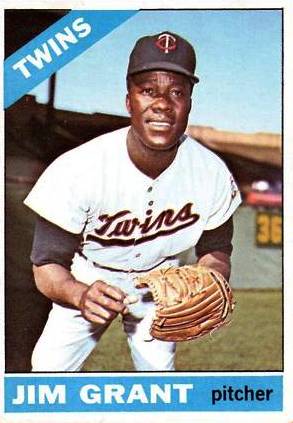
We cheered Jim "Mudcat" Grant in '65.
It was William Faulkner, of course, who said "the past is never dead - it's not even past." Well, the past did seem dead (or removed) in major league baseball in the mid-1960s. Our Minnesota Twins were part of a new era that brought a burgeoning of the sport into the west. Previously, a trip to St. Louis was "a trip west."
St. Louis? It might have seemed somewhat of an outpost at one time, a steamy hot outpost for many summer dates to be sure. At least Minnesota wouldn't present that discomfort. Minnesota might have some of its own weather travail in April and September to be sure. But Minnesota would have its charms with its new Metropolitan Stadium, a facility that seemed at first to be the last word in baseball facilities.
"The Met" became obsolete faster than we might have expected. But in 1965 it still had a "new car" sort of sheen. And boy, did our Minnesota Twins ever purr like a new car.
How can we assert "the past was dead?" Our Twins used to be the Washington Senators. Our '65 World Series opponent, the Los Angeles Dodgers, used to be those beloved Brooklyn Dodgers, the team that opened the door to integration with Jackie Robinson.
Roger Angell seemed fixated on the change element in baseball, when reflecting on the '65 Series in his book "The Summer Game." I salute him for his honesty. He was definitely east coast-centric. Many writers might want to suppress or disguise such chauvinism. Angell wrote for the New Yorker. He had the recognizable spots of an intellectual whose environs were definitely in the metropolitan Northeast. His writing thus might grate on us some. But again, I respect his candor.
How direct was he? His chapter heading for the '65 Series was "West of the Bronx." He cited the teams as "runaway orphans." The Dodgers made their move west in 1958. The Senators were transformed to our Twins in 1961.
There were 20 major league teams through most of the 1960s. Angell noted that half came into being or "pulled up stakes" (moved) since 1953. So he admitted that the Twins and Dodgers were really pretty typical. They had fan followings with less than ten years' loyalty. Not that this was a hindrance to overflowing enthusiasm. My, how Minnesota was captivated in that '65 summer.
Perhaps Angell's writing and his orientation should strike us as quaint now. In this age of the Internet, those who feel literature and culture have a natural home in the population centers (primarily the East of course) are on the defensive. We are all empowered.
Angell wrote about "the ghost of the Yankees" being perceptible in that '65 fall. Oh, the Yankees. They were once on quite the pedestal for the leading sports media. Players who were suited for obscurity and who would have normal, unremarkable careers elsewhere, could get a mystique playing for the Yankees. The establishment writers sought out every angle. For a primer on this I suggest the Billy Crystal movie "61*" (yes, with the asterisk).
Angell talked about the ghost of the Yankees and added "you could almost hear the distant rattle of IRT trains above center field." The throngs of Minnesota fans who turned out in '65 couldn't have cared less about IRT trains. (I'm not sure what "IRT" stands for.) We heard an occasional jet plane going overhead. No doubt we were in a metropolitan setting, or near one. Let's emphasize "near." Metropolitan Stadium was literally built on farmland in suburban Bloomington.
Angell talked about the "monstrous crash" of the New York Yankees in 1965. And there to take advantage were our Minnesota Twins. Our Twins were a humble sixth in the standings a year before. And the makeup of the team really didn't seem different for '65. Our power reputation was well established. Thrilling as this could be, it didn't propel us very far in the '64 season.
Manager Sam Mele saw a need to diversify. He brought in a new set of coaches. The team's personality was going to change. We still had "The Killer" and others who could hit the ball a long way. (The reference is to Harmon Killebrew of course.) But Mele was going to employ some nuances that might not be noticeable to fans. Let's look at the hit and run. Let's seek more stolen bases. Let's think of stretching singles. And in pitching, Johnny Sain came on the scene, a man portrayed as a coaching wizard in Jim Bouton's groundbreaking 1970 book "Ball Four." Sain made Jim Grant and Jim Kaat into personal projects. He gave them "homework" over the off-season, focusing on such things as spin ballistics.
Then we had shortstop Zoilo Versalles. A man for whom fame may not have been kind, the moody and seemingly shallow Cuban did have a heyday that had its peak in that '65 summer.
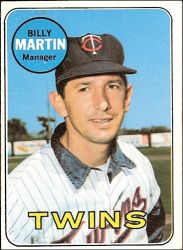
It was coach Billy Martin who made Versalles into a project. Martin wasn't yet a household word. He seemed healthier and less scrawny physically, which leads us to suspect alcohol hadn't taken a big toll on him yet. I'd call the late Martin the Hunter S. Thompson of baseball. He made a name for himself when he lived (relatively) clean and took care of himself, but is remembered for the oddball caricature he later became. Kids, please take note. These guys didn't become famous by living in the eccentric way that marked the closing stages of their careers. Get your sleep. Eat your peas. Forget booze and drugs, please.
Martin coaxed Versalles into being a more aggressive hitter. He groomed Versalles into being quick on the basepaths, and when fielding to get rid of the ball with lightning quickness. These attributes came through. Shortstop Versalles was the '65 American League MVP. He was known to "pop greenies" (pills). This might have shortened his career.
The only bad habit the press might reveal about players back then was drinking. We did consider drinking a vice. But we knew it was all around us. The "greatest generation" hardly crusaded against it. It was a vice with its charms. Finally Mothers Against Drunk Driving came along to change that, to make it very serious business. No more chuckles for Foster Brooks ("the lovable lush").
Mele found it unnecessary to assign any special coaching to a young, most phenomenal hitter, like Versalles from Cuba. My, what a pure and thrilling hitter Tony Oliva was. He won the A.L. batting title in 1965 like he had as a rookie in '64.
The L.A. Dodgers like the Twins finished in sixth place in '64. In '65 they prevailed despite a deficiency in hitting: an anemic team average of .245. In May they lost their best hitter, Tommy Davis, to injury: a broken ankle. Author Bouton would be a teammate of Davis with the Seattle Pilots in 1969. Davis always had a reputation as a natural hitter. He seemed dogged by injury after 1965. Thus he was available in the expansion team scrap-heap of talent for '69 and the new Seattle Pilots, a team that would last just one year before "pulling up stakes" and moving to Milwaukee.
Davis at his best could hit like Oliva. He was right-handed while Oliva was left. Without Davis the Dodgers found themselves in a much closer pennant race than the Twins. Angell called the N.L. "junglelike" with its competitiveness. The San Francisco Giants gave the Dodgers a real run. The Giants with Willie Mays having his best season (52 home runs in the pre-steroids era) won 14 straight games at one point.
The Dodgers' stock in trade was pitching. Sandy Koufax could seem other-worldly with his talents. Don Drysdale was a dogged competitor. Koufax beat the Braves 3-1 to clinch the pennant on the last Saturday of the season.
The Twins never put their fans through any real suspense. No game or series ever stood out as a "must win." We won the pennant by a margin of seven games. So it was a summer for us joy-filled Twins fans to just kick back and enjoy this marvelous entertainment. And to think that just ten years earlier, our prime baseball facility was Nicollet Park which was constructed in the 19th Century!
Did us boomers really know how good we had it? I'm not sure we did. We had a reputation for being spoiled, us boomers. In the 1950s there were no Twins or Vikings. Can you imagine that? Were they really "Happy Days?"
Twins fever was established instantly in 1961. We weren't like an expansion team (e.g. Seattle Pilots) that had to pay dues and lose. Truly our Twins hit the ground running. It just reached a climax in 1965.
Minnesota brimmed with unfettered pride for the '65 Series - hardly a drip of cynicism anywhere. Hubert Humphrey threw out the first ball at the Met. He was a Minnesotan and our vice president. If only our nation's morale hadn't been dragged down in subsequent years by the Viet Nam War. It seems that in 1965 we weren't overcome by all that unpleasantness yet. We were on the cusp. The civil rights battles were sobering too but that represented a job to be done. The Viet Nam War was nothing but bad.
Manager Mele was like a father figure to Minnesota boomers of the time. Later Bud Grant would have that role. They were mature, stable leaders. Mele's managerial opponent in the Series was Walter Alston who had the same image.
The Met was a marvelous showcase for Minnesota when that World Series of '65 opened, on an early October day with the temperature at 64 degrees. A west wind blew at 14 miles an hour. Writer Joe Soucheray would later recall how that effete eastern writer Angell portrayed that Series here as projecting "the quaint rural charm of this Midwestern outpost." And, that "fans leaving the ballpark after the opening game created a happy scene like a family wedding."
The characterization is accurate. But there's a bothersome condescension too. Were we "charming" in a manner like innocent hayseeds? Well, we needn't all follow the model of New York City rudeness, one might suggest.
We won the opener 8-2. "Mudcat" Grant pitched the whole way. We rallied for six runs in the third inning. Drysdale looked very mortal. Koufax couldn't pitch that day because it was a Jewish holiday. Rain fell that night. So the next morning, helicopters were deployed to dry the grass. A drizzly atmosphere prevailed at game time. I hope Angell wasn't inconvenienced by the temperature of 56 degrees. Yes it was October. The Metrodome would later remedy these issues, although eventually we sought the outdoors again.
There was a northwest wind of 17 MPH for game 2. Nearly 50,000 fans turned out. Again the Twins won. Jim Kaat turned in a complete game pitching performance just like Grant. Bob Allison made a stupendous catch.
Twins fans can easily forget games 3 through 5, played in L.A. and won by the Dodgers, as Twins' hitting turned anemic.
Finally on October 13 the Series with all its splendor came back to the Met. The temperature: 54 degrees. "Mudcat" pitched another complete game and even hit a three-run home run! What a marvelous afternoon it was for the 49,578 fans in attendance, as the "Twinkies" won 5-1.
The game 7 attendance crept over 50,000. Sandy Koufax took the mound for L.A. with the thermometer showing 60 degrees. We shouldn't have been surprised Koufax was at the top of his game. The legendary lefty shut out the Twins 2-0. He struck out ten. Lou Johnson famously hit a home run that glanced off the foul pole in left. It seemed Koufax would need only one run. He got two. The Twins' magical season was finally over amidst a bittersweet air.
The Twins would go on to have considerable success through the rest of the '60s, though the pennant would elude them. We got Dean Chance at his best. We got Billy Martin as manager in 1969, the first season of the divisional alignment of the leagues. Then we got Martin's firing which strangely turned off so many Twins fans. Rumors abounded about Martin's firing. The best guess now is that he was fired for his strategy with pitchers in the '69 playoffs vs. Baltimore. Whatever, the Twins won the Western Division in '69 and '70, losing both times to the Orioles. The '65 Series receded in time.
In '87 and '91 we finally won it all playing under that roof in Minneapolis. We were ecstatic about both those teams and the new cast of stars. But I almost had to shed a tear remembering those fantastic Twins of 1965 and how they came so close to reaching the summit. I was a fifth grader in Pearl Hanse's class at East Elementary, Morris, for that fall.
What special times and memories. Let's ponder an alternate history: Minnesota winning game 7!
- Brian Williams - morris mn minnesota - bwilly73@yahoo.com
Saturday, February 2, 2013

Baseball: more than an idle distraction in 1969

Twins: the year of Billy
The Minnesota Twins made the divisional playoffs in 1969. It was the first season of the divisional playoffs. It was about time. A ten-team league in which only one team advances offers too little hope for the second-tier teams.
Each league expanded to 12 teams for the '69 season. Our Twins were a dominant team in the A.L. Western Division. It was the year we had Billy Martin as manager. Minnesota fans formed an odd bond with the firebrand Martin. I never thought he was worth the trouble. In the '70s his eccentricities grew while his managing acumen showed some tarnish. In '69 he was at the helm of a Twins team that had the established names of the 1960s: the likes of Killebrew, Oliva etc.
Twins fans were not as excited as you might think. Really, there was nothing like the homer hanky-waving mania that swept us in the late 1980s.
It was nothing new for the Twins to win. We had won the pennant in 1965 and nearly won it in '67. The 1968 season was aberrational for baseball because pitchers took over. I'm mystified why the powers that be permitted that. There are ways to control this, just as how the Federal Reserve controls the economy (to a certain extent). Mainly this is through the strike zone. Compress it and you force pitchers to hit that narrow spot which can restrict what they can do.
We saw soccer-like scores in 1968. The powers that be lowered the pitching mound for '69. This was deemed a step to help hitters. Hitting indeed picked up. Tony Oliva hit with abandon. Harmon Killebrew had his best season in 1969.
But Minnesota as a state was not transfixed as it would be in 1987 through 1991. I can even recall a sense of defeatism, like we knew there'd be a good chance we'd lose to the Baltimore Orioles in both '69 and '70. We did indeed lose and we lost by sweep. The Orioles had Frank Robinson and Boog Powell.
Baseball players were still very restricted in their freedom and ability to negotiate better contract packages. Baseball owners were sportsmen who believed to a certain extent in the purity of the sport. Oh yes, they were businessmen who understood the bottom line, but they didn't do a cost-benefit analysis on everything. If they had, night baseball would have begun sooner for the post-season. (We'd eventually get Bowie Kuhn and his long underwear - remember? - so as to make fans think he was comfortable wearing just a suit and tie on a chilly fall night.) 
There was a time we assumed World Series games would be played in daytime. You might be distracted at school wondering how the game was going. I don't recall being excused from class to watch a World Series game, but I do recall such an accommodation for the state high school basketball tournament. In those days it wasn't necessary to say "boys basketball." It was "basketball" and it was one class.
We romanticize those days today. Thus we're attracted to the movie "Hoosiers." (Gene Hackman didn't actually get the girl, did he?)
Our answer to the fictional "Hickory" was Edgerton, a tiny burg that was a giant killer. In reality the one-class tourney was of course very unfair. But we had eyes glued to TV screens as each year's tourney was televised from Williams Arena at the U of M.
Our Morris High School team made state in the one-class system in 1955. We then lost rather badly to a metro team in state. The loss shouldn't take any luster from what that team did. Envision that team playing in the old elementary auditorium which still stands but has been abandoned for some time, crumbling as years pass. It wasn't called the elementary auditorium in 1955. Morris High School had its home in that place. Will it be mercifully razed this coming summer?
In 1969 this nation was feeling the stress of tumult caused largely by the Viet Nam War. Boys had to grow up fearing the draft. The generation gap was a very real phenomenon. The civil rights movement had to push past stubborn obstacles.
The Twins and Billy Martin found their place amidst all that was going on. Metropolitan Stadium was still a grand structure. (A large beer was "dollar size.")
 
The Mets: Koosman rears back
Franklin Roosevelt once proclaimed baseball had to go on. This was said amidst the strife of World War II. It reflected wisdom. Baseball  persevered as a diversion through wars, Viet Nam included. And in 1969 we not only had the winning Twins commanding our attention, we had the fascinating New York Mets.
I have read baseball described as an exception to the generation gap. Whatever rifts grew between generations, whether it had to do with politics, personal attire, musical tastes or whatever (OK, drugs), baseball was a tie that could bind. And in 1969 we were mesmerized by the Mets.
Once the Twins lost, we here in West Central Minnesota could focus on the Mets and their light blue theme color, because in their ranks was "one of ours." Jerry Koosman was a graduate of the West Central School of Agriculture. The school was the predecessor to UMM. It served agriculture interests in a bygone time, when "farm kids" had to compress their schooling into fewer months of the year than non-farm kids. Farm labor would tie them up.
Koosman was the big lefthanded starting pitcher for the New York Mets, No. 2 behind Tom Seaver. Seaver always wore the mantle of celebrity better than Koosman. Koosman didn't seem to seek celebrity at all. He would later be quoted saying he "just wanted to win." Spoken like a true sports gladiator.
The Mets were a darling team because just a few years earlier, they struggled badly. They were an expansion team in 1962. New York City had lost the Dodgers and Giants, and finally got the National League back again. But the Mets were a truly floundering group at the start, going a pathetic 40-120 in 1962. This isn't to say all their players were bad. They had some who might do well in a particular statistical department. But they absolutely could not jell into a consistently competitive product.
Such teams typically have a mixture of players on the way down and kids not quite ready. Don Mincher said this about the 1969 Seattle Pilots, another first-year expansion team. The Mets languished for a long time, never placing higher than ninth in the ten-team league over their first seven seasons.
Koosman was integral in helping the Mets escape their futility. They weren't sizzling at the start of '69, in fact going 18-23 out of the starting gate. For most of the season they trailed the Chicago Cubs in the National League East. Chicagoans talked about "the year of the Cubs."
The Cubs were managed by the crusty old Leo Durocher, clearly a representative of baseball from another era. Durocher couldn't keep the momentum going for Chicago. This in spite of the fact his Cubs enjoyed a rather gaping lead as late as mid-August. Koosman's Mets were in third place, trailing by 9 1/2 games.
Maybe there was divine intervention. George Burns as God said to John Denver on the big screen: "The last miracle I performed was the 1969 Mets."
Whatever force intervened - let's call it destiny or talent - the Mets under Gil Hodges won 39 of their last 50 games! Hardly anyone remembers that the Atlanta Braves won the N.L. West that season. We were transfixed by the Mets. Koosman had a 17-9 won-lost record with a 2.28 ERA and 180 strikeouts. He won eight of his last nine decisions. He did get beat up a little by Atlanta (with Hank Aaron and Orlando Cepeda) in game #2 of the divisional playoffs. Of course no one remembers that. Hey, New York won that game! The Mets went on to win that series and then beat Baltimore in the World Series.
Koosman was the pitching star of the 1969 Series. He was inducted into the Mets Hall of Fame in 1989. He attended the 40th anniversary reunion of the '69 team at Citi Field on August 22, 2009.
We may have loved "the amazin' Mets" of the Casey Stengel era. But we loved the '69 Mets more. All that excitement helped take our minds off the more unpleasant things going on in our country at that time. Indeed, baseball survived wars. Its biggest threat came from the strike of 1994. I have never viewed baseball the same since '94.
But I'll always cherish those memories of an earlier time when baseball, despite its imperfections and unfairness, gave a glorious backdrop for each summer us boomers were growing up.
- Brian Williams - morris mn minnesota - bwilly73@yahoo.com